Hot & Cold Thermal Bags, Insulated Mailers & Cold Chain Delivery Packaging

Fertilizer, Pesticide & Agrochemical Packaging

Cleaner, Laundry & Air Care Packaging

Custom Medical Packaging Solutions

Protective Structures, Inserts and Retail Packs

Custom Protein Powder Pouches, Vitamin Stick Packs & Nutrition Bar Bags

Cosmetics, Fragrance and Skincare Packaging

Takeout, Bakery and Beverage Packaging

Kibble, treat & wet food packaging
The eco kraft paper coffee bag is the packaging format where sustainability, functionality, and sensory appeal converge with the greatest intensity — because coffee is the product category most sensitive to oxygen, moisture, light, and aroma loss, and the consumer’s purchasing decision is driven more by sensory anticipation (the sight and smell of whole beans through the package) than for almost any other packaged food. Meeting these demands with a predominantly paper-based, plastic-minimized package requires engineering solutions at the component level: the one-way degassing valve, the aroma barrier, the transparent window, and the reclosable closure must each be reimagined in sustainable materials.
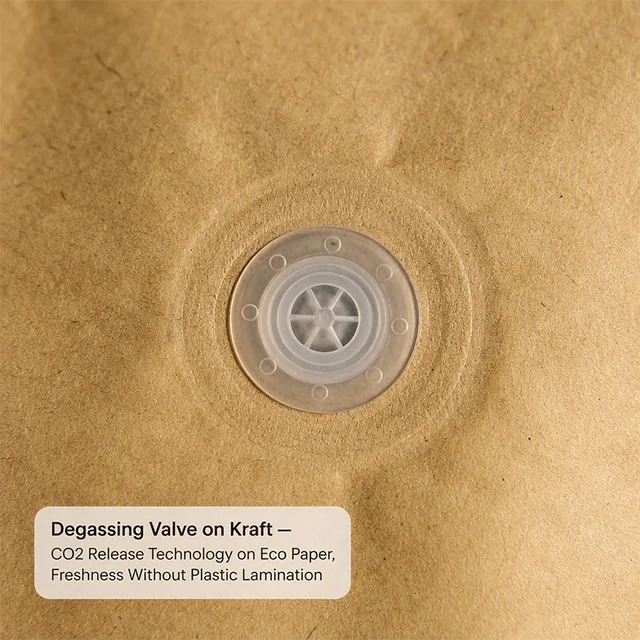
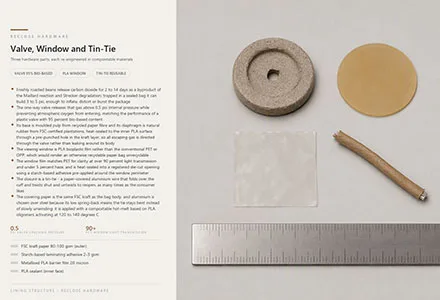
Freshly roasted coffee beans emit carbon dioxide for 2-14 days after roasting as a byproduct of the Maillard reaction and Strecker degradation that create coffee’s characteristic flavor compounds. If this CO₂ is trapped in a sealed package, the internal pressure can reach 3-5 psi — enough to inflate, distort, and potentially burst a sealed bag. The one-way degassing valve, traditionally a plastic injection-molded component with a silicone diaphragm, is re-engineered for this bag using a molded pulp base (from recycled paper fiber) with a natural rubber diaphragm sourced from FSC-certified rubber plantations. The valve allows CO₂ to escape at internal pressures above 0.5 psi while preventing atmospheric oxygen from entering — the same functional performance as a plastic valve, achieved with 95% bio-based material content.
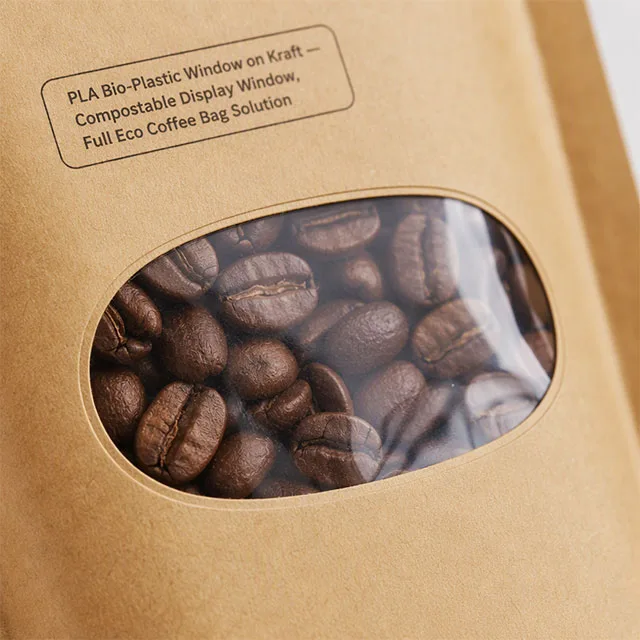
The transparent viewing window — essential for consumers to inspect bean size, roast color, and oil surface sheen before purchase — is produced from PLA (polylactic acid) bioplastic film rather than the conventional PET or OPP window films that render an otherwise recyclable paper bag unrecyclable. The PLA window is heat-sealed to the kraft paper through a registered die-cut opening using a specialized heat-seal process that bonds the PLA to a starch-based adhesive pre-applied to the kraft around the window perimeter. The PLA film provides optical clarity equivalent to PET (light transmission >90%, haze <5%) and serves as a partial oxygen barrier, but — critically — it is industrially compostable, matching the end-of-life pathway of the kraft body of the bag.
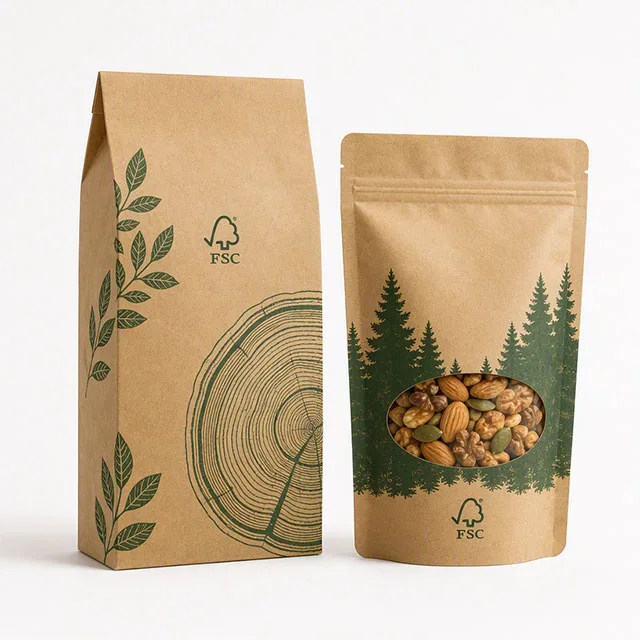
The closure uses a tin-tie — a paper-covered metal wire that can be folded over the bag opening and twisted to create an airtight seal, and untwisted for reopening, infinitely many times. The paper covering is produced from the same FSC-certified kraft as the bag body, creating visual harmony, and the metal wire is aluminum — chosen over steel because aluminum’s low spring-back means the tie stays in the bent position without the slow unwinding that steel ties exhibit. The tin-tie is applied during pouch converting with a hot-melt adhesive that activates at 120-140°C — a compostable adhesive formulation based on polylactic acid oligomers rather than the EVA-based hot melts used in conventional packaging.
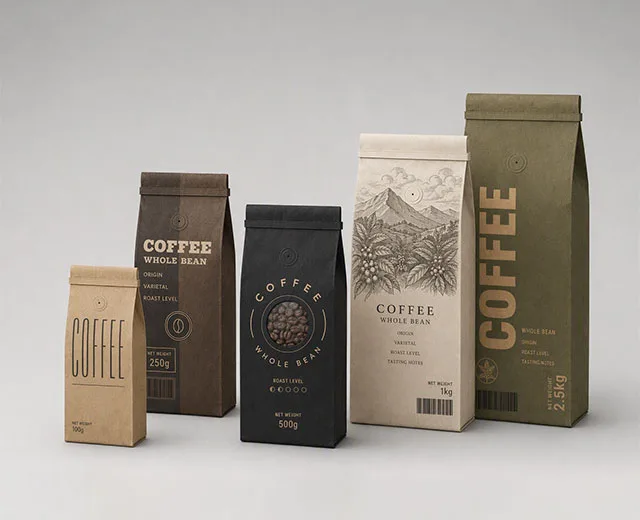
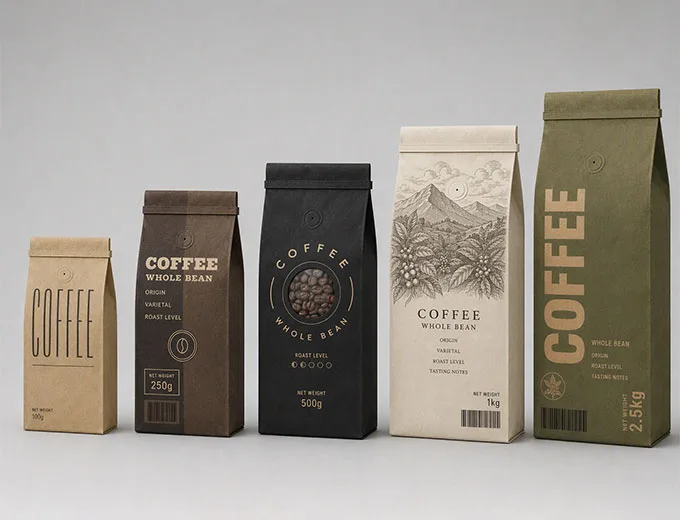
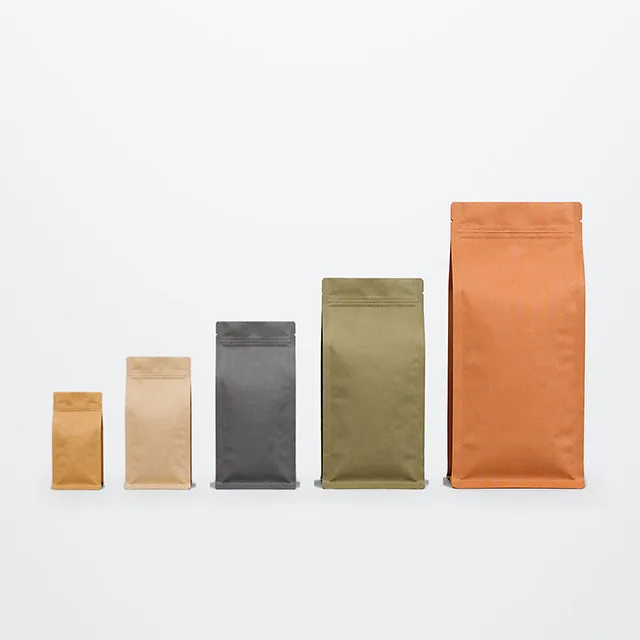
| Color | Size |
| Natural Kraft | 100g |
| Dark Roast Brown | 250g |
| Espresso Black | 500g (window) |
| Cream White | 1kg |
| Olive Green | 2.5kg |
| Custom Color Available | Custom Size Available |
Coffee bag printing occupies a distinctive position in packaging design: the graphics must convey the origin story of the coffee — the altitude, the varietal, the processing method, the roast profile — through visual codes that specialty coffee consumers have been trained to read. A kraft paper substrate is the ideal canvas for this narrative because its natural brown color and fibrous texture evoke the burlap sacks in which green coffee beans are traditionally shipped, creating an unconscious authenticity association that white or metallized substrates cannot replicate.
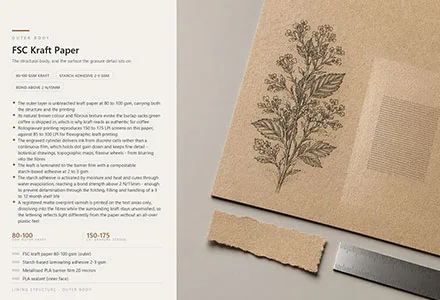
Our rotogravure printing on kraft coffee bags achieves the fine-detail reproduction required for the intricate illustrations — botanical drawings of coffee cherries, topographic maps of growing regions, tasting-note flavor wheels — that characterize specialty coffee packaging. Unlike the coarse halftone screens (85-100 LPI) typical of flexographic kraft printing, gravure’s engraved cylinder technology can reproduce 150-175 LPI screens on kraft paper because the ink is delivered from discrete cells rather than a continuous film, minimizing the dot gain (ink spread into the paper fibers) that blurs fine detail on absorbent substrates.
Color management for coffee packaging has specific requirements driven by the product’s unique color reference: the roasted bean itself. Package colors must harmonize with the coffee’s natural brown-black color range — warm earth tones (ochre, sienna, umber), deep greens (forest, olive), and rich creams — while providing sufficient contrast for the text hierarchy (origin name, varietal, roast level, tasting notes, net weight) to remain legible. We print a registered matte overprint varnish — a water-based acrylic coating — selectively on the text areas only, leaving the background kraft unvarnished. This creates a subtle gloss contrast: the text reflects light differently than the kraft background, improving legibility without the plastic feel of an all-over gloss coating — a technique that originated in premium wine label printing and has been adapted for specialty coffee.
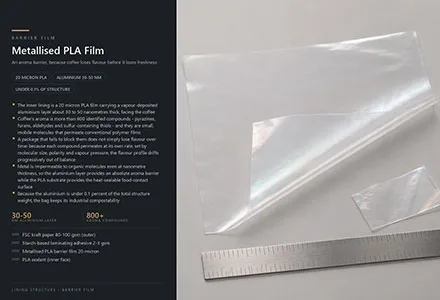
The lining of a kraft paper coffee bag must address a chemical threat that is unique to coffee: the volatile aromatic compounds that define coffee’s flavor — over 800 identified compounds including pyrazines, furans, aldehydes, and sulfur-containing thiols — are small, mobile molecules that readily permeate conventional polymer films. Coffee packaging that fails to block aroma compound permeation does not just lose flavor over time — it actually changes flavor character, because different aroma compounds permeate at different rates based on their molecular size, polarity, and vapor pressure, producing a progressively unbalanced flavor profile.
The barrier solution uses a metallized PLA film as the inner lining — a 20μm PLA film with a vapor-deposited aluminum layer (approximately 30-50 nanometers thick) facing inward toward the coffee. The aluminum layer provides an absolute barrier against aroma compound permeation — metal, even at nanometer thickness, is impermeable to organic molecules — while the PLA substrate provides the heat-sealable food-contact surface. Because the aluminum layer is <0.1% of the total structure weight, the bag retains its industrial compostability certification.
The complete structure is: outer FSC-certified kraft paper (80-100 gsm) for structure and print; a compostable starch-based laminating adhesive (2-3 gsm); the metallized PLA barrier film (20μm); and inner PLA sealant. The starch adhesive is activated by moisture and heat during the lamination process and cures through water evaporation, forming a bond strength of >2 N/15mm — sufficient to prevent delamination during the folding, filling, and consumer handling cycles of a coffee bag’s 3-12 month shelf life. The one-way valve is heat-sealed to the inner PLA surface through a pre-punched hole in the kraft layer, creating a gas-tight seal that directs all escaping CO₂ through the valve mechanism rather than leaking around the valve body.
North Side Of Nanyi Road, Shiwan Town Science And Technology Park (10th Floor, Building 1, No. 13)
INQUIRY