Custom packaging ·7-day sampling - Global delivery support

Fully Compostable Packaging Bag with OK Compost Industrial and Home Certified Multi-Layer Bio-Polymer Film Structure

Fully Compostable Packaging Bag with OK Compost Industrial and Home Certified Multi-Layer Bio-Polymer Film Structure

The fully compostable packaging bag represents the most ambitious goal in sustainable flexible packaging: a multi-layer barrier structure in which every single component — substrate, barrier, adhesive, ink, coating, and closure — is independently certified as compostable under EN 13432 (industrial) or OK Compost HOME (domestic) standards, and the complete assembled package passes the full suite of disintegration, biodegradation, ecotoxicity, and heavy-metal content testing as an integrated product. This is packaging designed to leave zero persistent waste — no microplastics, no landfill residue, no environmental accumulation — at the end of its functional life.

Color

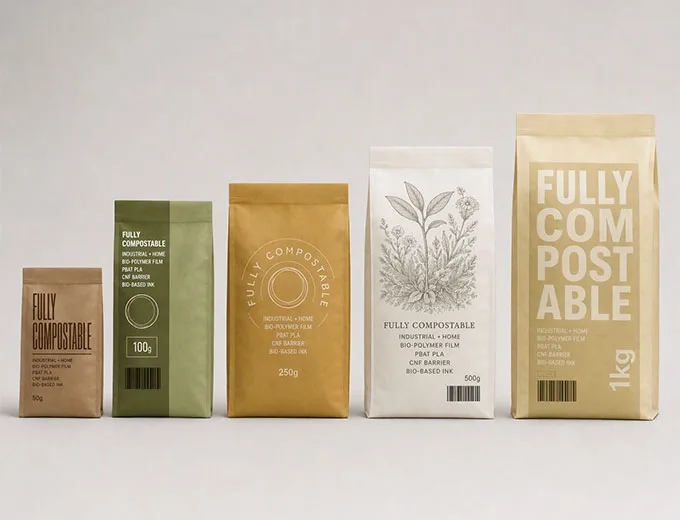
Size

  • 50g
  • 100g
  • 250g
  • 500g
  • 1kg
  • Custom Size Available

Shipping

Express (DHL/FedEx/UPS), Sea Freight, Air Freight

Payment Terms

T/T (Bank Transfer), L/C at Sight, PayPal, Western Union, Alibaba Trade Assurance

Lead Time

Samples: 3-5 working days | Mass Production: 15-25 working days

Samples

Contact us for FREE samples
Contact Us WhatsApp

Product Description

Certified Full-Circle Compostability: PBAT-PLA Multi-Layer Film Engineering for Industrial and Home Composting

Achieving compostability in a multi-layer flexible package requires solving a materials compatibility challenge that conventional packaging avoids entirely. In a standard composite pouch (PET/foil/PE), each layer serves a single function and the layers are bonded permanently — the PET provides print surface and stiffness, the foil provides barrier, the PE provides sealability. In a compostable pouch, every layer must also degrade under the same biological conditions within the same time window, and the degradation products of each layer must not inhibit the degradation of the other layers. The EN 13432 standard requires that the complete package disintegrates (fragments <2mm after 12 weeks), biodegrades (>90% conversion to CO₂ within 6 months), and passes ecotoxicity testing (no adverse effects on plant germination and growth at 100% compost concentration).

Our structure achieves this through a carefully selected combination of certified compostable polymers: the outer layer is a blend of PBAT (polybutylene adipate terephthalate) and PLA that provides the flexibility and toughness that pure PLA lacks — PBAT is an aliphatic-aromatic copolyester that is fully biodegradable through enzymatic hydrolysis of the ester bonds, and its elastomeric properties compensate for PLA’s inherent brittleness. The middle barrier layer uses a PVOH (polyvinyl alcohol) coating applied at 2-3 gsm — PVOH is water-soluble and completely biodegradable, and when applied as a continuous coating it reduces oxygen transmission by 50-100x compared to uncoated biopolymer film. The inner sealant is a low-melting-point PBAT grade with a seal initiation temperature of 80-90°C, enabling energy-efficient heat sealing without degrading the heat-sensitive PLA in the outer layer.

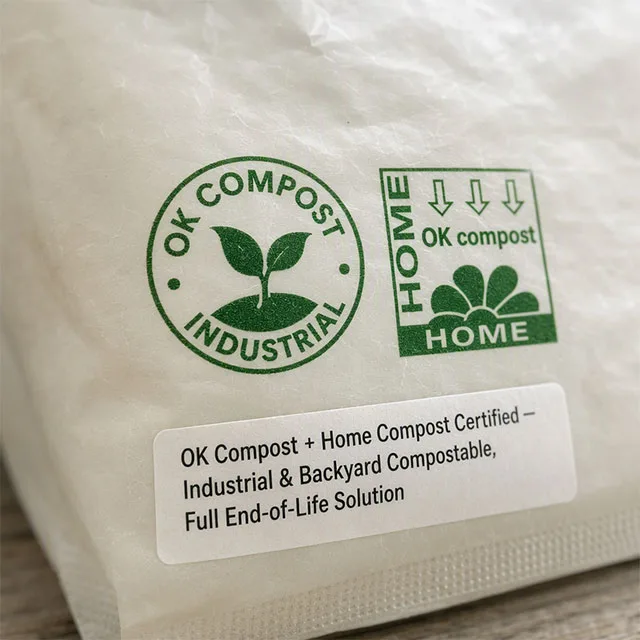
The distinction between Industrial and HOME composting is critical and often misunderstood. Industrial composting under EN 13432 requires sustained temperatures of 58°C ± 2°C, which accelerates both hydrolysis and microbial metabolism. HOME composting under OK Compost HOME (TÜV Austria) requires biodegradation at ambient temperatures (20-30°C), which is a far more demanding standard — the polymer must hydrolyze and biodegrade without the thermal acceleration that industrial conditions provide. Our HOME-certified variant achieves this through a higher PBAT content in the formulation, because PBAT’s aliphatic ester bonds are more susceptible to enzymatic hydrolysis at ambient temperature than PLA’s more crystalline structure. The trade-off is that higher PBAT content reduces stiffness and increases cost, so the HOME variant is specified for brands whose customers have access to home composting and for whom the ambient-temperature degradation claim carries premium marketing value.

Product Description

Specifications

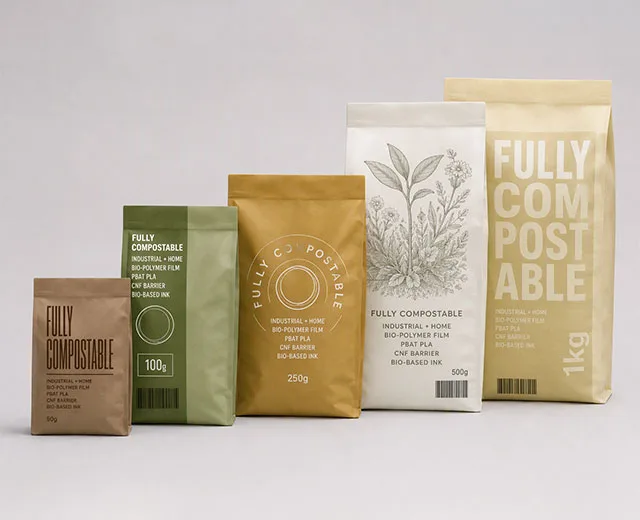
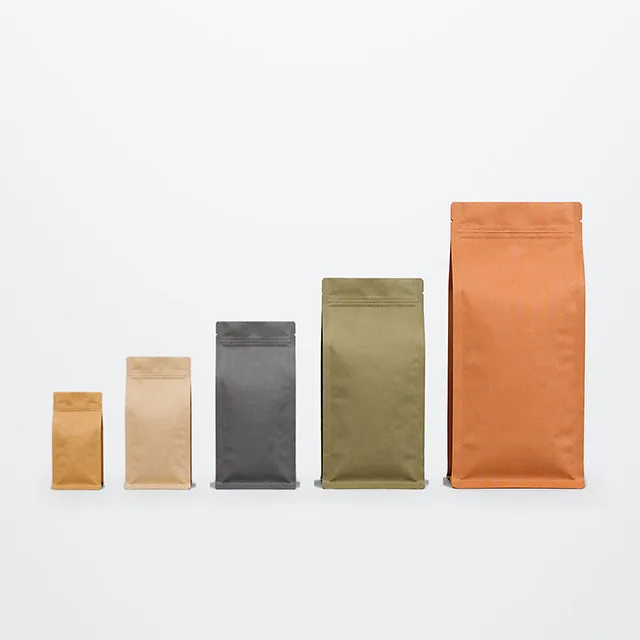
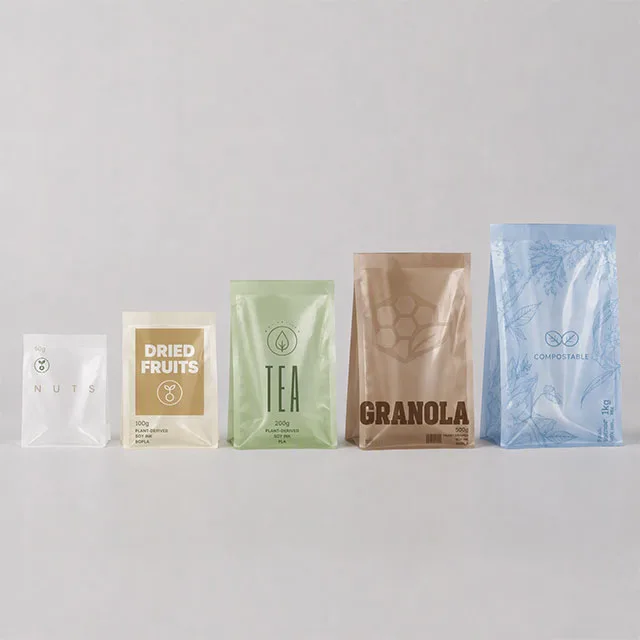
Customizable Color & Size Options for Every Market Need
Color Size
Compost Brown 50g
Moss Green 100g
Earth Ochre 250g
Seedling White 500g
Bamboo Cream 1kg
Custom Color Available Custom Size Available

Printing Process

Algae-Powered Print: EN 13432-Validated Bio-Ink for True Earth-to-Earth Compostability
Printing Process

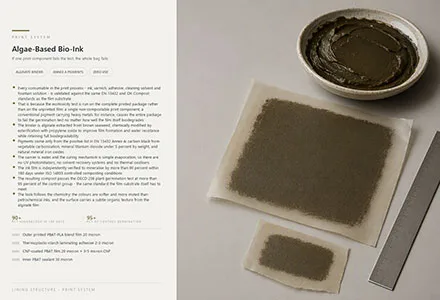
Printing on a fully compostable packaging bag requires that every consumable in the print process — ink, varnish, adhesive, cleaning solvent, fountain solution — be validated against the same EN 13432 / OK Compost standards as the film substrate, because the ecotoxicity test is conducted on the complete printed package, not on the unprinted film. A single non-compostable print component — for example, a conventional pigment containing heavy metals — will cause the entire package to fail the ecotoxicity germination test, regardless of how well the film itself biodegrades.

We use an algae-based bio-ink system that represents a recent breakthrough in compostable printing technology. The ink binder is derived from alginate — a polysaccharide extracted from brown seaweed (primarily Laminaria and Macrocystis species) — which is chemically modified through esterification with propylene oxide to improve film formation and water resistance while retaining full biodegradability. The pigments are selected exclusively from the positive list in EN 13432 Annex A: carbon black (from vegetable carbonization), titanium dioxide (mineral, <5% by weight), and iron oxides (natural mineral pigments). The ink carrier is water, and the curing mechanism is simple evaporation — no UV photoinitiators, no solvent recovery systems, no thermal oxidizers.

The visual aesthetic of algae-based printing has a distinctive character: the colors have a softer, slightly more muted saturation compared to petrochemical inks, and the surface has a subtle organic texture from the alginate film. This aesthetic aligns with the “earth-to-earth” brand narrative of fully compostable packaging — it looks and feels different from conventional packaging in a way that communicates its environmental story without words. The ink film’s biodegradation rate has been independently verified to exceed 90% mineralization within 180 days under ISO 14855 controlled composting conditions, and the resulting compost passes the OECD 208 plant germination test with germination rates >95% of the control group — the same standard required for the film substrate itself.

Lining Decoration

NanoFibril Barrier: CNF Nanocellulose Coating Engineering for Fully Compostable Multi-Layer Packaging
Outer Layer

Outer Layer

If one print component fails the test, the whole bag fails
Middle Layer

Middle Layer

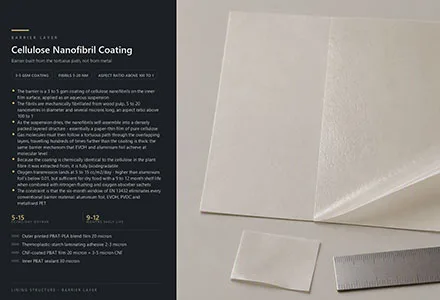
Barrier built from the tortuous path, not from metal
Contact Layer

Contact Layer

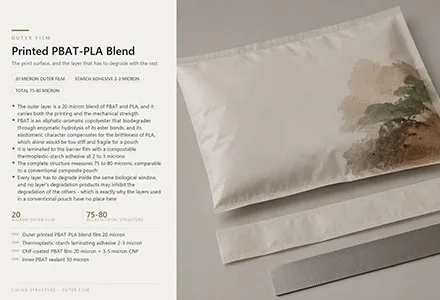
The print surface, and the layer that has to degrade with the rest

The lining structure of a fully compostable packaging bag must achieve barrier performance using only materials that biodegrade within the 6-month window of EN 13432 — which eliminates every conventional barrier material (aluminum foil, EVOH, PVDC, metallized PET) from consideration. This constraint has historically limited compostable packaging to dry products with minimal shelf-life requirements, but advances in nano-engineered bio-coatings are expanding the application range.

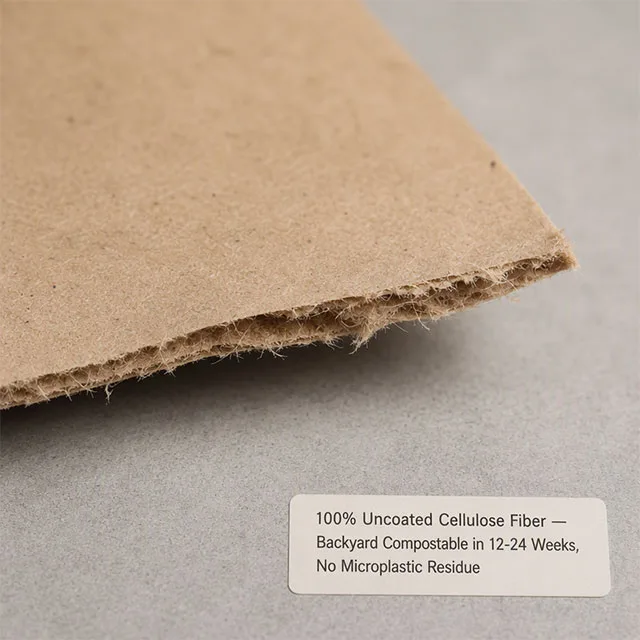
Our innovation is a nanocellulose barrier coating — a aqueous suspension of cellulose nanofibrils (CNF) extracted from wood pulp through mechanical fibrillation, applied at 3-5 gsm to the inner film surface. CNF particles are 5-20 nanometers in diameter and several microns in length, with an aspect ratio exceeding 100:1. When the aqueous suspension dries, the nanofibrils self-assemble into a densely packed layered structure — essentially a paper-thin film of pure cellulose — where the tortuous path through the overlapping nanofibril layers forces permeating gas molecules to travel distances hundreds of times longer than the coating thickness. This “tortuous path” effect is the same barrier mechanism that EVOH and aluminum foil achieve at the molecular level, but achieved here with a material that is chemically identical to the cellulose in the plant fiber it was extracted from — and therefore fully biodegradable.

The complete structure is: outer printed PBAT/PLA blend film (20μm) for print surface and mechanical strength; a compostable laminating adhesive based on thermoplastic starch (2-3μm); the CNF barrier coated PBAT film (20μm with 3-5μm CNF coating) providing oxygen barrier; and inner PBAT sealant (30μm). The total structure thickness of 75-80μm is comparable to conventional composite pouches, and the oxygen transmission rate of 5-15 cc/m²/day — while higher than aluminum foil’s <0.01 — is sufficient for dry food products with 9-12 month shelf life when combined with nitrogen flushing and oxygen absorber sachets. The entire structure has been independently certified to EN 13432 (industrial composting) and OK Compost HOME (domestic composting) by TÜV Austria.

Get In Touch With Us

Reach out for any inquiries, support, or to discuss how we can meet your industrial needs.
  • Address

    North Side Of Nanyi Road, Shiwan Town Science And Technology Park (10th Floor, Building 1, No. 13)

Contact Me

    You can upload a PDF or an image(max 5MB)

    INQUIRY