Custom packaging ·7-day sampling - Global delivery support

Industrial ESD Anti-Static Shielding Bag with Faraday Cage Multi-Layer Metallized Grid for Electronic Component Protection

Industrial ESD Anti-Static Shielding Bag with Faraday Cage Multi-Layer Metallized Grid for Electronic Component Protection

The industrial ESD anti-static shielding bag occupies a category of flexible packaging that is fundamentally different from food packaging: its primary function is not to protect the product from the environment, but to protect the product from electricity itself — specifically, from electrostatic discharge (ESD) events that can destroy sensitive electronic components in microseconds through voltages invisible to human senses. A person walking across a carpet generates 1,500-35,000 volts of static electricity; the discharge from a fingertip to a circuit board delivers this energy in nanoseconds at peak currents exceeding 10 amperes — enough to vaporize the aluminum traces on a semiconductor die. The ESD shielding bag must prevent this event through a combination of conductive, dissipative, and shielding mechanisms operating at different layers of the film structure.

Color

Size

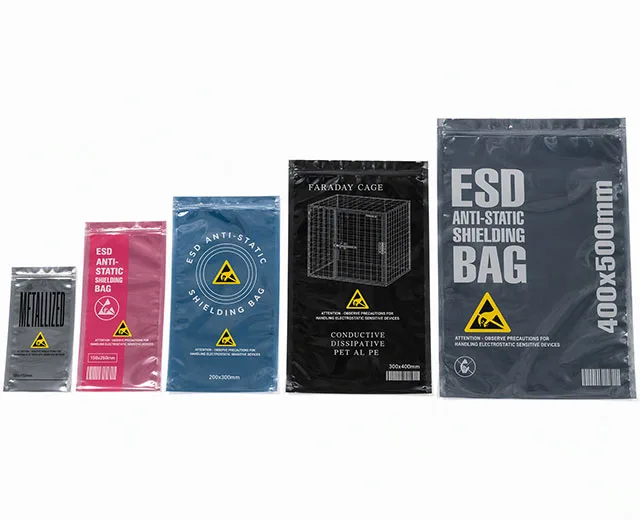
  • 100×150mm
  • 150×250mm
  • 200×300mm
  • 300×400mm
  • 400×500mm
  • Custom Size Available

Shipping

Express (DHL/FedEx/UPS), Sea Freight, Air Freight

Payment Terms

T/T (Bank Transfer), L/C at Sight, PayPal, Western Union, Alibaba Trade Assurance

Lead Time

Samples: 3-5 working days | Mass Production: 15-25 working days

Samples

Contact us for FREE samples
Contact Us WhatsApp

Product Description

Faraday Cage Shielding: Dual-Mechanism ESD Protection Through Metallized PET/Al/PE Multi-Layer Engineering

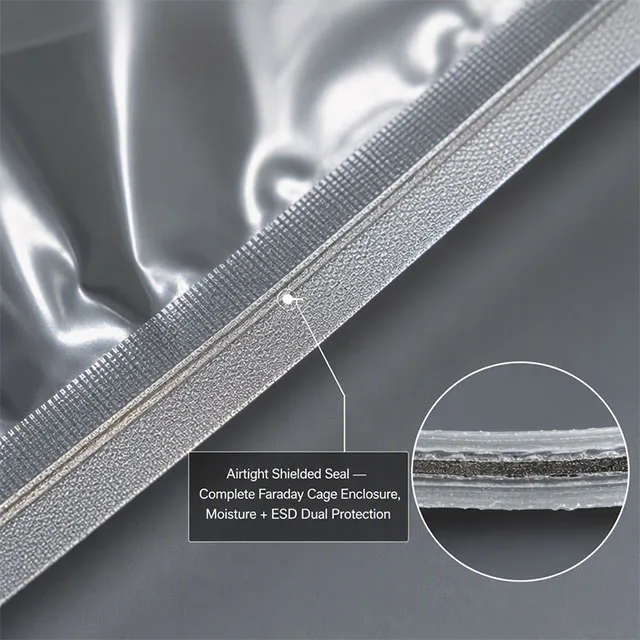
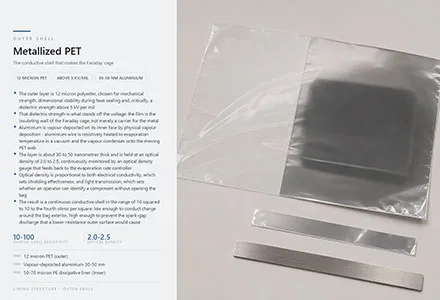
The engineering principle is the Faraday cage effect: a continuous conductive enclosure redistributes an external electric field around its exterior surface, creating a field-free interior volume — the same principle that protects aircraft passengers from lightning strikes. In a flexible packaging context, this requires a metallized layer that is electrically continuous and grounded during handling. Our PET/Al/PE three-layer structure achieves this through a vapor-deposited aluminum layer on the inner surface of the outer PET film, creating a conductive shell with a surface resistivity of 10²-10⁴ ohms per square — low enough to conduct charge around the bag exterior, high enough to prevent the spark-gap discharge that would occur with a lower-resistance outer surface.

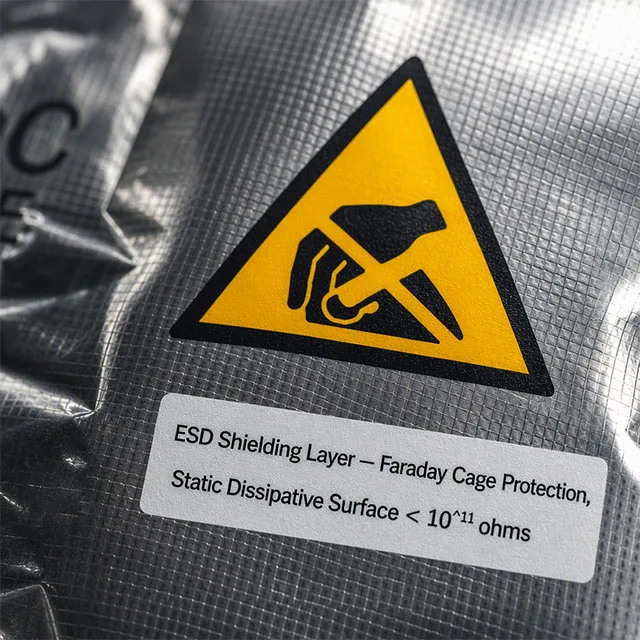
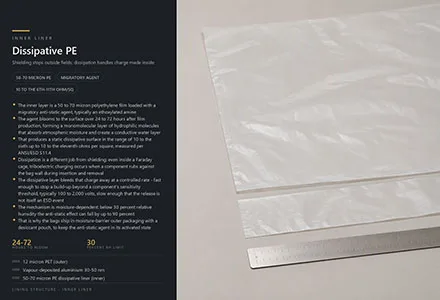
The inner layer provides static dissipative protection — a different mechanism from shielding. Even inside a Faraday cage, triboelectric charging can occur when the electronic component rubs against the inner bag surface during insertion and removal. A dissipative inner layer with surface resistivity of 10⁶-10¹¹ ohms per square (measured per ANSI/ESD S11.4) allows accumulated charge to bleed away at a controlled rate — fast enough to prevent voltage buildup that could exceed the component’s ESD sensitivity threshold (typically 100-2,000 volts for MOSFET and CMOS devices), slow enough to prevent the rapid discharge that is itself an ESD event. This dual mechanism — shielding from external fields plus controlled dissipation of internally generated charge — is what distinguishes a true ESD shielding bag from a simple anti-static (pink polyethylene) bag that provides only triboelectric protection. The bag is tested to ANSI/ESD S20.20 and IEC 61340-5-1 standards, including the critical shielded bag energy test that simulates a human body model (HBM) discharge through the bag wall to a sensitive component inside.

Product Description

Specifications

Customizable Color & Size Options for Every Market Need
Color Size
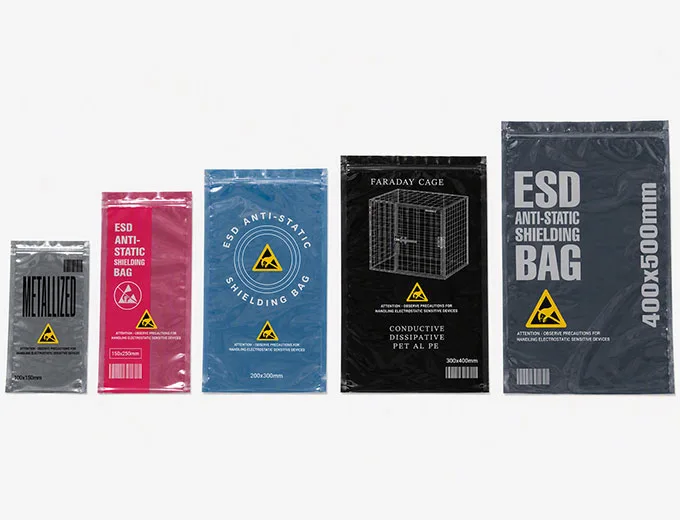
Silver-Grey Metallic 100×150mm
Translucent Pink 150×250mm
Semi-Transparent Blue 200×300mm
Opaque Black 300×400mm
Static-Shield Grey 400×500mm
Custom Color Available Custom Size Available

Printing Process

ESD Warning Compliance and Constrained Brand Real Estate
Printing Process

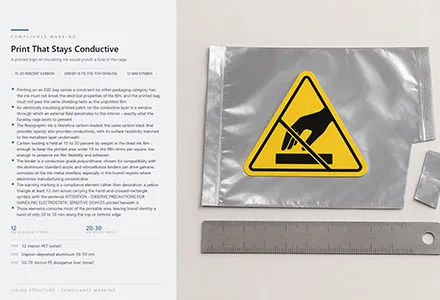
Printing on ESD shielding bags operates under a constraint unknown in any other packaging category: the ink must not compromise the electrical properties of the film, and the printed bag must continue to pass the same ESD shielding tests as the unprinted film. This is not a cosmetic requirement — a printed logo that creates an electrically insulating patch on the conductive layer can create a “window” through which an external electric field penetrates to the interior, defeating the entire purpose of the Faraday cage.

Our flexographic printing on the outer PET surface uses carbon-loaded conductive inks — the same carbon-black pigment that provides light-blocking opacity also provides electrical conductivity, with a surface resistivity matched to the underlying metallized layer. The carbon loading is precisely controlled to 15-20% by weight in the dried ink film — sufficient to maintain conductivity through the printed area (<10⁵ ohms/square), low enough to maintain ink film flexibility and adhesion. The ink vehicle is a conductive-grade polyurethane binder chosen for its compatibility with the aluminum metallization — standard acrylic and nitrocellulose binders can cause galvanic corrosion at the ink-metal interface over time, particularly in the high-humidity environments (Singapore, Malaysia, coastal China) where electronics manufacturing is concentrated.

The printing content on ESD bags serves a dual purpose: brand identification and ESD warning compliance. The standard ESD susceptibility symbol — a yellow triangle containing a hand reaching toward a black rectangle with a line through it — must be printed at a minimum size of 12mm and placed on both sides of the bag per ANSI/ESD S8.1. Below the symbol, the text “ATTENTION – OBSERVE PRECAUTIONS FOR HANDLING ELECTROSTATIC SENSITIVE DEVICES” is required. These compliance elements consume significant printable area, making the remaining brand real estate on an ESD bag extremely limited — typically a 20-30mm band at the top or bottom. Our pre-press workflow includes an ESD-compliance layer that verifies symbol size, placement, and contrast ratio against the bag color before plate production.

Lining Decoration

Moisture-Dependent Dissipative Inner Layer for Static Control
Outer Layer

Outer Layer

A printed logo on insulating ink would punch a hole in the cage
Middle Layer

Middle Layer

Shielding stops outside fields; dissipation handles charge made inside
Contact Layer

Contact Layer

The conductive shell that makes the Faraday cage

The lining structure of an ESD shielding bag is a lesson in functional layering — every layer in the 3-ply structure serves a specific electrical function, and the interfaces between layers are as critical as the layers themselves because charge transport across interfaces is the dominant failure mechanism in multi-layer ESD packaging.

The outer layer is 12μm polyester (PET) chosen for its mechanical strength, dimensional stability during heat sealing, and — critically — its dielectric strength of >5 kV/mil, which provides the primary voltage standoff for the Faraday cage. The inner surface of this PET layer carries the vapor-deposited aluminum metallization, applied at an optical density of 2.0-2.5 (transmission <1%) through physical vapor deposition in a vacuum chamber where aluminum wire is resistively heated to evaporation temperature and the vapor condenses on the moving PET web. The aluminum thickness — approximately 30-50 nanometers — is continuously monitored by an optical density gauge that feeds back to the evaporation rate controller, because the optical density is directly proportional to both the electrical conductivity (which determines shielding effectiveness) and the light transmission (which determines visibility of the contents — a functional requirement since operators must be able to identify components without opening the bag).

The inner dissipative layer is a 50-70μm polyethylene film loaded with a migratory anti-static agent — typically an ethoxylated amine that blooms to the surface over 24-72 hours after film production, creating a monomolecular layer of hydrophilic molecules that absorb atmospheric moisture and form a conductive water layer. This moisture-dependent mechanism is why ESD bags must be stored in humidity-controlled environments (<30% RH reduces anti-static effectiveness by up to 90%), and why our bags are shipped in moisture-barrier outer packaging with a desiccant pouch to maintain the anti-static agent in its activated state.

Get In Touch With Us

Reach out for any inquiries, support, or to discuss how we can meet your industrial needs.
  • Address

    North Side Of Nanyi Road, Shiwan Town Science And Technology Park (10th Floor, Building 1, No. 13)

Contact Me

    You can upload a PDF or an image(max 5MB)

    INQUIRY