Hot & Cold Thermal Bags, Insulated Mailers & Cold Chain Delivery Packaging

Fertilizer, Pesticide & Agrochemical Packaging

Cleaner, Laundry & Air Care Packaging

Custom Medical Packaging Solutions

Protective Structures, Inserts and Retail Packs

Custom Protein Powder Pouches, Vitamin Stick Packs & Nutrition Bar Bags

Cosmetics, Fragrance and Skincare Packaging

Takeout, Bakery and Beverage Packaging

Kibble, treat & wet food packaging
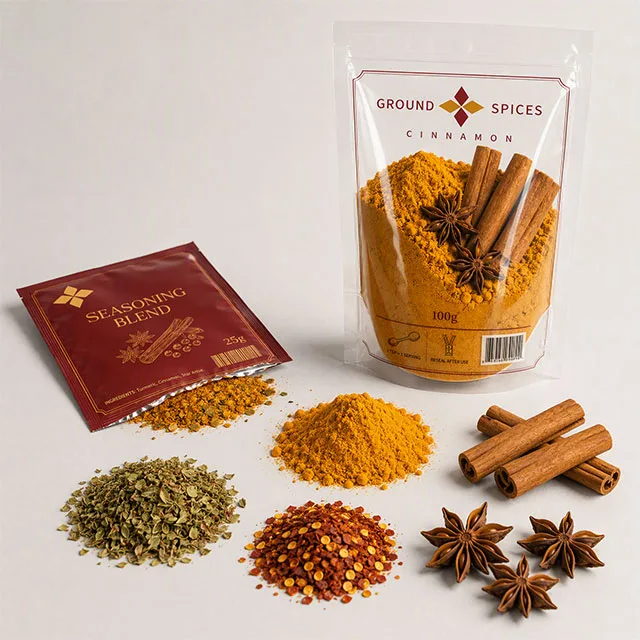
Spice and seasoning packaging operates under the most demanding barrier requirements in the entire flexible packaging industry — a fact that surprises many people who assume wet or frozen foods present the greater challenge. The reason is chemical: spices contain hundreds of volatile aromatic compounds that are so small and mobile they can pass through standard packaging barriers at the molecular level, causing two problems simultaneously — the spice loses its potency and aroma intensity over time, and nearby products in the same pantry or shipping container absorb those escaped aromas (cross-contamination). Our Spice & Seasoning Pouch is engineered specifically to address this dual challenge.
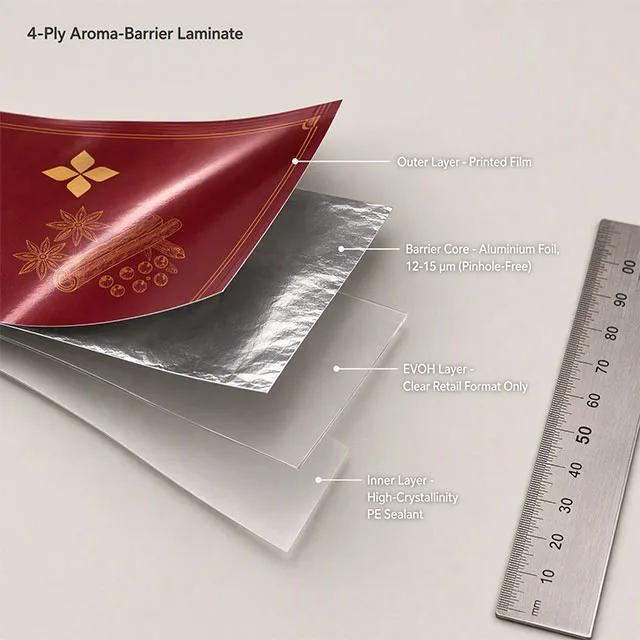
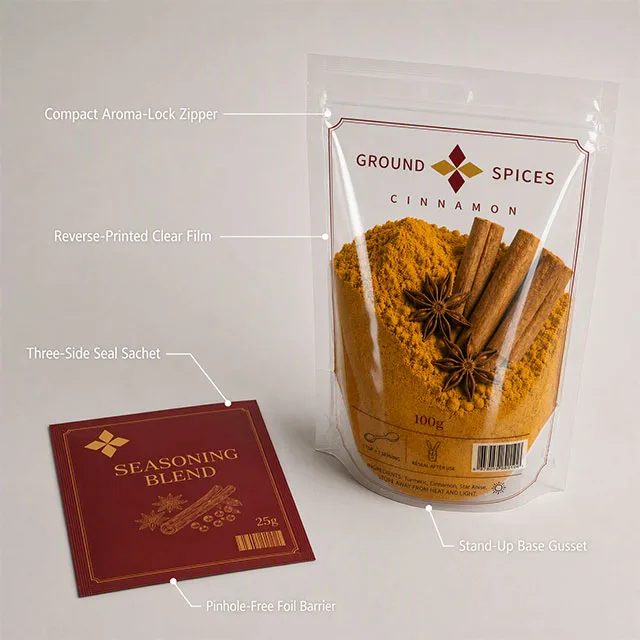
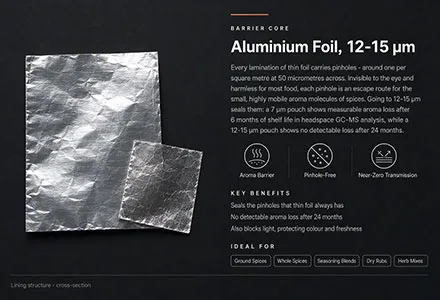
The aluminum foil barrier core in our pouch is not the standard 7-9 micron foil used in general food packaging — it is a 12-15 micron thick foil specifically selected for spice packaging. The additional thickness closes the microscopic pinholes that inevitably form in thinner foils during the lamination process, creating what barrier engineers call a “pinhole-free foil layer.” Even a single 50-micron pinhole per square meter — invisible to the naked eye and irrelevant for most food products — can serve as an aroma escape pathway for the highly volatile compounds in ground cinnamon, cumin, or cardamom. Our thick-gauge foil eliminates this failure mode.
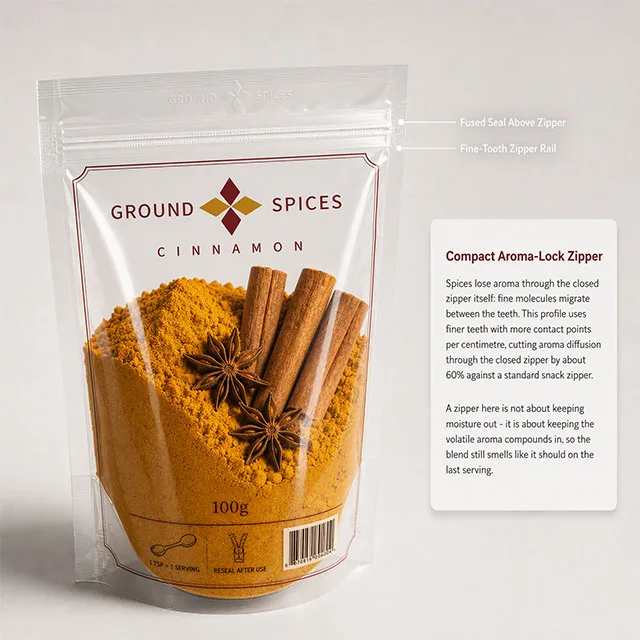
The compact zipper closure serves a different purpose than the resealable zipper on nut or pet food bags. For spices, the zipper’s primary function is aroma containment rather than moisture protection — keeping the intense aromatic compounds sealed inside the pouch between uses rather than escaping into the kitchen air. The small-format zipper is engineered with finer interlocking teeth than standard food zippers, creating more contact points per linear centimeter and reducing the aroma diffusion rate through the closed zipper by approximately 60% compared to standard zipper profiles.
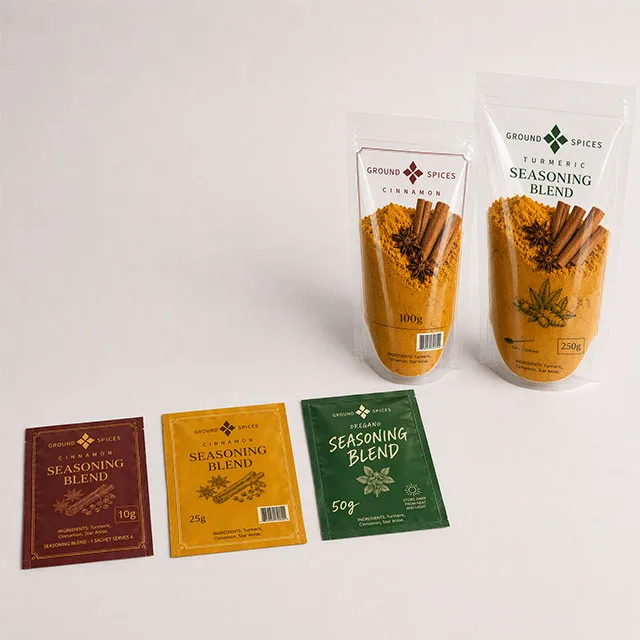
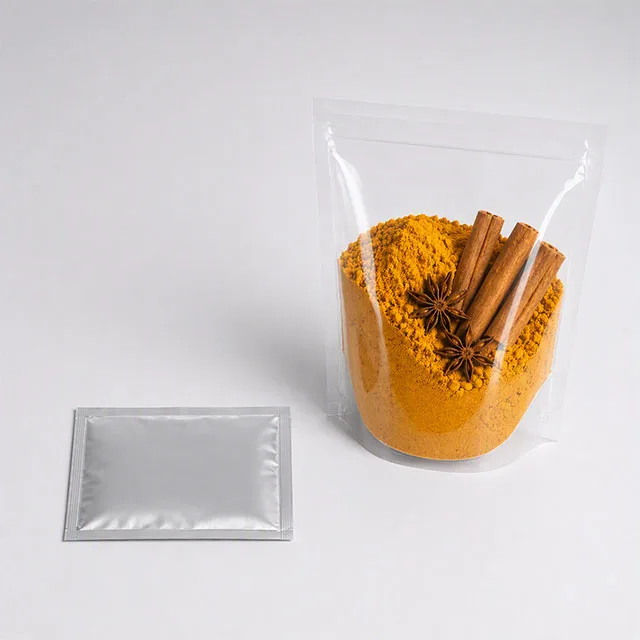
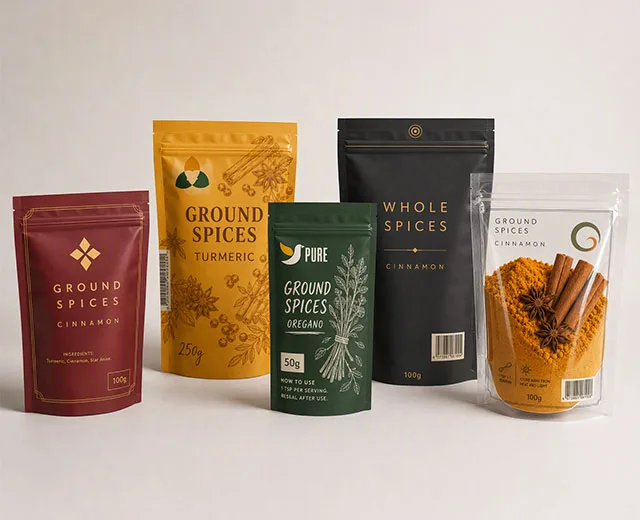
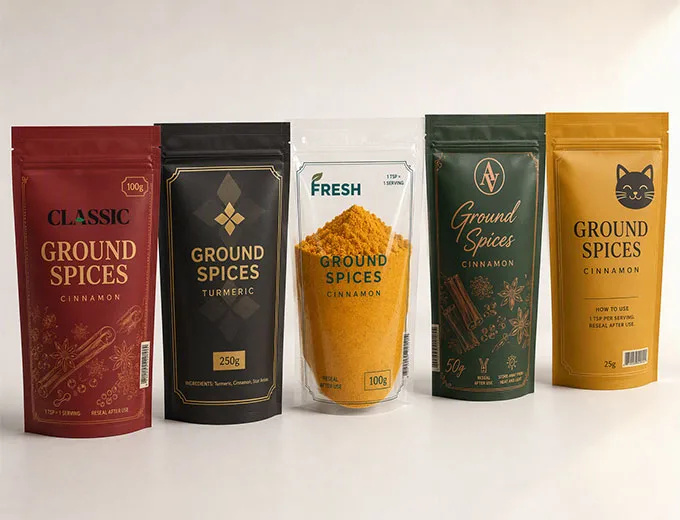
The dual-format strategy — small aluminum foil sachets (10-50g) and transparent stand-up pouches (100-250g) — serves different market channels. Small sachets target food service and ready-meal manufacturers who portion spices into individual meal kits. Transparent pouches target retail spice brands where the consumer needs to see the product color and texture to assess freshness — the clear film variant uses an EVOH barrier layer that provides aroma containment while maintaining product visibility. Key applications: ground spices, whole spices, seasoning blends, dry rubs, herb mixes, and food service portion packs.
| Color | Size |
| Deep Red | 10g Sachet |
| Turmeric Gold | 25g |
| Forest Green | 50g |
| Charcoal Black | 100g |
| Transparent | 250g |
| Custom Color Available | Custom Size Available |
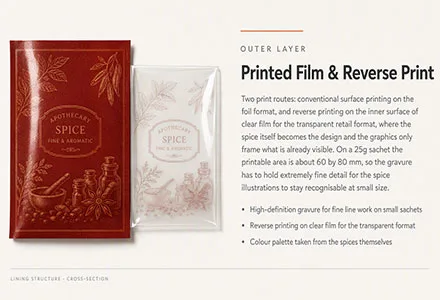
Spice packaging graphics must accomplish a challenging visual task: convey “intense flavor” and “authentic origin” in a package that is often extremely small — the 10-25g sachet format provides a print area of only 60x80mm. Every square millimeter of that surface must work hard to communicate brand identity, spice variety, and usage suggestions.
We print spice pouches using high-definition gravure that achieves exceptional fine-line detail at small scale — spice-identifying illustrations (pink peppercorns, star anise, cinnamon quills) remain clearly recognizable even at reduced size. The color palette draws from the rich, saturated tones of the spices themselves: deep reds for chili and paprika, turmeric golds and saffron yellows, forest greens for herb blends, and charcoal blacks for activated charcoal and specialty salts.
Metallic gold and copper accent inks are particularly effective for premium spice brands, communicating the historical association between spices and precious metals that dates back to the ancient spice trade. A gold-printed border or brand mark on a deep red or charcoal background creates a luxurious “apothecary” aesthetic that supports premium pricing in the $8-15 per bottle retail range.
For the transparent pouch format, reverse printing on the inner surface of the clear PET film creates a unique visual effect: the spice product itself becomes part of the package design. The printed graphics frame the visible product, and the vibrant natural colors of the spices — the rich yellow of turmeric, the deep brown of cinnamon, the bright green of dried oregano — provide a level of visual authenticity that no printed image can match. This is the visual strategy that has made transparent spice pouches the dominant format in European and Australian specialty food retail.
The lining of a spice pouch must provide what barrier engineers call “aroma barrier” — a measure of how effectively the package prevents volatile organic compounds (the molecules responsible for spice aroma and flavor) from migrating through the packaging material. Standard oxygen and moisture barrier measurements (OTR, WVTR) are insufficient for spice packaging because aromatic compounds can pass through barriers that are perfectly adequate for oxygen and water vapor.
Our aluminum foil barrier core — at 12-15 microns thickness — provides near-zero aroma transmission. The foil thickness is specifically selected to eliminate pinholes, which are the dominant aroma escape pathway. In testing, spice pouches with standard 7-micron foil show measurable aroma loss (detectable by GC-MS headspace analysis) after 6 months of shelf storage, while our 12-15 micron foil pouches show no detectable loss after 24 months.
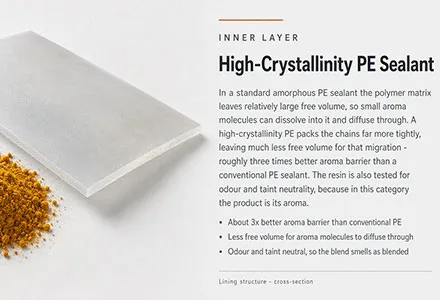
The inner PE sealant layer is formulated with a high degree of crystallinity in the polyethylene structure — a technical characteristic that reduces the free volume within the polymer matrix where small aromatic molecules can dissolve and diffuse. This “high-crystallinity PE” provides approximately 3x better aroma barrier than standard amorphous PE, adding an additional layer of protection beyond the foil core. The PE layer is also tested for odor and taint neutrality — a critical requirement when the product inside is valued specifically for its pure, unadulterated aroma profile.
North Side Of Nanyi Road, Shiwan Town Science And Technology Park (10th Floor, Building 1, No. 13)
INQUIRY