Custom packaging ·7-day sampling - Global delivery support

Eco-Friendly Kraft Paper Composite Stand-up Pouch with Natural Unbleached Fiber Exterior and Hidden Aluminum Barrier

Eco-Friendly Kraft Paper Composite Stand-up Pouch with Natural Unbleached Fiber Exterior and Hidden Aluminum Barrier

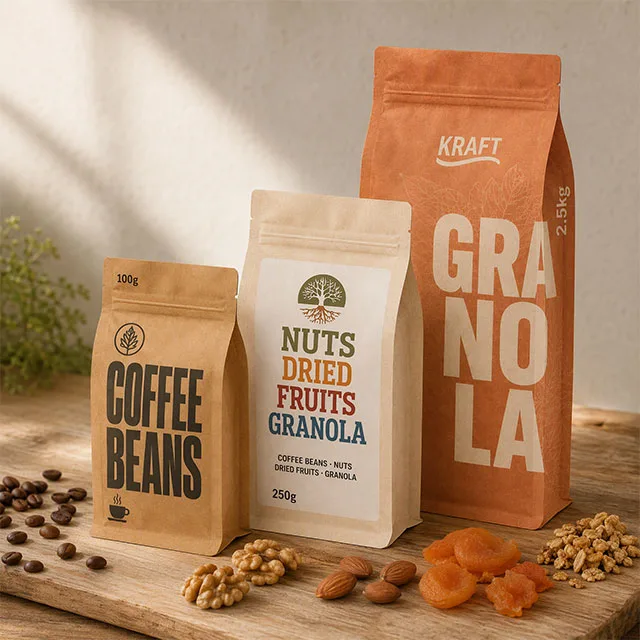
The eco-friendly kraft paper composite stand-up pouch represents a structural paradox that defines modern sustainable packaging: the consumer-facing exterior communicates “natural, unprocessed, earth-friendly” through the tactile and visual language of unbleached kraft paper, while a hidden inner barrier layer delivers the oxygen and moisture protection that the kraft paper alone — being porous, hygroscopic, and oxygen-permeable — could never provide. Reconciling these two opposing requirements into a single, functional package is the defining engineering challenge of kraft composite packaging.

Color

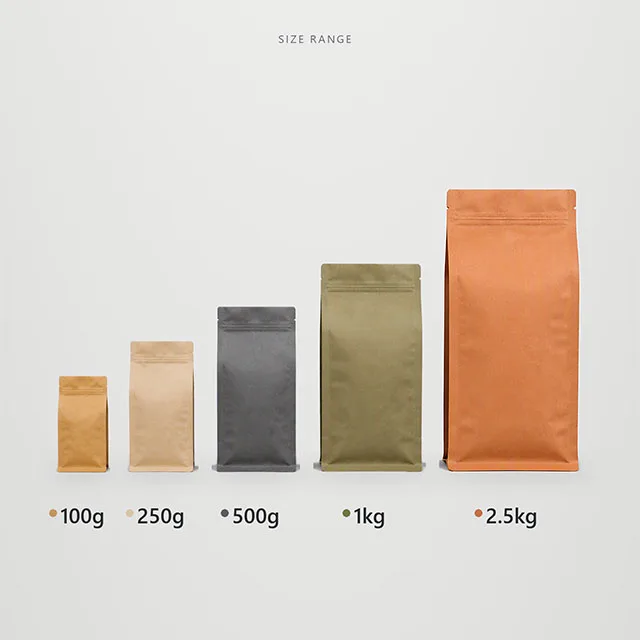
Size

  • 100g
  • 250g
  • 500g
  • 1kg
  • 2.5kg
  • Custom Size Available

Shipping

Express (DHL/FedEx/UPS), Sea Freight, Air Freight

Payment Terms

T/T (Bank Transfer), L/C at Sight, PayPal, Western Union, Alibaba Trade Assurance

Lead Time

Samples: 3-5 working days | Mass Production: 15-25 working days

Samples

Contact us for FREE samples
Contact Us WhatsApp

Product Description

Hidden Aluminum Foil Barrier with Solvent-Free Lamination

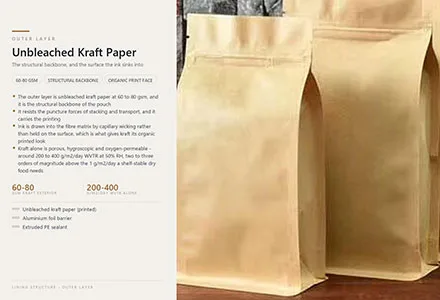
Kraft paper derives its name from the German word for “strength,” and the kraft pulping process — which uses sodium hydroxide and sodium sulfide to delignify wood chips under heat and pressure — produces fibers that are longer, stronger, and more tear-resistant than those from sulfite or mechanical pulping. A 60-80 gsm unbleached kraft exterior provides the structural backbone of the composite pouch: it resists the puncture forces of stacking and transport, it absorbs printing inks through capillary action into the fiber matrix rather than holding them on the surface (creating a distinctive organic print aesthetic), and it provides the haptic warmth — the slight texture, the matte finish, the earthy color — that consumers associate with sustainability and artisanal quality. However, kraft paper’s WVTR (water vapor transmission rate) at 50% RH is approximately 200-400 g/m²/day — two to three orders of magnitude higher than the <1 g/m²/day required for shelf-stable dry food packaging.

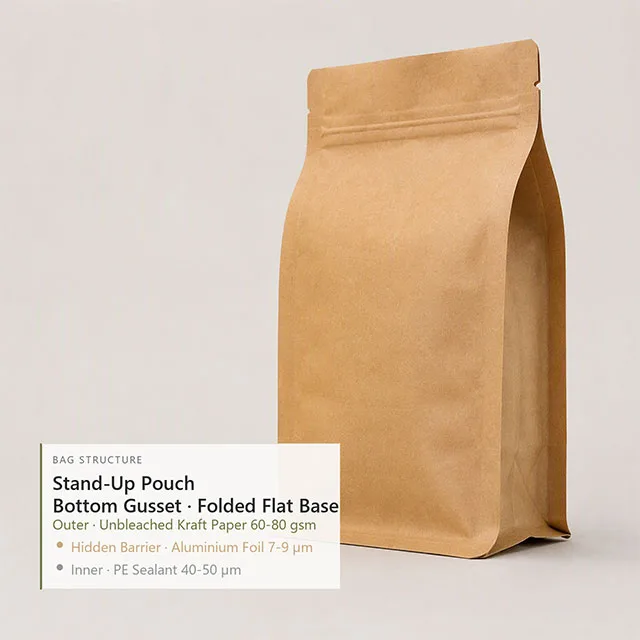
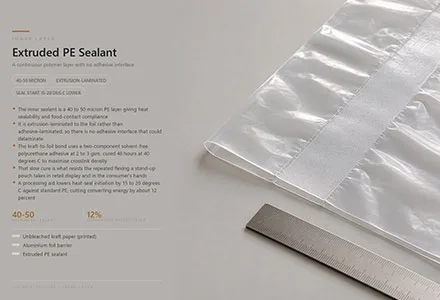
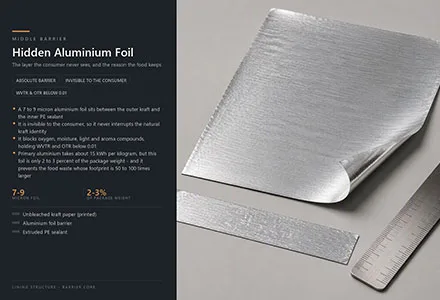
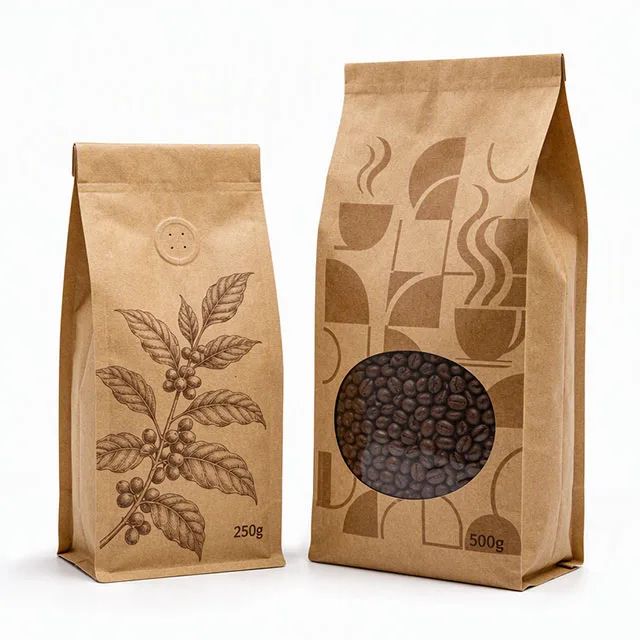
The hidden barrier is a 7-9μm aluminum foil layer laminated between the outer kraft and an inner PE sealant. Because the foil is invisible to the consumer, it does not disrupt the “natural kraft” visual identity, yet it delivers the near-absolute barrier performance — WVTR and OTR below 0.01 units — required for products like coffee beans, nuts, dried fruits, and granola that would stale within days in a pure kraft pouch. The lamination adhesive is a solvent-free polyurethane system applied at 2-3 gsm, contributing zero residual solvents to the finished package — a detail that matters when the brand’s sustainability story is central to its market positioning. The inner PE sealant is formulated with a processing aid that lowers the heat-seal initiation temperature by 15-20°C versus standard PE, reducing energy consumption during pouch converting by approximately 12%, a measurable contribution to the product’s lifecycle carbon footprint reduction.

Product Description

Specifications

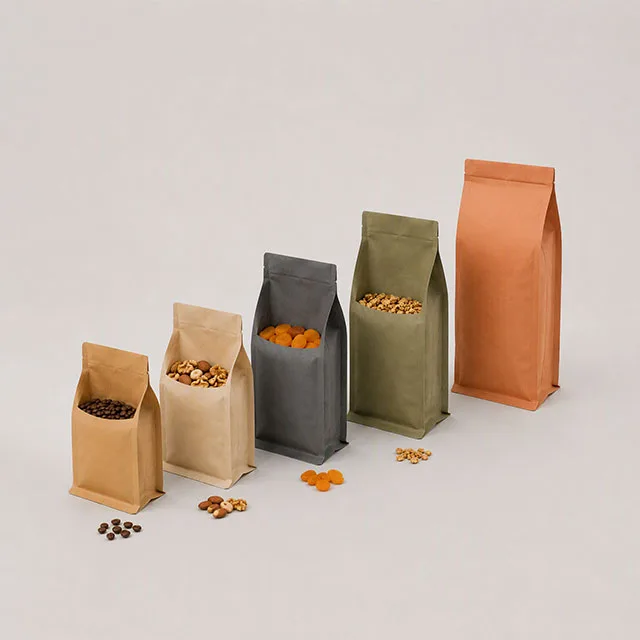
Customizable Color & Size Options for Every Market Need
Color Size
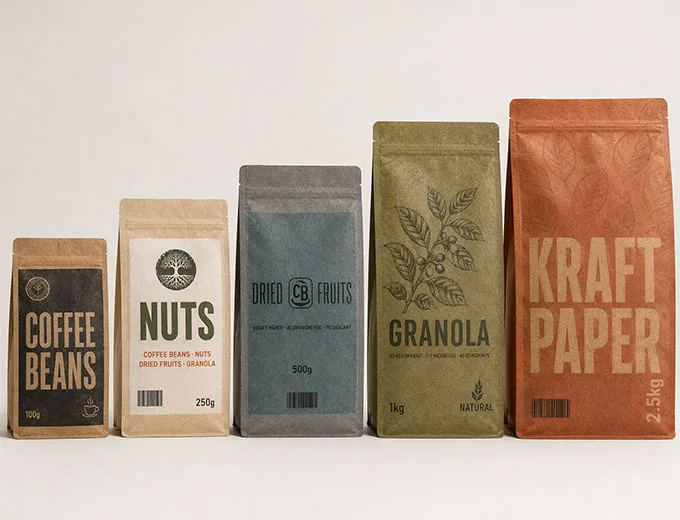
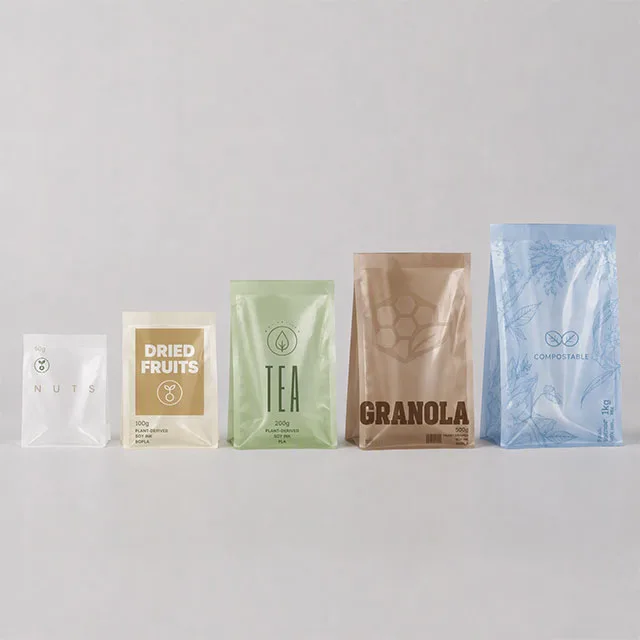
Natural Kraft Brown 100g
Unbleached Beige 250g
Charcoal Grey 500g
Olive Green 1kg
Warm Terracotta 2.5kg
Custom Color Available Custom Size Available

Printing Process

Registered Spot White Underprint for High-Contrast Graphics
Printing Process

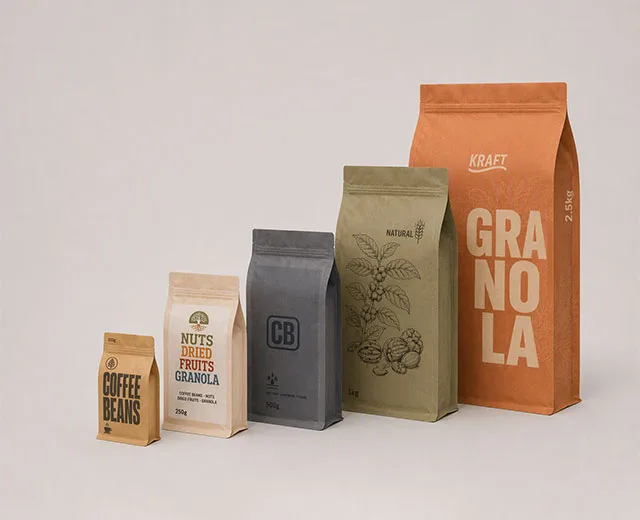
Printing on uncoated kraft paper is fundamentally different from printing on plastic film: the ink does not sit on the surface — it penetrates into the fiber matrix through capillary wicking, creating a visual texture where the ink color is modulated by the underlying paper fibers, their natural lignin color variations, and the surface topography of the sheet. This means that identical ink densities will render differently on every sheet — a variability that conventional packaging print QC systems are designed to eliminate, but that kraft packaging brands deliberately embrace as evidence of authenticity.

Our flexographic printing process on kraft paper uses water-based inks formulated with acrylic emulsion binders designed specifically for absorbent substrates. The water carrier carries pigment into the fiber voids, where the acrylic binder cures through water evaporation and film coalescence to lock the pigment in place. This penetration creates the characteristic “softer” print look of kraft packaging — edges are slightly feathered rather than razor-sharp, solid areas have subtle tonal variation, and halftone dots diffuse into the paper rather than sitting as discrete dots on the surface. These effects are technically “defects” in conventional print terms, but they are the visual language that communicates craft, authenticity, and natural origin to consumers.

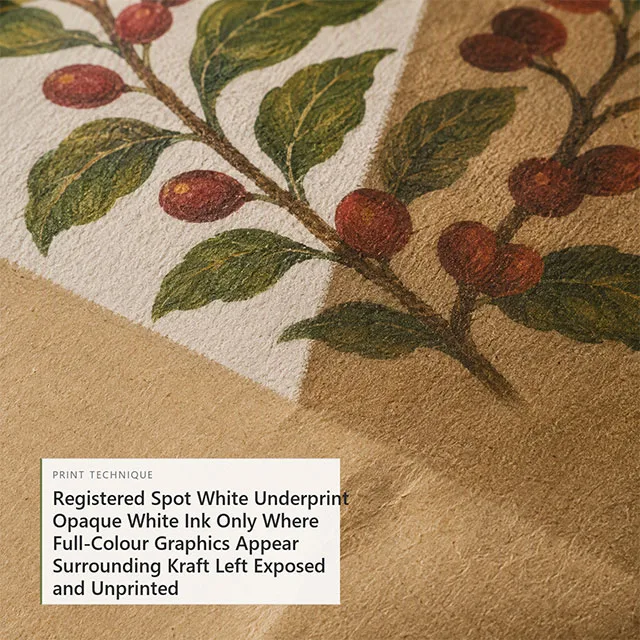
For brands that want crisp, high-contrast graphics on kraft, we offer a registered spot white underprint: an opaque white ink layer printed only in the areas where full-color graphics will appear, creating a smooth, bright canvas on the kraft surface while leaving the surrounding kraft area exposed and unprinted. This technique preserves the “natural kraft” frame around the graphics while delivering the color saturation of plastic-film printing within the graphic area — a best-of-both-worlds approach that is exclusive to flexographic printing due to the station-by-station control required for precise white-to-color registration.

Lining Decoration

Extrusion-Laminated PE and Solvent-Free Adhesive Bonding
Outer Layer

Outer Layer

Extruded PE Sealant
Middle Layer

Middle Layer

Hidden Aluminium Foil
Printing Process

Contact Layer

Unbleached Kraft Paper

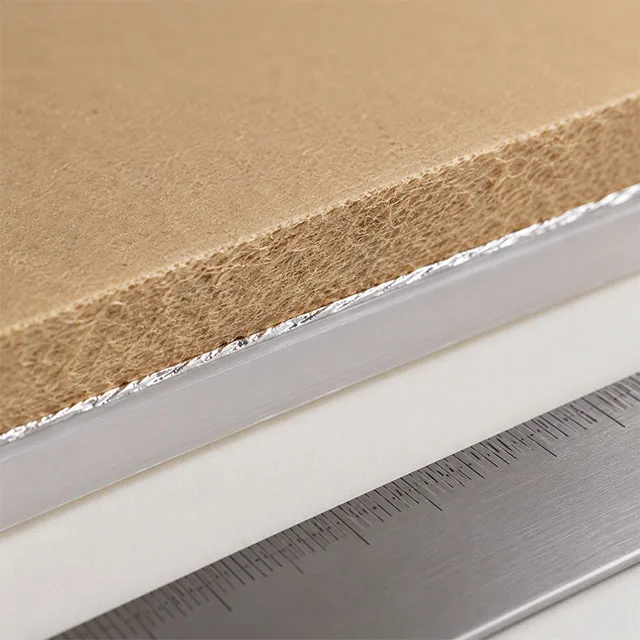
The lining structure of a kraft paper composite pouch is defined by the aluminum foil barrier layer — a material whose environmental reputation is complex and often misunderstood. Aluminum production is energy-intensive (approximately 15 kWh per kilogram of primary aluminum), making foil appear environmentally unfavorable in a simplistic lifecycle analysis. However, a foil barrier layer at 7 microns thickness contributes only 2-3% of the total package weight, and the barrier performance it provides eliminates food waste — the far larger environmental impact. A package that prevents 100g of coffee from staling has prevented the environmental footprint of growing, processing, transporting, and roasting those 100g of coffee, which is 50-100x larger than the footprint of the 0.5g of aluminum foil that protected it.

Our 3-ply laminate structure consists of: outer kraft paper (60-80 gsm) for the structural layer and print surface; middle aluminum foil (7-9μm) for absolute barrier against oxygen, moisture, light, and aroma; inner PE sealant (40-50μm) for heat sealability and food-contact compliance. The PE layer is extrusion-laminated rather than adhesive-laminated to the foil, creating a continuous polymer layer with no adhesive interface that could delaminate. The kraft-to-foil bond uses a 2-component solvent-free polyurethane adhesive cured at 40°C for 48 hours — a slow-cure process that maximizes crosslink density for delamination resistance during the repeated flexing that stand-up pouches experience in retail display and consumer handling.

Get In Touch With Us

Reach out for any inquiries, support, or to discuss how we can meet your industrial needs.
  • Address

    North Side Of Nanyi Road, Shiwan Town Science And Technology Park (10th Floor, Building 1, No. 13)

Contact Me

    You can upload a PDF or an image(max 5MB)

    INQUIRY