Custom packaging ·7-day sampling - Global delivery support

Industrial Household Chemical Refill Pouch with Chemical-Resistant Inner Layer and Child-Resistant Spout Cap for Detergents and Cleaners

Industrial Household Chemical Refill Pouch with Chemical-Resistant Inner Layer and Child-Resistant Spout Cap for Detergents and Cleaners

The industrial household chemical refill pouch occupies a category where packaging failure is not a quality defect — it is a safety incident. Laundry detergents, fabric softeners, all-purpose cleaners, and bleach solutions contain surfactants, enzymes, oxidizing agents, acids, and alkalis that can chemically attack standard packaging films through at least four distinct mechanisms: hydrolysis of ester-containing polymers (PET, PLA), oxidative degradation of unsaturated polymer backbones, plasticizer extraction that embrittles the film, and stress cracking — the propagation of microscopic fissures when a chemically softened film is subjected to mechanical stress. A refill pouch that leaks laundry detergent into a consumer’s pantry causes product loss and brand damage. A refill pouch that leaks bleach or drain cleaner causes chemical burns.

Color

Size

  • 250ml
  • 500ml
  • 1L
  • 2L
  • 5L
  • Custom Size Available

Shipping

Express (DHL/FedEx/UPS), Sea Freight, Air Freight

Payment Terms

T/T (Bank Transfer), L/C at Sight, PayPal, Western Union, Alibaba Trade Assurance

Lead Time

Samples: 3-5 working days | Mass Production: 15-25 working days

Samples

Contact us for FREE samples
Contact Us WhatsApp

Product Description

Chemical-Specific Sealant Formulations for Alkaline, Acidic, and Oxidizing Products

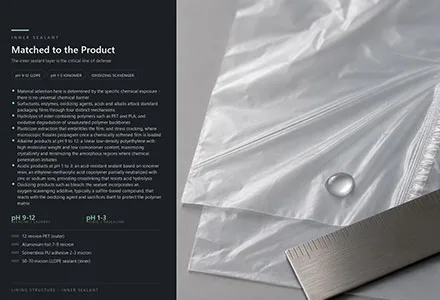
The inner sealant layer is the critical line of defense, and material selection here is determined by the specific chemical exposure. For alkaline products (laundry detergents, all-purpose cleaners at pH 9-12), we use a linear low-density polyethylene (LLDPE) with a high molecular weight and low comonomer content — characteristics that maximize crystallinity and minimize the amorphous regions where chemical penetration initiates. For acidic products (toilet bowl cleaners, descaling solutions at pH 1-3), a specialized acid-resistant sealant based on ionomer resin (ethylene-methacrylic acid copolymer partially neutralized with zinc or sodium ions) provides crosslinking that resists acid hydrolysis. For oxidizing products (bleach, hydrogen peroxide-based cleaners), the sealant incorporates an oxygen-scavenging additive — typically a sulfite-based compound — that preferentially reacts with the oxidizing agent, sacrificing itself to protect the polymer matrix.

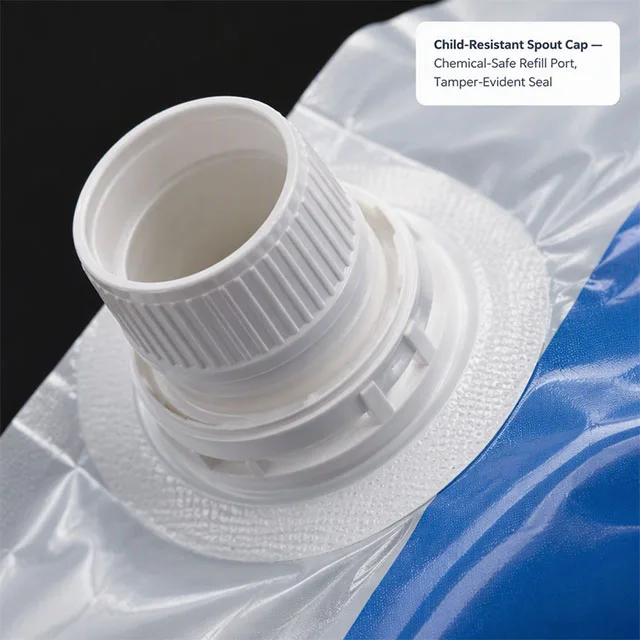
The spout fitment introduces additional safety requirements beyond liquid-tight sealing. Our child-resistant (CR) spout cap uses a “push-and-turn” mechanism — the cap must be pressed downward against a spring-loaded ratchet while simultaneously rotated counterclockwise, a simultaneous dual-action movement that children under 5 years old cannot reliably perform (validated through panel testing per ISO 8317 child-resistant packaging protocol). The cap is injection-molded from polypropylene with a living hinge connecting the cap body to a tamper-evident tear band — a ring of plastic that must be physically torn away before the cap can be opened, providing visible evidence of prior opening. The band is engineered with a tear force of 15-25 N, calibrated through tensile testing to be easy enough for elderly consumers (validated through senior-use panel testing per ISO 8317 Annex A) while being impossible to reattach after removal. Applications include laundry detergent refills, fabric softener refills, all-purpose cleaner refills, and liquid soap refill pouches.

Product Description

Specifications

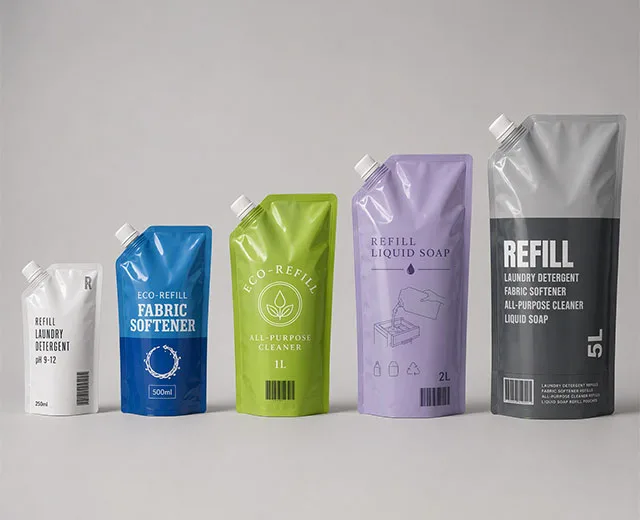
Customizable Color & Size Options for Every Market Need
Color Size
Bright White 250ml
Ocean Blue 500ml
Citrus Green 1L
Lavender Purple 2L
Clean Grey 5L
Custom Color Available Custom Size Available

Printing Process

Sustainability Messaging and Regulatory Compliance Graphics
Printing Process

Printing on household chemical refill pouches must withstand an environment that is uniquely hostile to graphics: the printed surface will be repeatedly contacted by wet hands during use in laundry rooms and under kitchen sinks, splashed with the chemical product itself during pouring, and stored in high-humidity environments (bathrooms, basements) for weeks or months. Ink delamination or color bleeding in these conditions is not merely an aesthetic failure — it creates consumer doubt about the chemical integrity of the entire package and, by association, the product and the brand.

Our rotogravure printing uses a 2-component polyurethane ink system where the ink binder is crosslinked during curing through reaction with an isocyanate hardener, creating a three-dimensional polymer network that resists chemical attack by surfactants, solvents, and the alkaline pH (9-12) typical of laundry products. The crosslinking density is controlled by the hardener ratio (typically 5-8% by weight of the ink solids) — higher than the 2-3% used in food packaging inks, because chemical resistance is the primary requirement rather than the flexibility and low migration needed for food contact. The cured ink film is tested for chemical resistance through a 24-hour immersion test in the actual product formulation (not a laboratory simulant — the real detergent or cleaner that will be packaged), with pass criteria of no blistering, no softening (pencil hardness change <2H), and no color change (ΔE <2.0 measured by spectrophotometer).

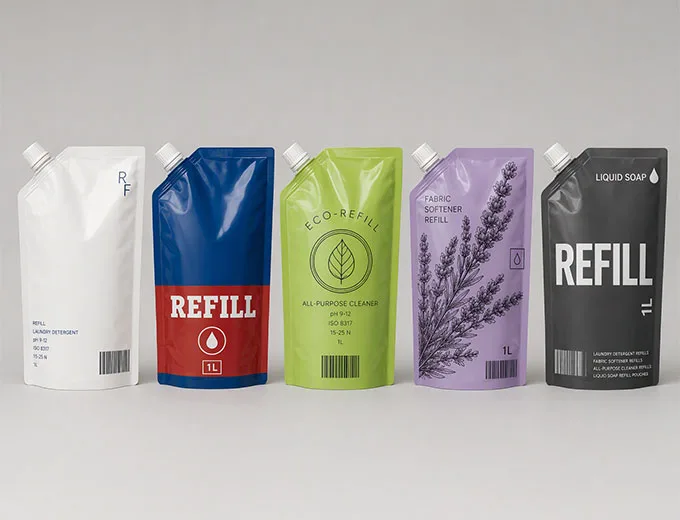
The graphic design requirements for refill pouches are driven by sustainability messaging: the refill format typically reduces plastic consumption by 70-85% compared to the rigid bottle it replaces, and this environmental benefit is a primary purchase motivator for refill consumers. The printed graphics must communicate this message while also being visually subordinate to the parent brand’s rigid bottle — the pouch is an accessory to the bottle, not a replacement for it. Our printing achieves this through a reduced-size logo, a predominant “REFILL” or “ECO-REFILL” callout, and environmental icons (recycling symbol with percentage reduction claim) that are verified against local green claims regulations (FTC Green Guides in the US, EU Directive 2005/29/EC on unfair commercial practices).

Lining Decoration

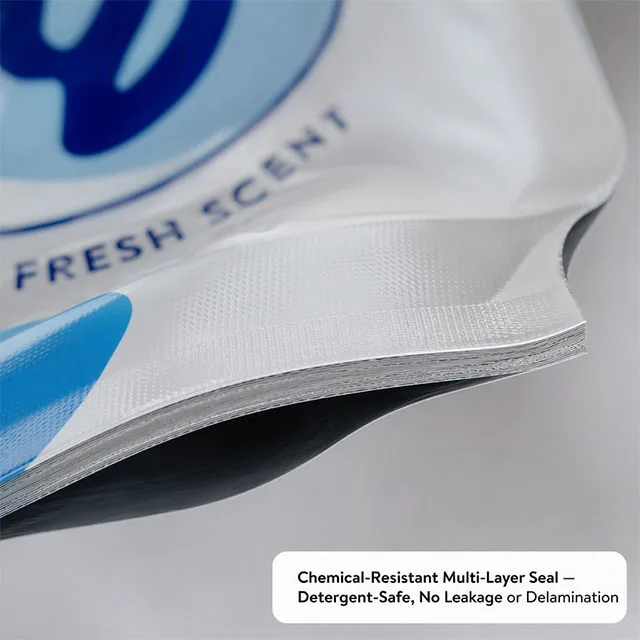
Alkaline-Resistant LLDPE and Aluminum Foil Barrier Structure
Outer Layer

Outer Layer

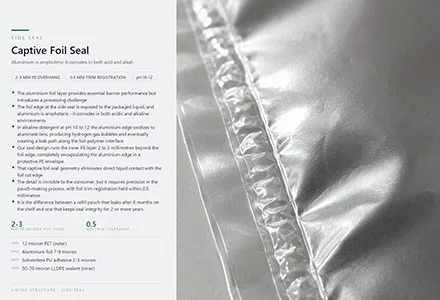
Captive Foil Seal
Middle Layer

Middle Layer

The inner sealant layer is the critical line of defense
Contact Layer

Contact Layer

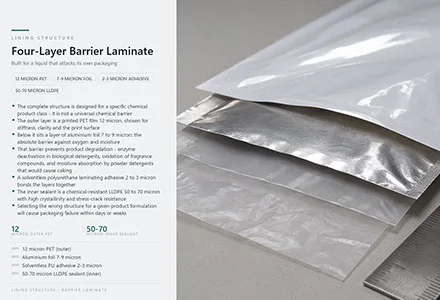
Built for a liquid that attacks its own packaging

The lining structure of a chemical refill pouch is a case study in barrier engineering for aggressive environments, where the inner layer must resist chemical attack that can operate through multiple simultaneous mechanisms. The complete structure is designed for a specific chemical product class — it is not a universal chemical barrier, and selecting the wrong structure for a given product formulation will result in packaging failure within days or weeks.

The structure for alkaline laundry products (the most common refill application, representing >60% of the refill pouch market) consists of: outer printed PET film (12μm) for stiffness, clarity, and print surface; a layer of aluminum foil (7-9μm) for the absolute barrier against oxygen and moisture that prevents product degradation (enzyme deactivation in biological detergents, oxidation of fragrance compounds, moisture absorption by powder detergents that would cause caking); a solventless polyurethane laminating adhesive (2-3μm); and the inner chemical-resistant LLDPE sealant (50-70μm) with high crystallinity and stress-crack resistance.

The aluminum foil layer, while providing essential barrier performance, introduces a processing challenge: the foil edge at the side seal is exposed to the packaged liquid, and aluminum is amphoteric — it corrodes in both acidic and alkaline environments. In alkaline detergent (pH 10-12), the aluminum edge undergoes oxidation to aluminate ions (Al(OH)₄⁻), producing hydrogen gas bubbles and eventually creating a leak path along the foil-polymer interface. Our solution is a seal design where the inner PE layer extends 2-3mm beyond the foil edge at the side seal, completely encapsulating the aluminum edge in a protective PE envelope — a “captive foil” seal geometry that eliminates direct liquid contact with the foil cut edge. This design detail is invisible to the consumer and requires precision in the pouch-making process (foil trim registration within ±0.5mm), but it is the difference between a refill pouch that leaks after 6 months on the shelf and one that maintains seal integrity for 2+ years.

Get In Touch With Us

Reach out for any inquiries, support, or to discuss how we can meet your industrial needs.
  • Address

    North Side Of Nanyi Road, Shiwan Town Science And Technology Park (10th Floor, Building 1, No. 13)

Contact Me

    You can upload a PDF or an image(max 5MB)

    INQUIRY