Hot & Cold Thermal Bags, Insulated Mailers & Cold Chain Delivery Packaging

Fertilizer, Pesticide & Agrochemical Packaging

Cleaner, Laundry & Air Care Packaging

Custom Medical Packaging Solutions

Protective Structures, Inserts and Retail Packs

Custom Protein Powder Pouches, Vitamin Stick Packs & Nutrition Bar Bags

Cosmetics, Fragrance and Skincare Packaging

Takeout, Bakery and Beverage Packaging

Kibble, treat & wet food packaging
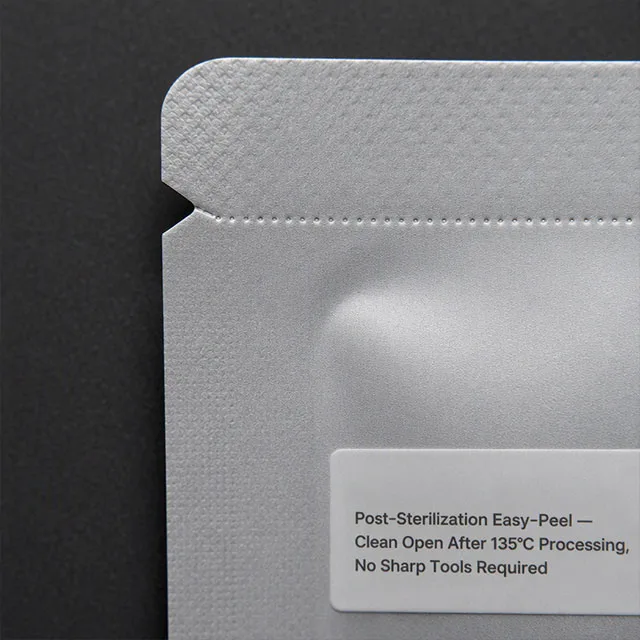
The industrial high-temperature retort pouch operates at the thermodynamic limit of flexible packaging: it must withstand sustained exposure to saturated steam at 135°C and 3.2 bar (absolute) for 30-60 minutes — conditions that would delaminate, deform, or burst a standard composite pouch within minutes. Unlike food retort pouches that operate at the standard 121°C sterilization temperature, industrial retort applications (medical device sterilization, military rations, ready-to-eat meals for remote operations, laboratory media) require the higher 135°C temperature to achieve sterility assurance levels (SAL) of 10⁻⁶ — the probability of one non-sterile unit per million processed — for heat-resistant bacterial spores such as Bacillus stearothermophilus and Geobacillus species that survive standard 121°C processing.
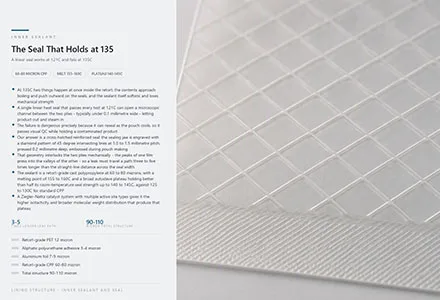
The seal architecture is the critical failure point in high-temperature retort, and standard linear heat seals — which work reliably at 121°C — fail catastrophically at 135°C through a mechanism called “channel leak formation.” During retort processing, the internal pressure of the pouch increases as the liquid contents approach their boiling point, creating an outward force on the seals. Simultaneously, the sealant polymer softens further as temperature increases, losing mechanical strength. When the softened seal can no longer resist the internal pressure, a microscopic channel opens between the seal plies — typically less than 0.1mm wide — through which contents leak and external steam/water enters, contaminating the product. This failure mode is insidious because the channel may reseal as the pouch cools after retort, passing visual QC inspection but containing a contaminated product.
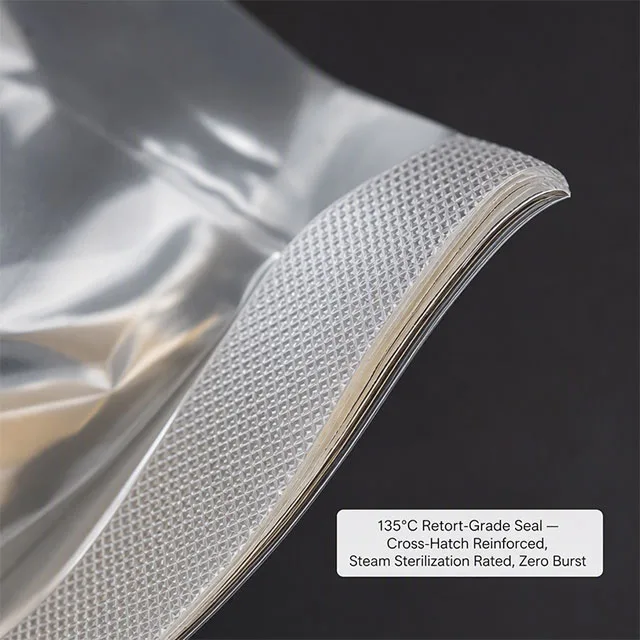
Our solution uses a cross-hatched reinforced seal architecture: instead of a single linear seal line, the sealing jaw is engraved with a diamond cross-hatch pattern (45° intersecting lines at 1.0-1.5mm pitch, 0.2mm depth) that creates a three-dimensional seal interface. The cross-hatch pattern provides mechanical interlocking between the two film plies — the peaks of one film are pressed into the valleys of the other, creating a tortuous leak path that is 3-5x longer than the straight-line distance across the seal width. This geometry converts a potential channel leak into a dead-end path that cannot propagate across the full seal width. The seal strength at 135°C is enhanced by a specialized retort-grade cast polypropylene (CPP) sealant with a melting point of 155-160°C and a broad autoclave plateau — the temperature range over which the polymer maintains at least 50% of its room-temperature seal strength, which for retort CPP extends to 140-145°C versus 125-130°C for standard CPP.
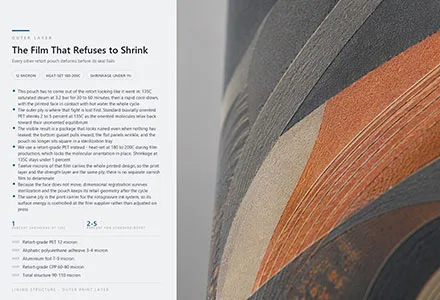
The outer film uses a retort-grade PET that has been annealed during manufacturing to relieve internal stresses that would cause shrinkage at retort temperatures. Standard biaxially oriented PET (BOPET) shrinks 2-5% at 135°C as the oriented molecules relax toward their unoriented equilibrium state, causing the pouch to visibly deform — gussets pull inward, flat panels develop wrinkles, and the overall package appears damaged even if seal integrity is maintained. Retort-grade PET is heat-set at 180-200°C during film production, locking in the molecular orientation so that shrinkage at 135°C is <1%, maintaining pouch geometry and retail appearance after sterilization.
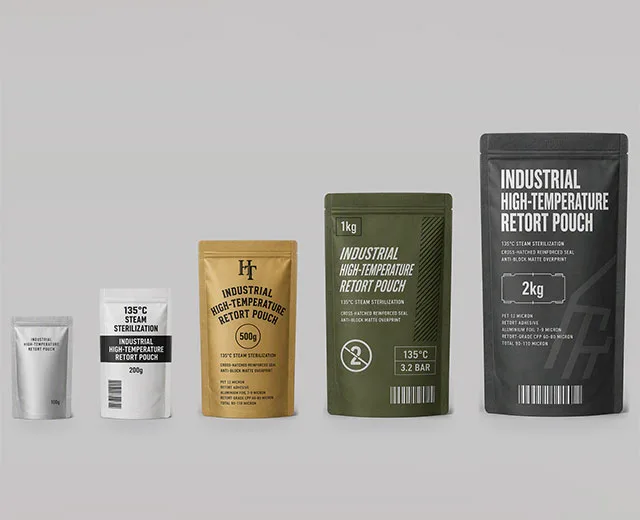
| Color | Size |
| Silver Matte | 100g |
| Pearl White | 200g |
| Amber Transparent | 500g |
| Military Green | 1kg |
| Industrial Grey | 2kg |
| Custom Color Available | Custom Size Available |
Printing on retort pouches must survive conditions that would destroy the graphics on any other packaging format: 135°C saturated steam at 3.2 bar for up to 60 minutes, followed by rapid cooling to ambient temperature, all while the pouch is immersed in water with the printed surface in direct contact with hot water for the entire sterilization cycle. Ink delamination during retort — visible as blisters, color bleeding, or complete graphic detachment — is the most common cause of retort pouch rejection at QC inspection and represents a complete loss of the batch because the printed graphics cannot be reapplied after sterilization.
Our rotogravure retort ink system uses a polyester-based polyurethane binder crosslinked with an aliphatic isocyanate hardener — chosen over aromatic isocyanates because aliphatic crosslinks do not yellow at retort temperatures (aromatic isocyanates form quinoid structures at >130°C that produce visible yellowing even on colored backgrounds). The crosslinking reaction is completed through a post-print curing cycle at 50-60°C for 48-72 hours — a slow-cure process that maximizes crosslink density because incomplete crosslinking is the primary cause of retort ink failure. The cured ink film is tested through a simulated retort cycle in an autoclave with the actual product simulant (water, oil, or 3% acetic acid depending on the packaged product), with visual inspection for blistering, tape adhesion testing (3M 610 tape, no ink removal), and color measurement (ΔE <2.0 after retort versus before retort).
The anti-block matte overprint coating serves a functional purpose beyond aesthetics: during the retort process, pouches are stacked in sterilization trays with the printed surface of one pouch pressed against the back surface of the adjacent pouch, under the combined pressure of the steam atmosphere and the weight of the pouch stack above. Without an anti-block coating, the printed ink film would fuse to the adjacent pouch surface at 135°C — a phenomenon called “blocking” — and the pouches would tear when separated after retort. Our matte overprint coating contains silica micro-particles (3-5μm) that create a microscopic surface roughness (Ra 0.5-1.0μm) preventing direct ink-to-film contact between adjacent pouches, while the matte finish provides the low-gloss (<10 GU at 60°) appearance preferred for industrial and medical applications.
The lining structure of a high-temperature retort pouch is defined by the retort-grade CPP sealant layer — a material that costs 2-3x more than standard CPP but is the only economically viable sealant that survives 135°C sterilization without seal failure. The CPP for retort applications is produced using a specialized polymerization process that creates a polymer with higher isotacticity (the percentage of methyl groups on the same side of the polymer chain, which determines crystallinity and melting point) and a broader molecular weight distribution than standard CPP, achieved through the use of a Ziegler-Natta catalyst system with multiple active site types that produce polymer chains of varying lengths simultaneously.
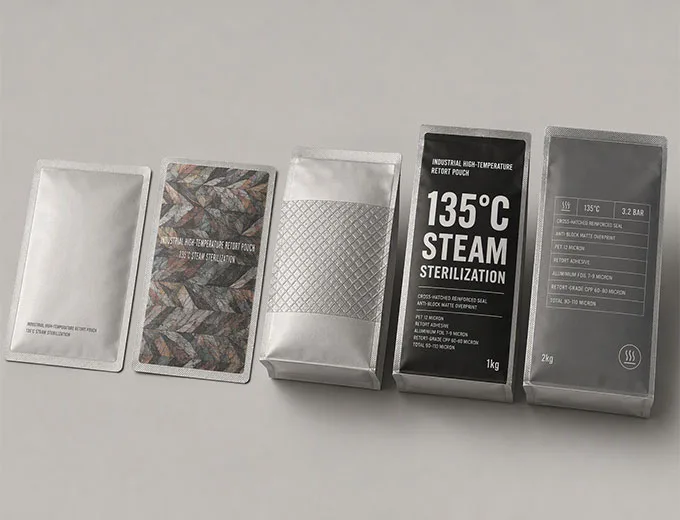
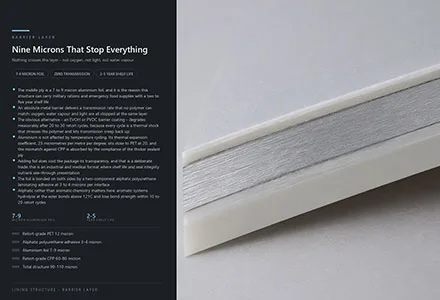
The complete structure for 135°C retort applications is: outer retort-grade PET film (12μm, heat-set, printed); a retort-grade laminating adhesive based on a 2-component aliphatic polyurethane system (3-4μm) that resists hydrolysis at retort temperatures — standard aromatic polyurethane adhesives undergo ester bond hydrolysis at >121°C, losing bond strength within 10-20 retort cycles; an aluminum foil barrier layer (7-9μm) for the zero-transmission barrier essential for products with 2-5 year shelf life requirements (military rations, emergency food supplies); a second layer of retort adhesive (3-4μm); and the retort-grade CPP sealant (60-80μm) with the cross-hatched seal pattern embossed by the sealing jaw during pouch making.
The aluminum foil is essential despite adding a non-transparent layer because the 2-5 year shelf life required for military and emergency rations is achievable only with an absolute (metal) barrier — EVOH and PVDC barrier layers degrade measurably after 20-30 retort cycles due to thermal cycling stress, while aluminum foil is unaffected by temperature cycling because the thermal expansion coefficient of aluminum (23 μm/m·°C) is closely matched to PET (20 μm/m·°C) and CPP (100 μm/m·°C compensated by the thicker sealant layer’s compliance). The total structure thickness of 90-110μm is optimized for the balance between thermal resistance (thicker = more thermal mass, slower heating to sterilization temperature, longer cycle times) and mechanical durability (thinner = more prone to flex-crack pinholes during handling after retort).
North Side Of Nanyi Road, Shiwan Town Science And Technology Park (10th Floor, Building 1, No. 13)
INQUIRY