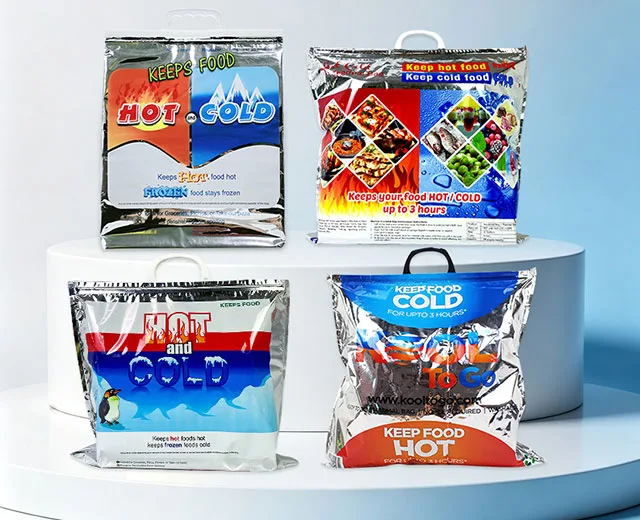
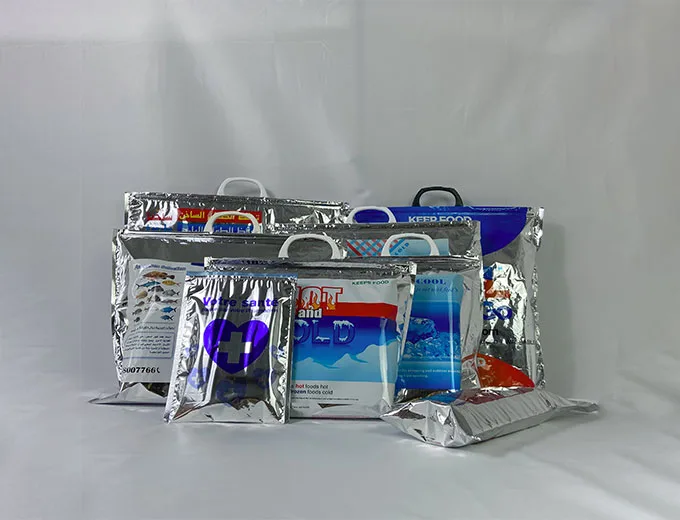
Hot & Cold Thermal Bags, Insulated Mailers & Cold Chain Delivery Packaging

Fertilizer, Pesticide & Agrochemical Packaging

Cleaner, Laundry & Air Care Packaging

Custom Medical Packaging Solutions

Protective Structures, Inserts and Retail Packs

Custom Protein Powder Pouches, Vitamin Stick Packs & Nutrition Bar Bags

Cosmetics, Fragrance and Skincare Packaging

Takeout, Bakery and Beverage Packaging

Kibble, treat & wet food packaging
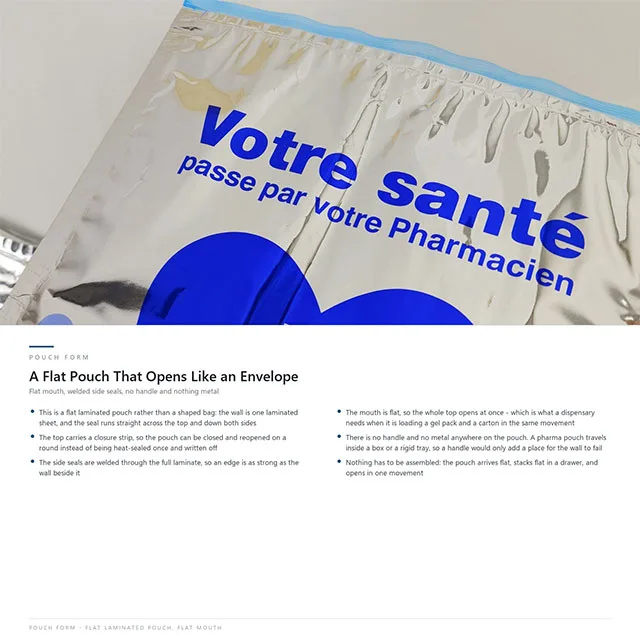
The pharmaceutical thermal delivery pouch operates under a stricter temperature contract than any food bag: the 2-8°C cold chain that vaccines, insulin, biologics, and temperature-sensitive diagnostics must never leave — not during transport, not during a traffic delay, not during the final doorstep handover. Regulators in every major market (EU GDP, US CDC Vaccine Storage guidelines, WHO EIR) treat excursions outside 2-8°C as a batch-destroying event, regardless of how long the excursion lasted. This pouch is engineered as a validated passive cold-chain system: an insulated envelope that, together with phase-change gel packs, maintains 2-8°C for a documented duration, and communicates its own thermal history through a monitoring label window.
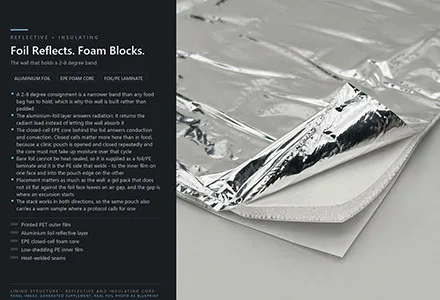
The thermal performance comes from a layered construction tuned for pharmaceutical duty. The outer shell is a high-density 10mm EPE foam core faced with a durable laminated film that resists the isopropyl alcohol and quaternary ammonium wipes used in pharmacy and clinic environments; the inner cavity is sized with engineered headroom so that a standard configuration — product plus two phase-change gel packs preconditioned at 2-8°C — achieves a validated hold time of 8-12 hours at ambient 25°C, extending to 24+ hours with four gel packs for long-haul courier routes. A magnetic or hook-and-loop closure seals the envelope without compressing the foam, because compressed foam loses R-value exactly where protection is needed most.
Validation is the difference between a bag and a pharma-grade system. Each pouch design is delivered with a thermal validation report based on ISTA 7D-style temperature testing: product zone sensors record a full 24-hour profile across summer, winter, and extreme ambient conditions, and the report documents time-to-excursion for each configuration. The front panel carries a dedicated monitoring-label zone sized for USB temperature loggers or chemical-indicator strips, so the receiving pharmacist can verify the cold chain before accepting the shipment — a requirement increasingly written into pharma tenders and wholesaler contracts.
| Color | Size |
| Medical White | S (2L) |
| Sterile Blue | M (5L) |
| Grey | L (8L) |
| Navy Blue | XL (12L) |
| Dark Grey | XXL (16L) |
| Custom Color Available | Custom Size Available |
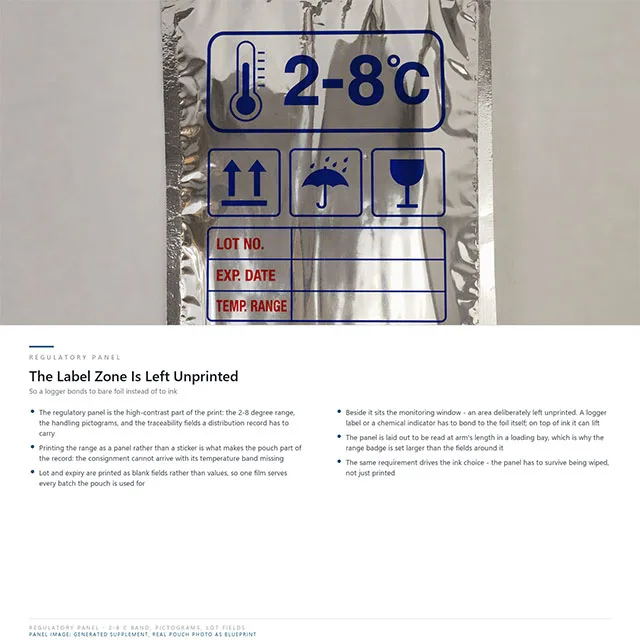
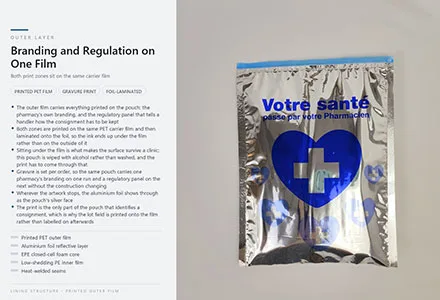
Printing on pharma thermal pouches must satisfy two masters: brand identity and regulatory communication. The brand zone carries logos and distribution graphics with 12-color gravure, printed on the outer film before lamination so the ink is protected under the clear topcoat that withstands disinfectant wiping. The regulatory zone is a high-contrast panel printed with temperature-range pictograms (2-8°C cold-chain symbol), handling instructions, and lot traceability fields — printed with durable gravure ink that remains legible after 100+ wipe cycles with 70% isopropyl alcohol, verified by an abrasion test that exceeds standard packaging rub tests.
A third print zone, the monitoring window, is deliberately left unprinted: a transparent film aperture where the temperature logger label adheres. Its position and dimensions are specified to match standard USB temperature loggers and chemical-indicator labels used in pharma logistics, so the pouch accepts any monitoring technology the distributor already uses. For controlled-substance deliveries, an optional sequential-numbering print on the tamper-evident closure strip provides chain-of-custody tracking that satisfies narcotics and controlled-medicine distribution audits.
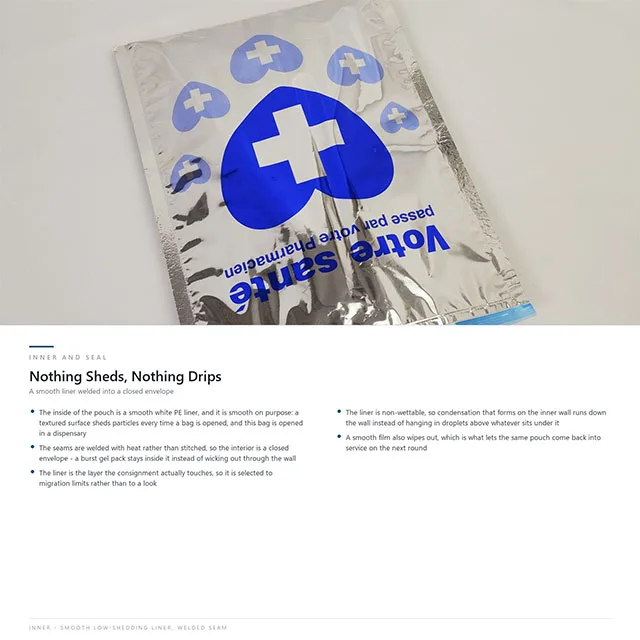
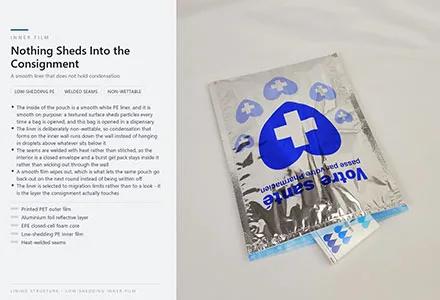
The inner lining of a pharma pouch must never introduce a contaminant into a sterile or semi-sterile environment.The inner film is a pharmaceutical-grade PE sealant that meets food-contact migration limits (EU 10/2011) as a conservative baseline, with a smooth, low-shedding surface that does not release particulates when the pouch is opened repeatedly. Unlike grocery bags, the pharma lining is deliberately non-wettable — a hydrophobic surface that prevents condensation droplets from forming on the inner wall and dripping onto product cartons, which would compromise secondary packaging integrity.
The foam core is selected for low outgassing: closed-cell EPE with a total mass loss below 0.5% (ASTM E595), because volatile compounds from the insulation could theoretically interact with sensitive biologics over extended contact. The gel-pack contact surfaces are lined with a puncture-resistant film layer, because a burst phase-change pack introduces liquid into a 2-8°C shipment — an excursion event plus a contamination event. Every pouch ships with a batch certificate documenting foam density, film migration data, and the validation protocol version applicable to that production lot.
North Side Of Nanyi Road, Shiwan Town Science And Technology Park (10th Floor, Building 1, No. 13)
INQUIRY