Hot & Cold Thermal Bags, Insulated Mailers & Cold Chain Delivery Packaging

Fertilizer, Pesticide & Agrochemical Packaging

Cleaner, Laundry & Air Care Packaging

Custom Medical Packaging Solutions

Protective Structures, Inserts and Retail Packs

Custom Protein Powder Pouches, Vitamin Stick Packs & Nutrition Bar Bags

Cosmetics, Fragrance and Skincare Packaging

Takeout, Bakery and Beverage Packaging

Kibble, treat & wet food packaging
The cold chain grocery insulated bag exists to solve the weakest link in fresh food logistics: the last mile. From the distribution centre to the consumer door a grocery order can sit in a delivery vehicle for 30 to 90 minutes, which is long enough for strawberries to soften, ice cream to melt and leafy greens to wilt without active refrigeration. This bag extends the cold chain by pairing an insulated body with a dedicated gel-pack sleeve, so e-grocery operators can ship chilled and frozen items on the same trip as ambient groceries without cross-contamination or temperature compromise.
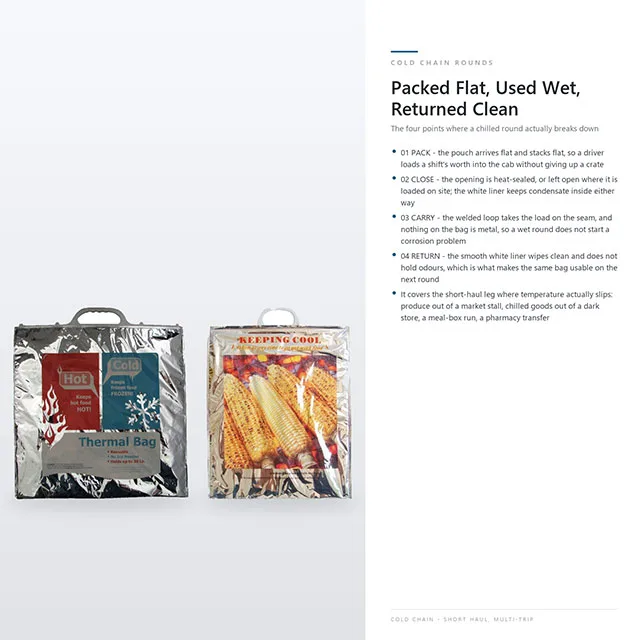
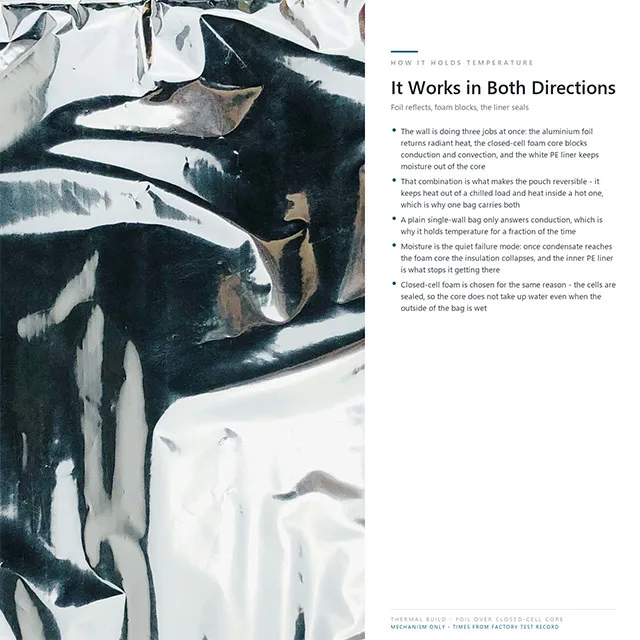
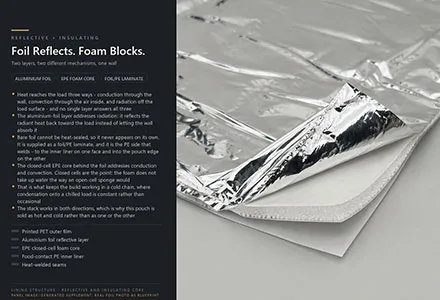
The thermal architecture is the standard four-layer build for this class of bag, assembled from the outside in: a printed outer layer carrying the brand artwork, a closed-cell EPE foam core, an aluminium-foil reflective barrier, and a food-contact inner liner. The aluminium foil does the radiant work, reflecting the heat load back off the contents instead of letting it conduct inward. Because bare foil cannot be heat-sealed, it is supplied as an Al/PE laminate and the PE side is what welds to the inner liner. Behind the foil the EPE core blocks conduction and convection, and 8mm is the mainstream gauge for retail and delivery insulated bags, with 3mm, 5mm and 10mm the other common thicknesses.
Performance is quoted as a system figure rather than a single-layer number: closed-cell PE foams sit at roughly R 3.6 to 4.2 per inch, and a foil-lined foam build reaches an effective R 5 to 10 once the reflective layer and the trapped air gap are counted. A comparable construction of 600D outer, 8mm PE foam and aluminium-foil lining is quoted by the trade at about 8 to 10 hours of cold retention at 25 to 30 C ambient. The wide mouth opens fully for mechanical packing lines, the reinforced bottom carries 15kg without sagging, and the size ladder runs from 6L to 25L to cover single-basket and multi-basket grocery orders.
| Color | Size |
| Silver Metallic | S (6L) |
| Arctic White | M (10L) |
| Graphite Grey | L (15L) |
| Navy Blue | XL (20L) |
| Olive Green | XXL (25L) |
| Custom Color Available | Custom Size Available |
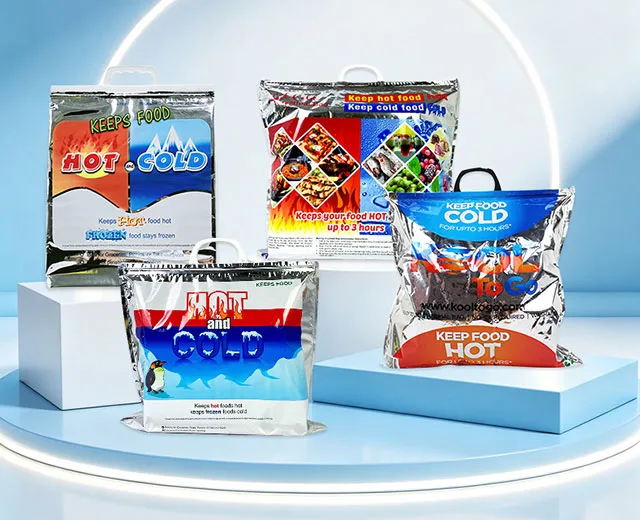
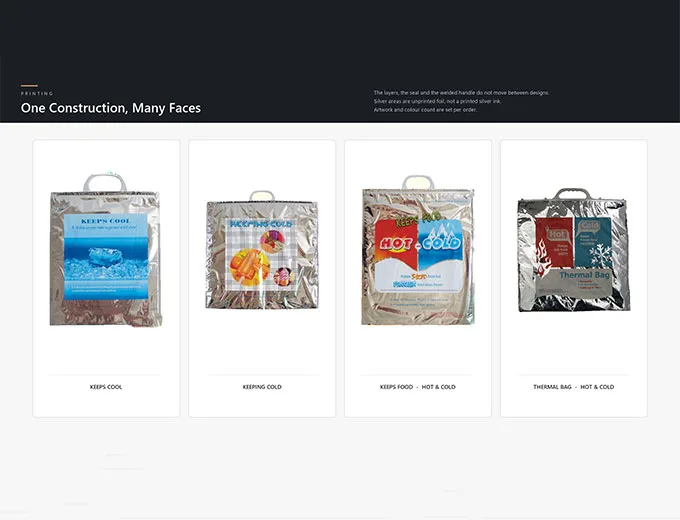
Grocery bags carry information that changes with every order, including customer name, delivery window, order contents and temperature zone, so the print is split between permanent brand graphics and variable order data. The brand panel of logo, campaign graphics and sustainability messaging is printed on the outer layer, while a dedicated thermal-label zone on the front panel accepts warehouse-printed labels. A colour-coded temperature band along the bottom edge, blue for chilled, dark blue for frozen and neutral for ambient, lets loading staff route each bag to the correct dispatch bay without reading a label.
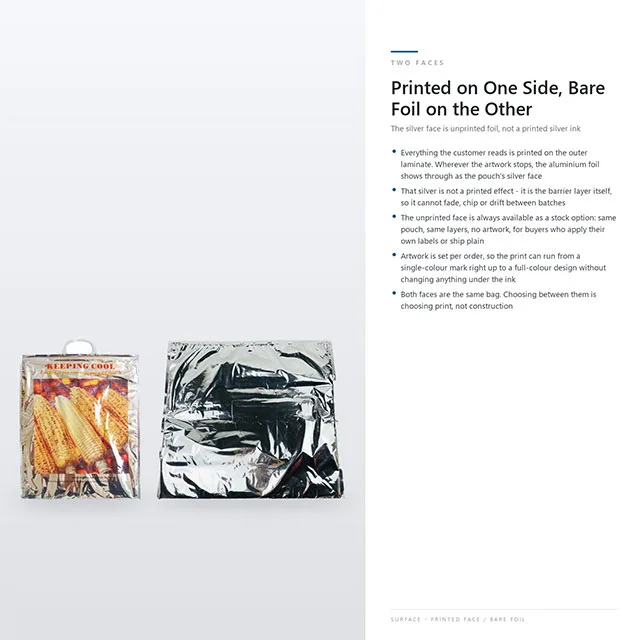
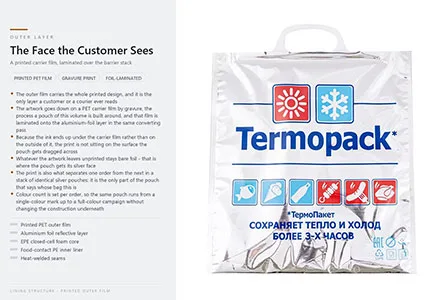
The outer artwork is printed on a PET transfer film and laminated to the outer layer in the same converting pass as the insulation, so the ink sits beneath a clear protective layer that resists vehicle loading abrasion and commercial wash-down. The printed surface is built to survive repeated flexing of a loaded bag and the wipe-down routine of a commercial kitchen, so the graphics stay legible for the life of the bag.
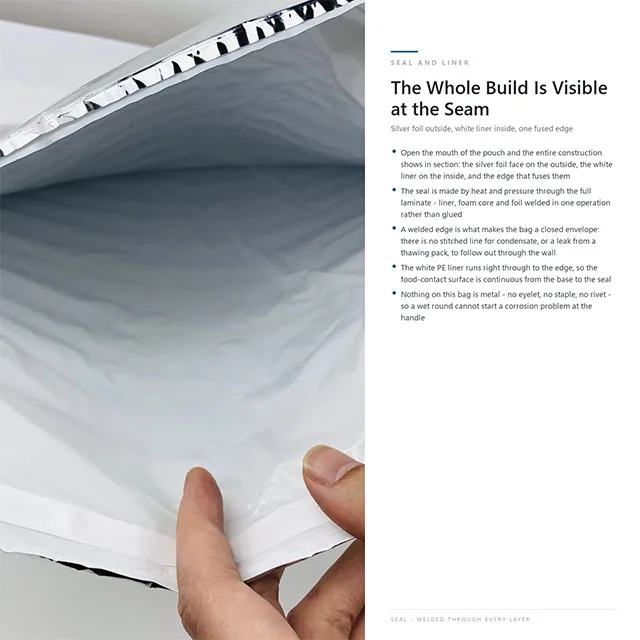
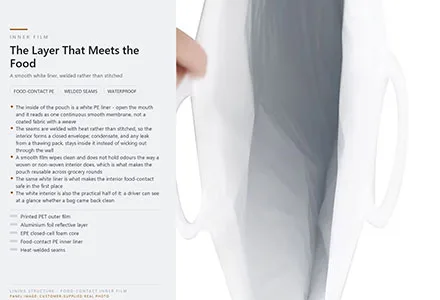
The inner lining is the layer that meets the load. On the food-facing side that is the Al/PE reflective laminate, with the PE side welded so the interior forms a continuous envelope rather than a stitched seam. For leakage from thawing proteins and condensation from fresh produce the standard answer in this category is a food-grade PE or PEVA liner, PEVA foil being the mainstream choice for consumer insulated bags and heavier foil laminates used where more performance is needed.
The insulated body is combined with a dedicated gel-pack sleeve: a double-walled internal pocket sized for a standard 500g phase-change gel pack and closed with a hook-and-loop flap. The wall facing the food zone is deliberately thin so cold transfers inward quickly, while the outer wall carries a foam layer that stops ambient heat leaking back in through the sleeve. Packing chilled and frozen items in the same bag stays practical because the coolant sits in its own compartment instead of loose among the food.
North Side Of Nanyi Road, Shiwan Town Science And Technology Park (10th Floor, Building 1, No. 13)
INQUIRY