Hot & Cold Thermal Bags, Insulated Mailers & Cold Chain Delivery Packaging

Fertilizer, Pesticide & Agrochemical Packaging

Cleaner, Laundry & Air Care Packaging

Custom Medical Packaging Solutions

Protective Structures, Inserts and Retail Packs

Custom Protein Powder Pouches, Vitamin Stick Packs & Nutrition Bar Bags

Cosmetics, Fragrance and Skincare Packaging

Takeout, Bakery and Beverage Packaging

Kibble, treat & wet food packaging
The frozen breast milk storage bag occupies the most demanding intersection of packaging engineering: it must simultaneously meet medical-device-grade sterility standards, food-contact safety regulations that are more stringent for infant nutrition than for any other food category, and the practical realities of home freezer storage where contamination risks are highest during the transfer, freeze, thaw, and pour steps of the consumer usage cycle. No other flexible packaging application combines these three layers of performance requirements in a single disposable product.
The fundamental engineering challenge is sterility assurance without compromising polymer integrity. Our bags are manufactured in an ISO Class 7 cleanroom environment and sterilized using gamma irradiation at a validated dose of 25 kGy — the international standard for medical device terminal sterilization. The critical material selection criterion is radiation resistance: standard polyethylene undergoes chain scission and crosslinking under gamma exposure, generating free radicals that continue reacting for weeks after irradiation, producing off-odors and embrittlement. We use a radiation-stabilized polyolefin formulation containing free-radical scavengers that quench these reactive species during and after irradiation, ensuring the film retains its original mechanical properties — seal strength, puncture resistance, and flexibility — throughout the product’s 3-year shelf life.
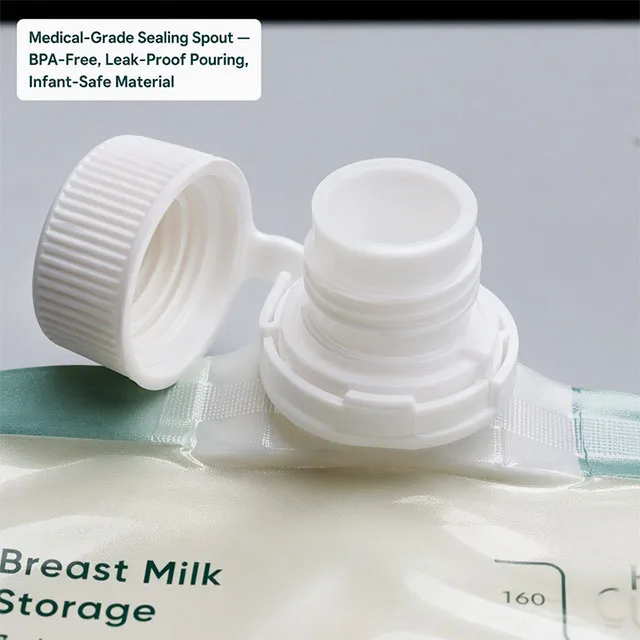
The double-layer zip closure is the primary contamination barrier during freezer storage. Unlike single-zip closures that rely on a single line of contact, the dual interlocking profile creates a tortuous path for microbial ingress: any contaminant must navigate two independent seal planes separated by a dead-air gap, reducing penetration probability by orders of magnitude. Each zip track is dimensionally verified by laser micrometer to ensure interlock engagement depth of 0.8-1.2mm — the range validated through microbial challenge testing with Brevundimonas diminuta, the industry-standard 0.3μm test organism. The pouring spout features an asymmetric geometry that channels liquid flow away from the external zip tracks during decanting, preventing cross-contamination from the outer bag surfaces that have been handled during freezer retrieval. Temperature-indicating labels change color irreversibly if the bag has been thawed and refrozen — a safety feature that protects against the bacterial growth risk of temperature abuse.
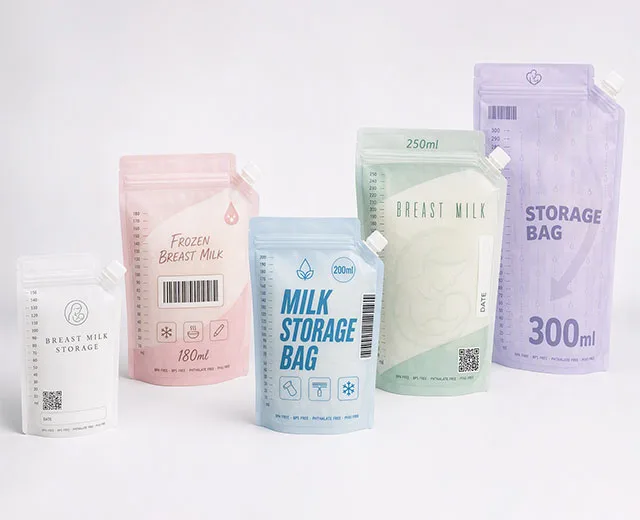
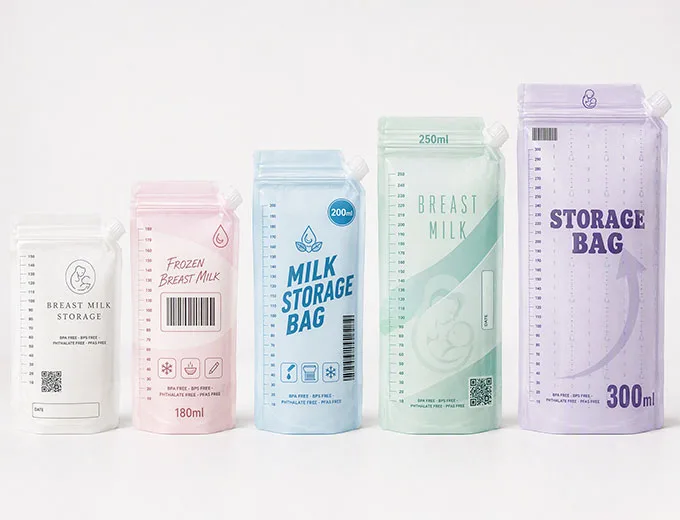
| Color | Size |
| Medical White | 150ml |
| Soft Pink | 180ml |
| Baby Blue | 200ml |
| Mint Green | 250ml |
| Lavender | 300ml |
| Custom Color Available | Custom Size Available |
Printing on medical-grade breast milk storage bags operates under constraints that would be considered impossibly restrictive in any other packaging category: every ink, coating, and solvent that contacts the film must be toxicologically evaluated for potential migration into human milk, and the print must remain legible and durable through gamma sterilization (which can discolor certain pigments), freezer storage at -20°C, and the boiling-water thaw process (where bags are immersed in 40-50°C water for 10-15 minutes).
We use a solvent-free, electron-beam-cured ink system that produces zero volatile organic compound (VOC) emissions and contains no photoinitiators — a class of compounds that have come under regulatory scrutiny for potential endocrine-disrupting effects. The ink is cured through electron beam crosslinking, which polymerizes the ink film instantly without requiring the benzophenone or ITX photoinitiators used in conventional UV-curable inks. The resulting ink film is a highly crosslinked polymer network with near-zero migration potential — tested according to EU 10/2011 overall migration limits for infant food contact materials, which are 10x more stringent than adult food packaging standards.
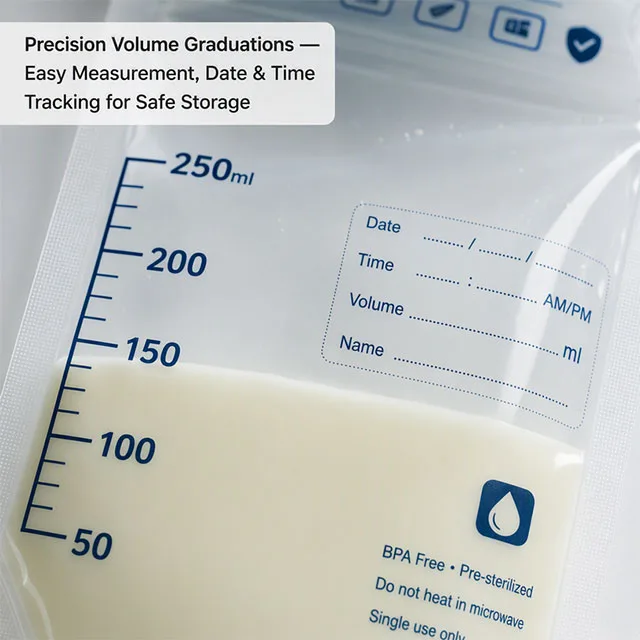
The print design prioritizes functional information over decorative graphics: volume graduation markings are printed with a registered embossing effect that creates a tactile ridge at each 10ml interval, allowing volume measurement by touch alone — critical for sleep-deprived parents at 3 AM. The date-label area uses a write-on matte coating developed through a proprietary silica-particle surface treatment that accepts ballpoint pen, permanent marker, and pencil without smearing even when the bag surface is frosted from freezer condensation. All text is printed in a sans-serif typeface at a minimum 8pt size, validated through human-factors testing for legibility under low-light nursery conditions.
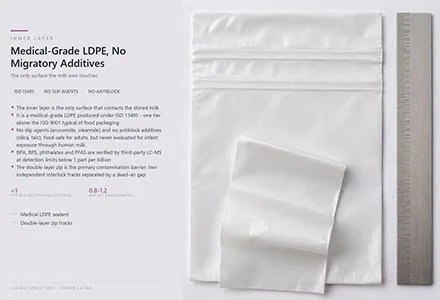
The lining structure of a breast milk storage bag represents the apex of food-contact safety engineering in flexible packaging. The inner layer — the only surface that contacts the stored milk — must be free of bisphenol A (BPA), bisphenol S (BPS), phthalates, and per- and polyfluoroalkyl substances (PFAS), verified through independent third-party laboratory testing using liquid chromatography-mass spectrometry (LC-MS) with detection limits below 1 part per billion.
The inner sealant is a medical-grade low-density polyethylene (LDPE) produced under ISO 13485 quality management system certification — the standard for medical device manufacturing, one tier above the ISO 9001 certification typical of food packaging. This LDPE grade is manufactured without the use of slip agents (erucamide, oleamide) or antiblock additives (silica, talc) that are standard in food packaging PE formulations, because these migratory additives — while food-safe for adult consumption — have not been evaluated for infant exposure through human milk.
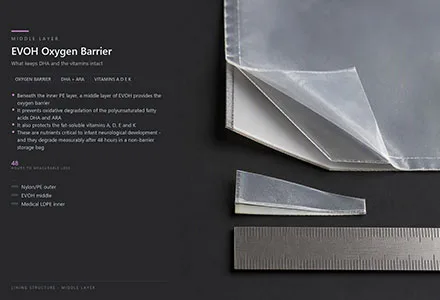
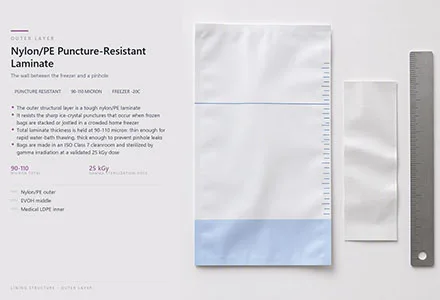
Beneath the inner PE layer, a middle layer of EVOH provides oxygen barrier that prevents oxidative degradation of polyunsaturated fatty acids (DHA, ARA) and fat-soluble vitamins (A, D, E, K) in stored milk — nutrients that are critical for infant neurological development and that degrade measurably after 48 hours in non-barrier storage bags. The outer structural layer is a tough, puncture-resistant nylon/PE laminate that prevents the sharp ice-crystal punctures that can occur when frozen bags are stacked or jostled in a crowded home freezer. Total thickness of 90-110 microns is optimized to be thin enough for rapid thawing via water bath while thick enough to prevent pinhole leaks.
North Side Of Nanyi Road, Shiwan Town Science And Technology Park (10th Floor, Building 1, No. 13)
INQUIRY