Custom packaging ·7-day sampling - Global delivery support

Frozen Meat Vacuum Bag with Diamond-Emboss Nylon Composite and Oleophobic Deep-Freeze Rated Inner Coating

Frozen Meat Vacuum Bag with Diamond-Emboss Nylon Composite and Oleophobic Deep-Freeze Rated Inner Coating

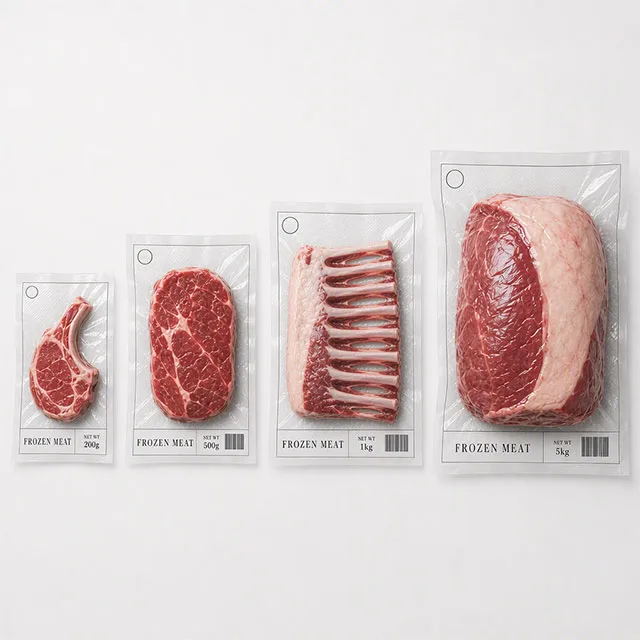
The frozen meat vacuum bag sits at the intersection of three distinct engineering disciplines: vacuum technology (the package must evacuate air efficiently and maintain vacuum integrity), polymer science (the film must resist puncture from sharp bone fragments and maintain flexibility at deep-freeze temperatures), and meat science (the package must prevent the myoglobin oxidation that turns fresh red meat brown within hours of exposure to oxygen). A failure in any one of these three domains results in product that is unsaleable — either physically damaged, freezer-burned, or visually unappealing to consumers who associate the bright cherry-red color of oxymyoglobin with freshness.

Color

Size

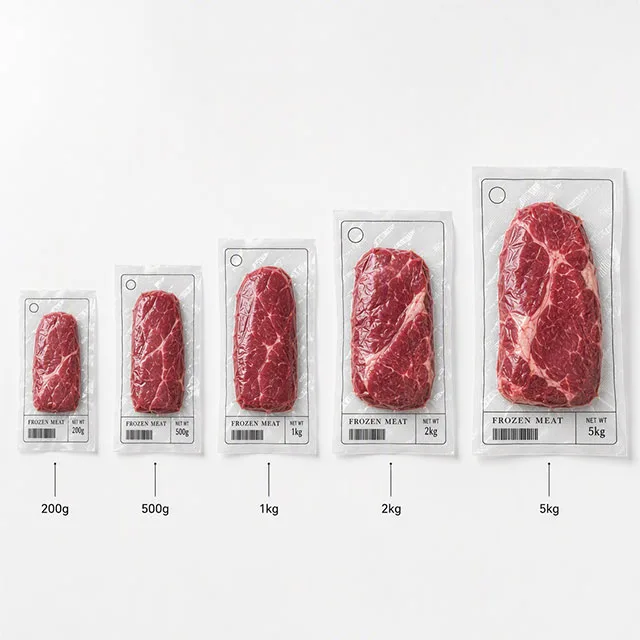
  • 200g
  • 500g
  • 1kg
  • 2kg
  • 5kg
  • Custom Size Available

Shipping

Express (DHL/FedEx/UPS), Sea Freight, Air Freight

Payment Terms

T/T (Bank Transfer), L/C at Sight, PayPal, Western Union, Alibaba Trade Assurance

Lead Time

Samples: 3-5 working days | Mass Production: 15-25 working days

Samples

Contact us for FREE samples
Contact Us WhatsApp

Product Description

BOPA Structural Layer for Puncture Resistance and Low-Temp Toughness

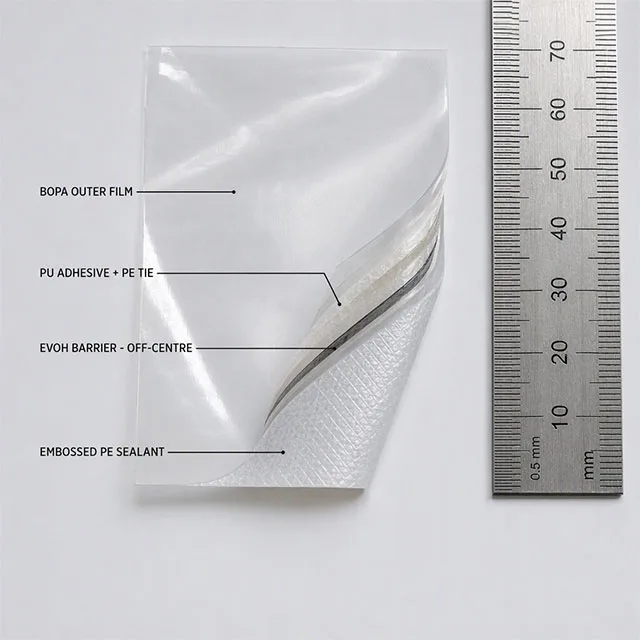
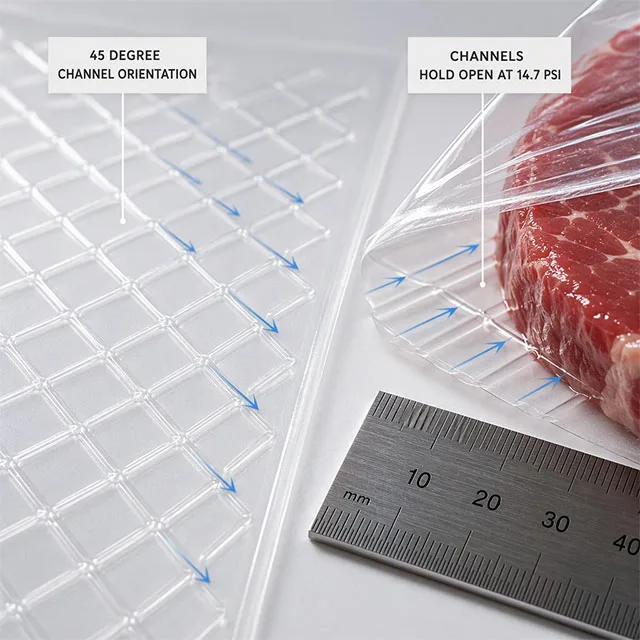
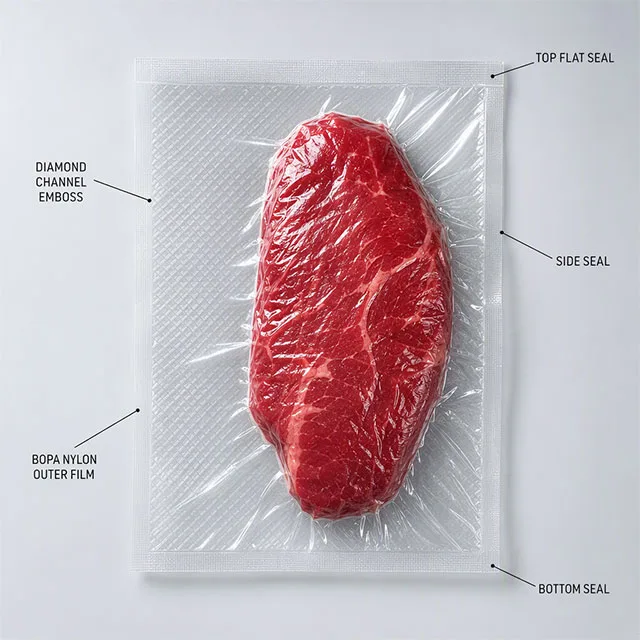
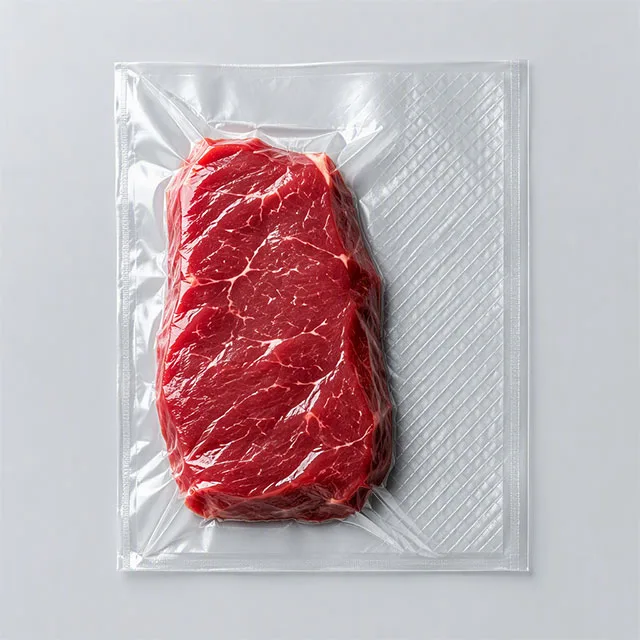
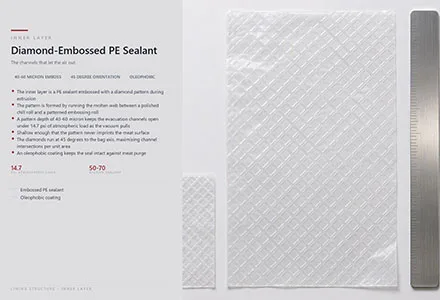
The vacuum channel architecture is the most visually distinctive feature of a meat vacuum bag: a diamond-embossed pattern on the inner film surface creates a network of interconnected micro-channels that allow air to be evacuated from every area of the bag, even when the two film surfaces are pressed together by external atmospheric pressure. Without these channels, the flat film surfaces would seal against each other prematurely during vacuum evacuation, trapping pockets of residual air — and the oxygen in those pockets would immediately begin the chemical chain reaction that converts oxymyoglobin to metmyoglobin, the brown pigment that consumers interpret as spoilage. The emboss pattern geometry is engineer-optimized: the diamond orientation at 45° to the bag axis maximizes the number of channel intersections per unit area, providing redundant evacuation paths so that a blocked channel (e.g., by a meat surface irregularity) does not isolate an entire section of the bag.

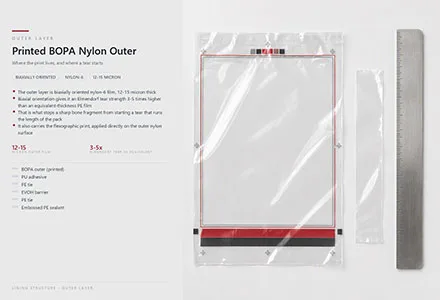
The structural layer is a biaxially oriented nylon (BOPA) film — nylon-6, specifically — chosen for its exceptional combination of puncture resistance, oxygen barrier, and low-temperature toughness. Nylon’s puncture resistance is measured by the Elmendorf tear test at values 3-5x higher than equivalent-thickness polyethylene, which matters critically when vacuum-packaging bone-in cuts where sharp edges can concentrate pressure to thousands of PSI at the sub-millimeter scale. At -40°C deep-freeze conditions, nylon retains >80% of its room-temperature impact strength, compared to standard PE which loses >60%. The oleophobic inner coating — a fluoropolymer treatment applied at sub-micron thickness — prevents the adhesion of frozen meat tissue to the film surface, eliminating the problem of film fragments tearing away and remaining on the meat surface when the package is opened. Key applications: beef primal cuts, pork ribs, lamb racks, bone-in chicken, and game meats.

Product Description

Specifications

Customizable Color & Size Options for Every Market Need
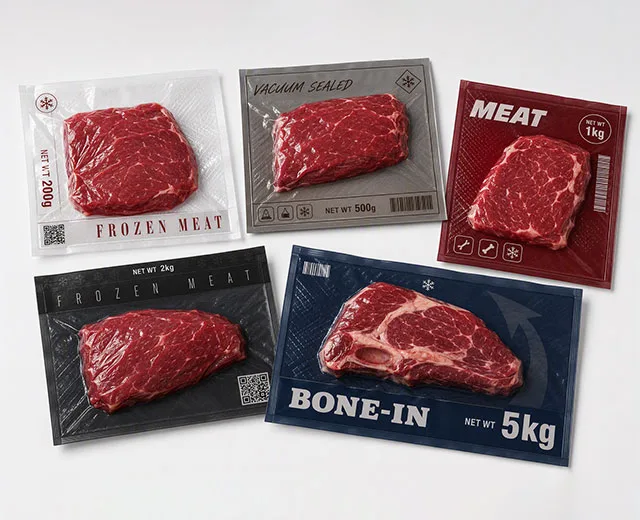
Color Size
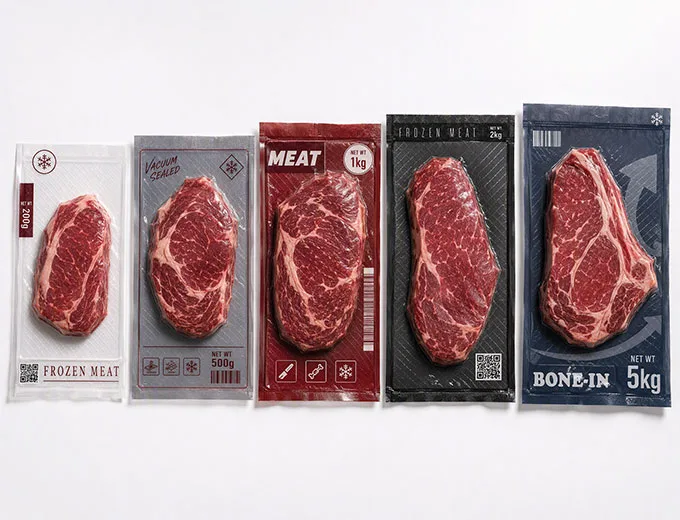
Transparent Clear 200g
Smoky Grey 500g
Deep Red 1kg
Black 2kg
Navy Blue 5kg
Custom Color Available Custom Size Available

Printing Process

Complementary Color Strategy and Dual-Cure Purge Resistance
Printing Process

Meat vacuum bag printing operates in a visual environment where the product — not the package — is the primary visual signal. Unlike snack or coffee packaging where the bag itself carries the entire brand message, meat vacuum packaging is typically transparent or semi-transparent to showcase the product quality, with printing confined to a perimeter frame, a bottom banner, or a discrete label panel. This constrained real estate demands that every square centimeter of print communicates with maximum efficiency.

Our flexographic printing process on the outer nylon surface achieves the register precision required for small-format graphics through a closed-loop automatic register control system that monitors print-to-print registration at each station using high-speed cameras and servo-adjusted plate cylinders. The system maintains register accuracy within ±0.1mm at line speeds up to 200 meters per minute — performance that is critical when the total printable area may be as narrow as a 15mm header strip where brand logo, product name, weight declaration, and USDA/FDA required information must all fit legibly.

The color strategy for meat packaging diverges from the bright, saturated palettes used in snack and beverage categories. Deep crimson reds, rich burgundies, and charcoal greys complement the natural meat color rather than competing with it — a design principle validated by eye-tracking studies showing that consumers spend 60-70% of their visual attention on the visible product and only 30-40% on the printed graphics. The ink system uses a dual-cure mechanism: UV-initiated polymerization followed by thermal post-cure, producing an ink film with the chemical resistance to withstand contact with meat purge (the protein-rich liquid that exudes from vacuum-packed meat) without softening, swelling, or delaminating — a failure mode that standard flexo inks experience within 48 hours of meat contact.

Lining Decoration

Asymmetric 7-Layer Structure to Minimize Oxygen Reservoir
Outer Layer

Outer Layer

Diamond-Embossed PE Sealant
Outer Layer

Middle Layer

Asymmetrical EVOH Barrier
Contact Layer

Contact Layer

Printed BOPA Nylon Outer

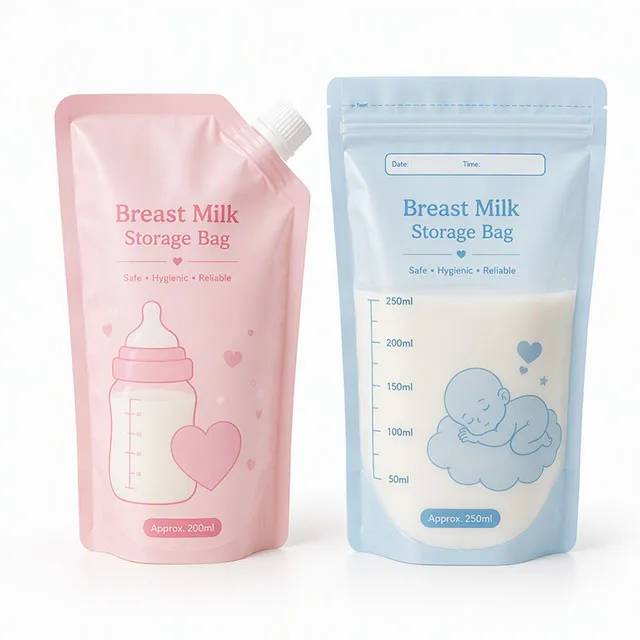
The lining structure of a breast milk storage bag represents the apex of food-contact safety engineering in flexible packaging. The inner layer — the only surface that contacts the stored milk — must be free of bisphenol A (BPA), bisphenol S (BPS), phthalates, and per- and polyfluoroalkyl substances (PFAS), verified through independent third-party laboratory testing using liquid chromatography-mass spectrometry (LC-MS) with detection limits below 1 part per billion.

The inner sealant is a medical-grade low-density polyethylene (LDPE) produced under ISO 13485 quality management system certification — the standard for medical device manufacturing, one tier above the ISO 9001 certification typical of food packaging. This LDPE grade is manufactured without the use of slip agents (erucamide, oleamide) or antiblock additives (silica, talc) that are standard in food packaging PE formulations, because these migratory additives — while food-safe for adult consumption — have not been evaluated for infant exposure through human milk.

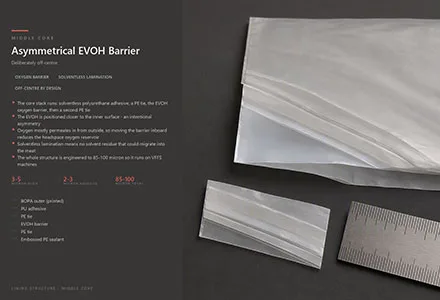
Beneath the inner PE layer, a middle layer of EVOH provides oxygen barrier that prevents oxidative degradation of polyunsaturated fatty acids (DHA, ARA) and fat-soluble vitamins (A, D, E, K) in stored milk — nutrients that are critical for infant neurological development and that degrade measurably after 48 hours in non-barrier storage bags. The outer structural layer is a tough, puncture-resistant nylon/PE laminate that prevents the sharp ice-crystal punctures that can occur when frozen bags are stacked or jostled in a crowded home freezer. Total thickness of 90-110 microns is optimized to be thin enough for rapid thawing via water bath while thick enough to prevent pinhole leaks.

Get In Touch With Us

Reach out for any inquiries, support, or to discuss how we can meet your industrial needs.
  • Address

    North Side Of Nanyi Road, Shiwan Town Science And Technology Park (10th Floor, Building 1, No. 13)

Contact Me

    You can upload a PDF or an image(max 5MB)

    INQUIRY