Hot & Cold Thermal Bags, Insulated Mailers & Cold Chain Delivery Packaging

Fertilizer, Pesticide & Agrochemical Packaging

Cleaner, Laundry & Air Care Packaging

Custom Medical Packaging Solutions

Protective Structures, Inserts and Retail Packs

Custom Protein Powder Pouches, Vitamin Stick Packs & Nutrition Bar Bags

Cosmetics, Fragrance and Skincare Packaging

Takeout, Bakery and Beverage Packaging

Kibble, treat & wet food packaging
The frozen popsicle bag occupies a unique position in flexible packaging: it is one of the few formats where the packaged product undergoes a complete phase change — from liquid to solid — after the package is sealed, and the film must accommodate the 9% volumetric expansion of water as it crystallizes into ice without rupturing, leaking, or losing seal integrity. This seemingly simple requirement drives material selection into a narrow class of polymers that retain ductility at sub-zero temperatures.
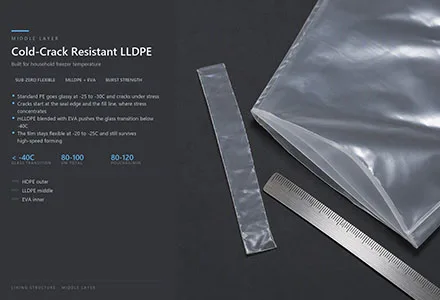
Standard polyethylene films undergo a glass transition at approximately -25°C to -30°C, below which they become brittle and susceptible to cold-crack failure — a catastrophic rupture that propagates from microscopic stress concentrations at the seal edge or fill-line interface. Our solution uses a metallocene-catalyzed LLDPE (mLLDPE) blended with EVA (ethylene-vinyl acetate) copolymer, which depresses the glass transition temperature to below -40°C through the disruption of crystalline domains by the vinyl acetate side groups. The result is a film that remains flexible, elastic, and crack-resistant even at the -20°C to -25°C typical of household freezers.
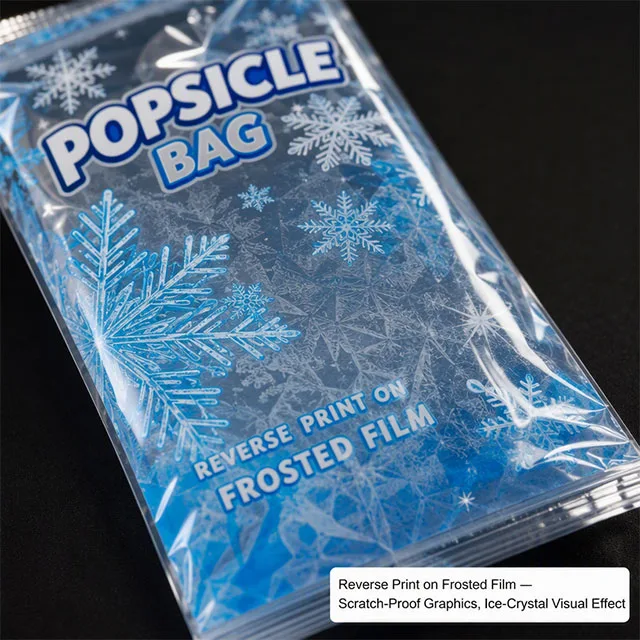
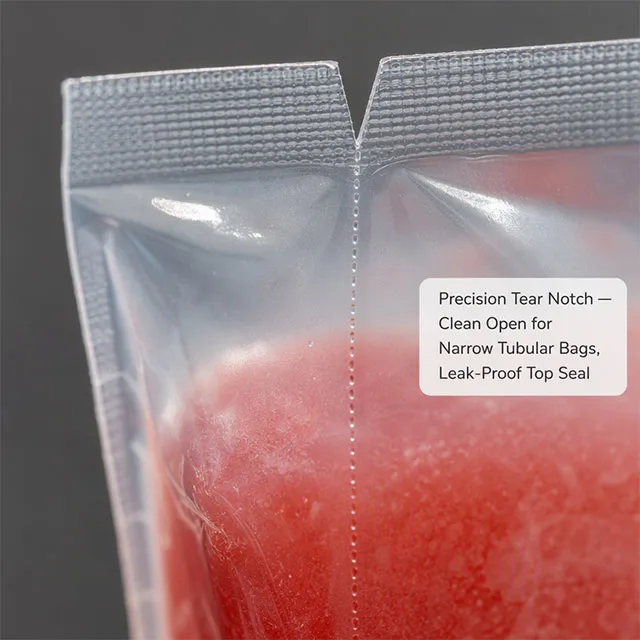
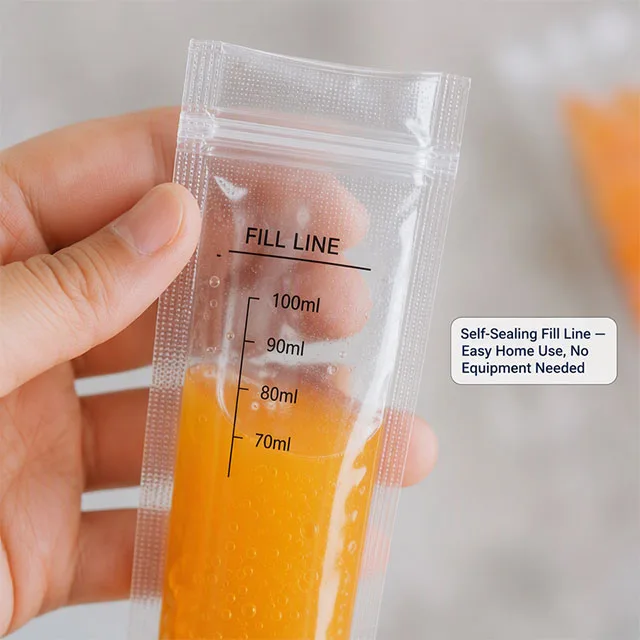
The tubular extrusion process eliminates longitudinal side seams entirely — the film emerges from the annular die as a continuous tube, which is then cut and bottom-sealed. This seam-free cylindrical geometry distributes the expansion stress uniformly around the circumference rather than concentrating it at a weak seam line. The transverse bottom seal uses a specialized impulse-sealing profile with a rounded inner contour that avoids the sharp corner stress risers characteristic of flat-bar seals. A laser-scored tear notch at the top provides controlled opening without scissors, while the self-sealing fill line printed on the exterior guides the consumer to the correct fill volume — typically 80% of maximum capacity — leaving headspace for expansion. Applications include home-made popsicles, yogurt tubes, freezer pops, ice candy, and frozen cocktail pouches.
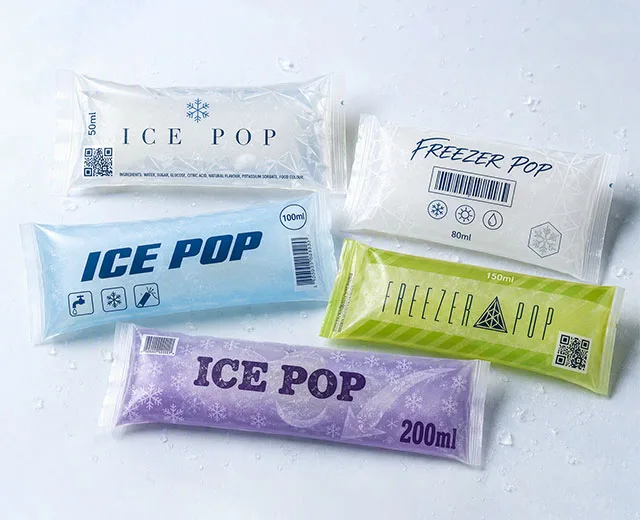
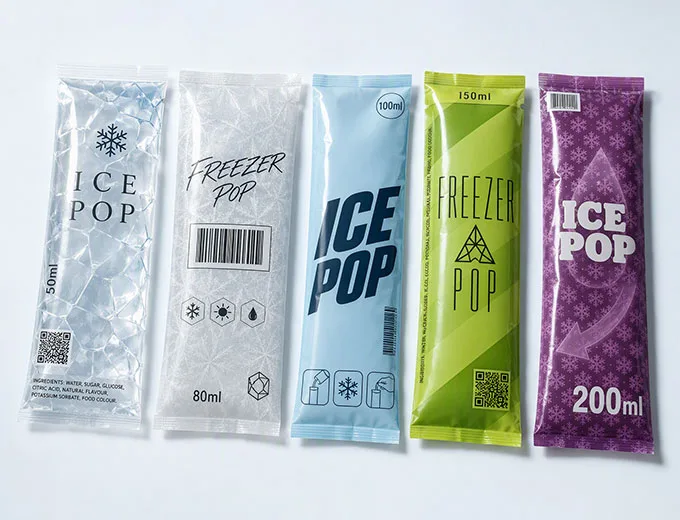
| Color | Size |
| Transparent Clear | 50ml |
| Frosted White | 80ml |
| Ice Blue | 100ml |
| Lime Green | 150ml |
| Berry Purple | 200ml |
| Custom Color Available | Custom Size Available |
Printing on tubular frozen popsicle packaging presents distinctive challenges because the cylindrical substrate curves away from the printing plate throughout the entire print run — there is no flat surface, and the ink must bond to a low-surface-energy polyolefin film that will be subjected to moisture condensation during the freeze-thaw cycle. These constraints make surface pretreatment and ink formulation the two critical determinants of print quality and durability.
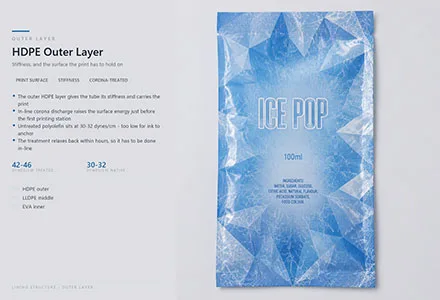
Our rotogravure process begins with in-line corona discharge treatment that raises the film surface energy from its native 30-32 dynes/cm to a stable 42-46 dynes/cm — the minimum threshold for durable ink adhesion on polyolefin substrates. The treatment is applied immediately before the first printing station because corona-treated surfaces experience hydrophobic recovery within hours as low-molecular-weight oligomers migrate back to the surface. This real-time treatment ensures maximum ink anchorage for every meter of film.
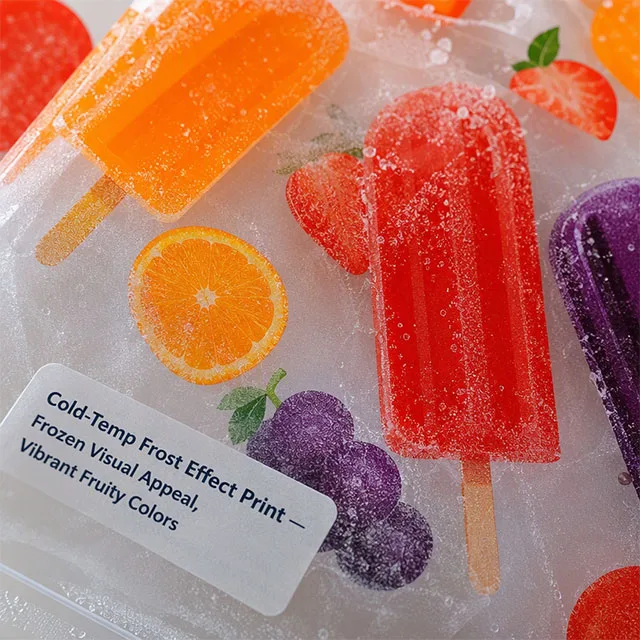
For the popsicle category, we use a specialized low-temperature-cure ink system formulated with polyurethane binders that maintain flexibility at freezer temperatures. Standard nitrocellulose-based gravure inks — perfectly adequate for room-temperature packaging — become brittle and micro-crack at -20°C, creating aesthetic defects and potential delamination points. The polyurethane binder maintains its elastomeric properties across the full temperature range from -30°C to +40°C, so the graphics remain intact through the entire freeze-thaw-consume lifecycle. The color palette favors bright, saturated colors — citrus yellows, berry purples, tropical greens — printed at densities calibrated for maximum impact on the small curved surface of a 50-100ml popsicle tube.
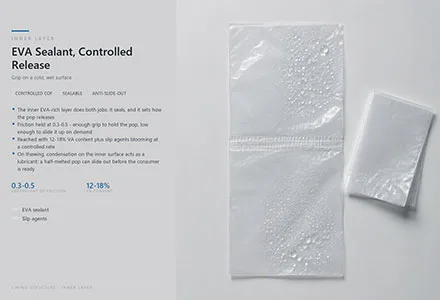
The lining of a frozen popsicle bag must address a problem that room-temperature packaging never encounters: moisture condensation that forms on the inner film surface when the frozen product is removed from the freezer and begins to thaw. This condensation creates a microscopic water layer between the product and the film, which can act as a lubricant causing the partially thawed popsicle to slide out of the tube prematurely — a consumer experience failure that undermines the entire package.
The inner layer is an EVA-rich sealant formulation with a precisely controlled coefficient of friction (COF) in the 0.3-0.5 range — high enough to grip the frozen product securely during handling, but low enough to allow controlled release as the product is pushed upward from the bottom. This balance is achieved through a specific VA content (typically 12-18%) and the addition of slip agents that bloom to the surface at controlled rates during aging.
The film structure is a 3-layer co-extrusion: outer HDPE for stiffness and print surface, middle LLDPE for toughness and cold-crack resistance, and inner EVA-rich layer for sealability and controlled release. The total thickness of 80-100 microns is engineered to provide sufficient burst strength during the freezing expansion cycle while remaining thin enough for cost-effective high-speed vertical form-fill-seal operation at 80-120 pouches per minute.
North Side Of Nanyi Road, Shiwan Town Science And Technology Park (10th Floor, Building 1, No. 13)
INQUIRY