Hot & Cold Thermal Bags, Insulated Mailers & Cold Chain Delivery Packaging

Fertilizer, Pesticide & Agrochemical Packaging

Cleaner, Laundry & Air Care Packaging

Custom Medical Packaging Solutions

Protective Structures, Inserts and Retail Packs

Custom Protein Powder Pouches, Vitamin Stick Packs & Nutrition Bar Bags

Cosmetics, Fragrance and Skincare Packaging

Takeout, Bakery and Beverage Packaging

Kibble, treat & wet food packaging
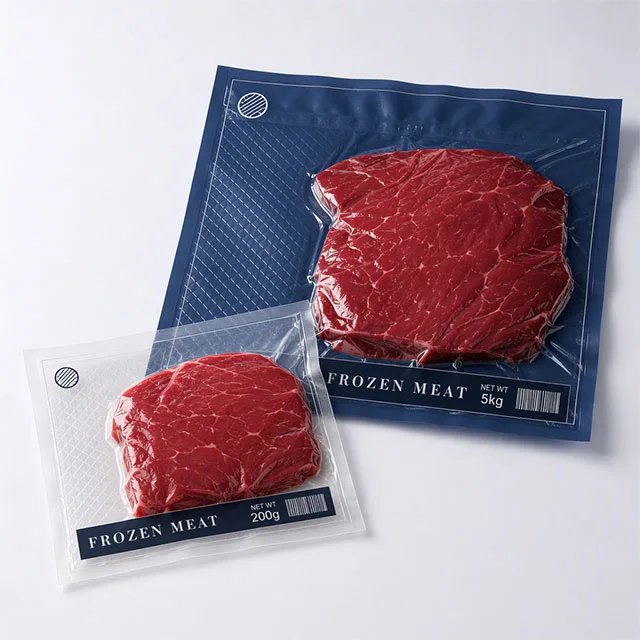
The frozen food bag addresses the single most pernicious quality defect in the frozen food industry: freezer burn. Despite being one of the most successful food preservation technologies ever developed — extending shelf life from days to months — freezing introduces a dehydration mechanism that progressively degrades texture, flavor, and appearance. Understanding this mechanism is essential to understanding why our frozen food bag is engineered the way it is.
Freezer burn is not, as commonly believed, the result of low temperature itself. It is caused by sublimation — the direct phase transition of ice from solid to vapor without passing through the liquid phase. Inside a frozen food package, microscopic ice crystals on the food surface sublimate into water vapor, which then migrates through the headspace and re-deposits as larger ice crystals on the coldest available surface: the inner wall of the packaging film. Every cycle of this process removes moisture from the food and transfers it to the package interior, leaving behind the desiccated, leathery, discolored patches that define freezer burn. The rate is accelerated by temperature fluctuations during the defrost cycles of automatic-defrosting freezers.
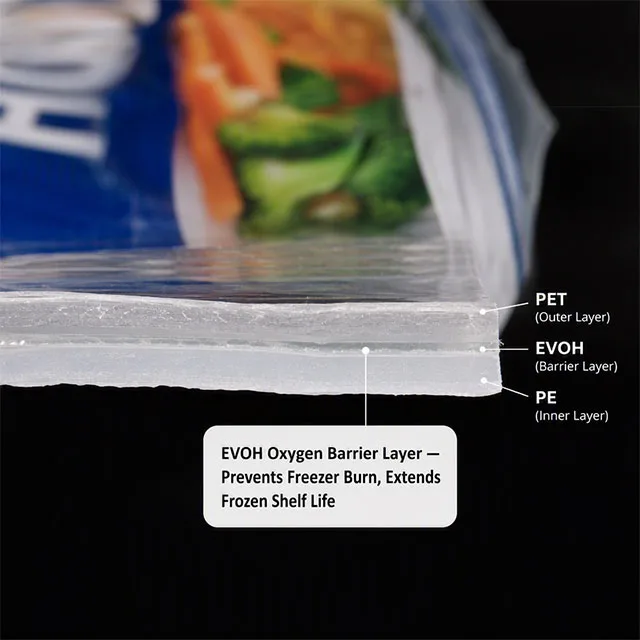
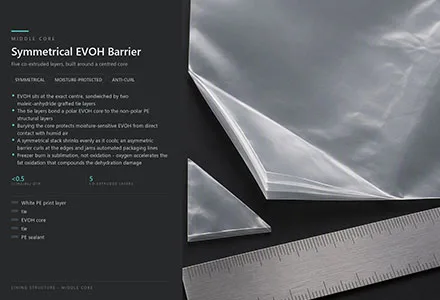
The solution requires an oxygen barrier layer — counterintuitively, because freezer burn is a moisture problem, not an oxidation problem. However, oxygen catalyzes the oxidation of unsaturated fats even at freezer temperatures, and lipid oxidation products accelerate protein denaturation, compounding the dehydration damage. Our EVOH (ethylene vinyl alcohol) barrier layer delivers oxygen transmission rates below 0.5 cc/m²/day, effectively eliminating oxidative co-damage. The EVOH is co-extruded between two tie layers of maleic anhydride-grafted PE that bond the polar EVOH to the non-polar polyethylene structural layers — a buried barrier architecture that protects the moisture-sensitive EVOH from direct contact with high-humidity environments that would otherwise plasticize and degrade its barrier performance.
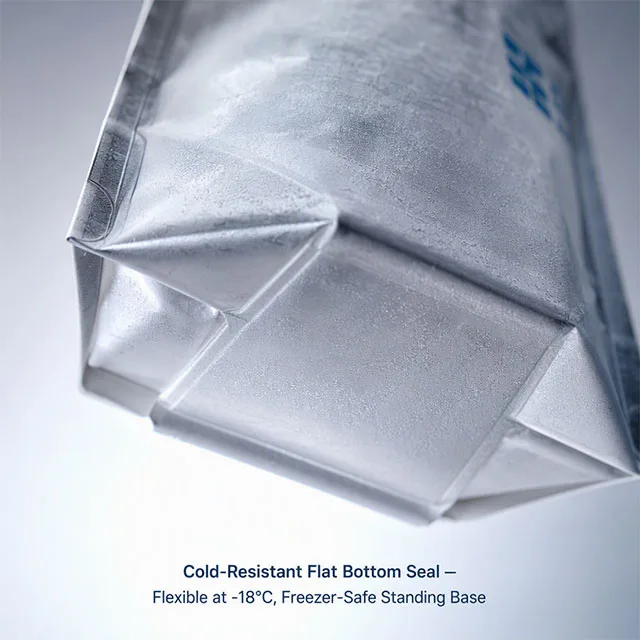
The outer structural layers incorporate a low-temperature impact modifier that shifts the ductile-to-brittle transition temperature well below -20°C, ensuring the film absorbs impact energy — from stacking, transport vibration, and consumer handling — without crack initiation. Key applications: frozen vegetables, frozen fruits, frozen prepared meals, frozen seafood, and frozen bakery products.
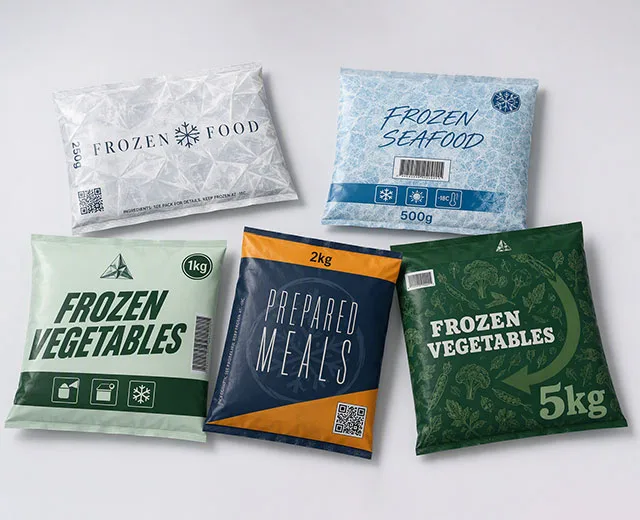
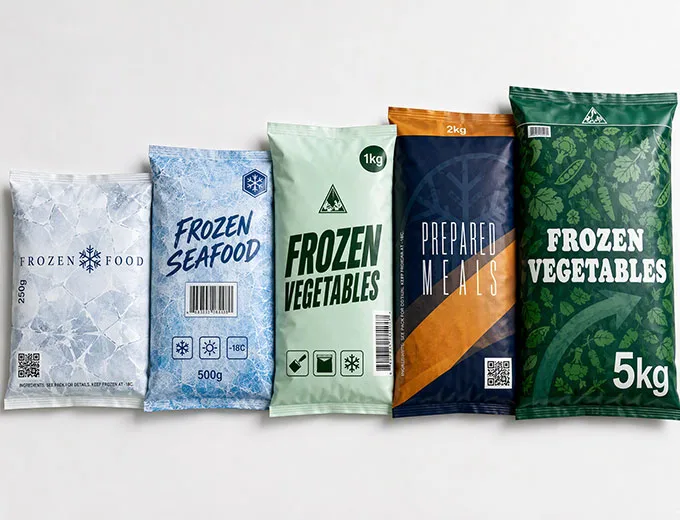
| Color | Size |
| Frost White | 250g |
| Ice Blue | 500g |
| Mint Green | 1kg |
| Deep Navy | 2kg |
| Forest Green | 5kg |
| Custom Color Available | Custom Size Available |
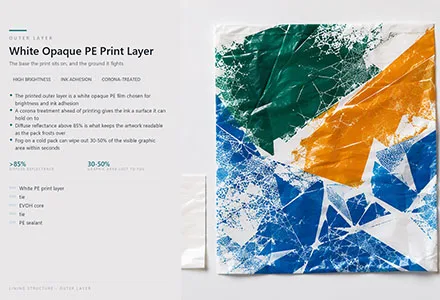
The visual communication challenge of frozen food packaging is unique in the grocery environment: the product must communicate appetite appeal — sizzling, steaming, fresh-from-the-oven imagery — through a film surface that will be covered in frost and fog the moment the package is removed from the freezer case. This condensation masking effect can reduce the visible graphic area by 30-50% within seconds of ambient exposure, making ink density and contrast-ratio engineering critical for frozen food brands.
Our rotogravure process on white PE substrate addresses this through multilayer ink laydown at densities 20-30% above conventional packaging print. The white base film itself contributes a diffuse reflectance of >85%, creating a bright canvas that punches through condensation better than transparent or metallized substrates, where frost scatters light and obscures the image. When a frozen vegetable bag goes from the freezer to the consumer’s cart, the 30 seconds of fogging is a make-or-break moment for brand recognition — the graphic must remain legible through the condensation layer.
The color palette for frozen food is deliberately engineered for high chroma and strong value contrast: deep forest greens for vegetable products, warm amber-orange tones for prepared meals, cool ocean blues for seafood. These choices are not merely aesthetic — they trigger the cross-modal sensory associations that compensate for the consumer’s inability to smell or taste the frozen product at the point of purchase. The gloss level is specified as semi-matte (60° gloss reading of 40-50 GU) — brighter than a fully matte finish to enhance color saturation, but not so glossy that condensation forms discrete water droplets that act as miniature lenses, distorting the printed image underneath.
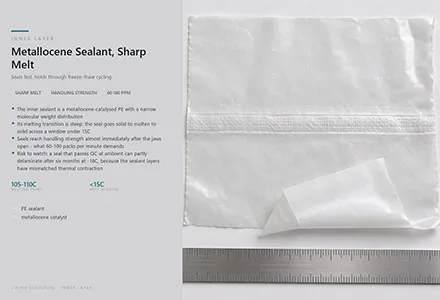
The inner lining of a frozen food bag must solve a seemingly simple but technically demanding problem: maintaining heat-seal integrity through the freeze-thaw-refreeze cycle that frozen food packaging experiences during distribution and consumer handling. A seal that passes QC at the factory at ambient temperature may partially delaminate after 6 months at -18°C due to differential thermal contraction between sealant layers with mismatched coefficients of thermal expansion.
The structure begins with the outer printed layer — a white opaque PE film selected for its high brightness and excellent ink adhesion after corona treatment. The middle layers form the functional core: a symmetrical PE/tie/EVOH/tie/PE 5-layer co-extrusion where the EVOH oxygen barrier is centrally positioned and moisture-protected on both sides. This symmetrical architecture prevents curling — a common defect in asymmetrical barrier films where differential shrinkage on cooling causes the film to roll up at the edges, jamming automated packaging lines.
The inner sealant layer uses a metallocene-catalyzed PE with a precisely controlled melting point of 105-110°C and a narrow molecular weight distribution that provides a sharp melting transition — the seal goes from solid to molten and back to solid across a temperature window of less than 15°C. This sharp transition enables the high-speed sealing cycles required for frozen food packaging lines (60-100 packages per minute) because the seal solidifies rapidly after the heat-seal jaws open, reaching handling strength almost immediately.
North Side Of Nanyi Road, Shiwan Town Science And Technology Park (10th Floor, Building 1, No. 13)
INQUIRY