Hot & Cold Thermal Bags, Insulated Mailers & Cold Chain Delivery Packaging

Fertilizer, Pesticide & Agrochemical Packaging

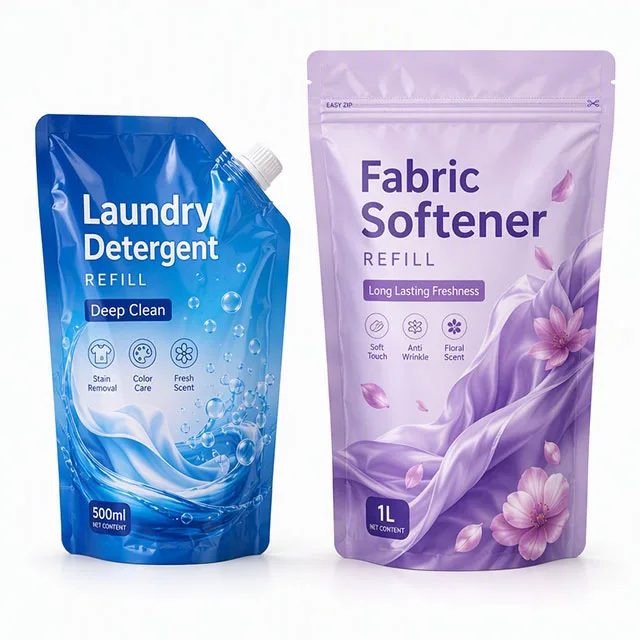
Cleaner, Laundry & Air Care Packaging

Custom Medical Packaging Solutions

Protective Structures, Inserts and Retail Packs

Custom Protein Powder Pouches, Vitamin Stick Packs & Nutrition Bar Bags

Cosmetics, Fragrance and Skincare Packaging

Takeout, Bakery and Beverage Packaging

Kibble, treat & wet food packaging
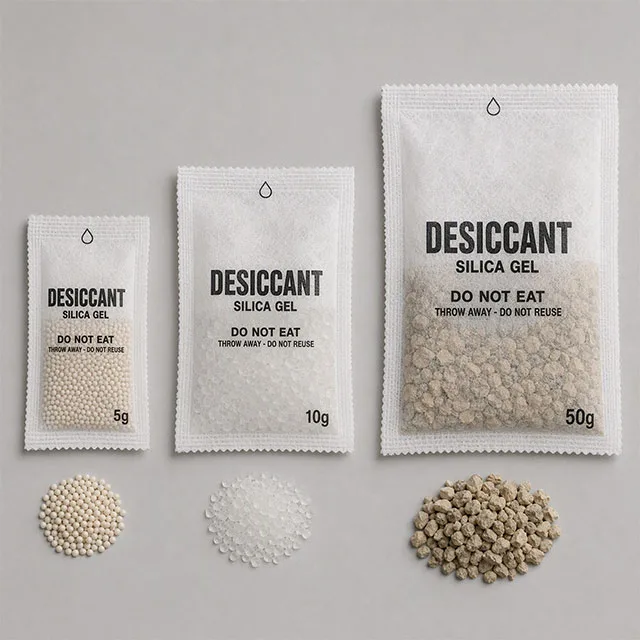
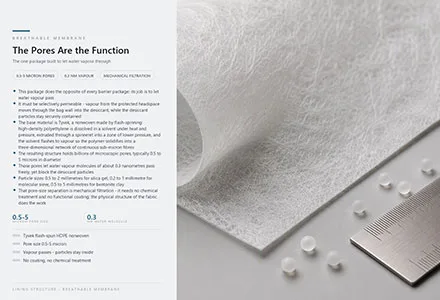
The industrial desiccant and moisture-control bag represents a paradox in packaging design: its primary function is to allow the passage of water vapor — the very molecule that every other flexible package is engineered to block. Unlike barrier packaging that seals the product hermetically against moisture ingress, a desiccant bag must be selectively permeable, allowing water vapor from the protected headspace to pass through the bag wall and be absorbed by the desiccant material inside, while simultaneously containing the desiccant particles (which may be dust-producing, corrosive, or staining) securely within the package. This selective permeability — high WVTR combined with particle containment — requires a fundamentally different material solution than conventional flexible packaging.
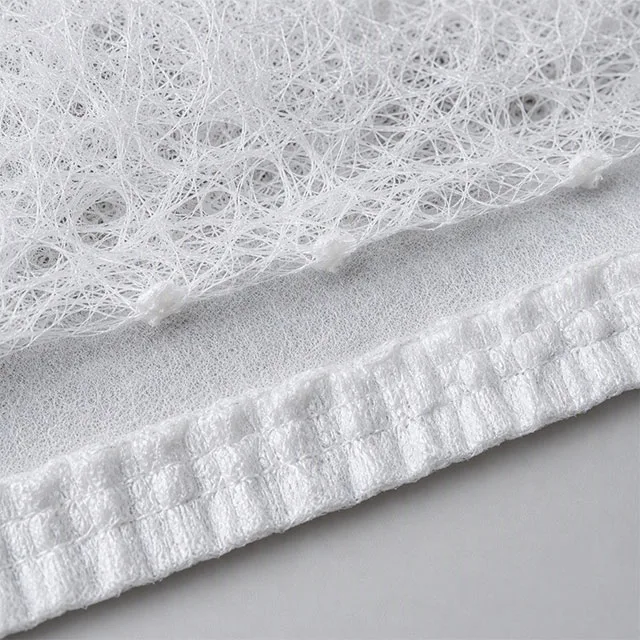
The key material is Tyvek, a nonwoven fabric produced by DuPont through a flash-spinning process in which high-density polyethylene (HDPE) fibers are formed by dissolving the polymer in a solvent under heat and pressure, then extruding the solution through a spinneret into a zone of lower pressure where the solvent flashes to vapor and the polymer solidifies into a three-dimensional network of continuous, sub-micron fibers. The resulting structure contains billions of microscopic pores — typically 0.5-5 microns in diameter — that are large enough to allow water vapor molecules (approximately 0.3 nanometers in diameter) to pass freely, but small enough to physically block desiccant particles (typically 0.5-2 millimeters for silica gel, 0.2-1mm for molecular sieve, and 0.5-5mm for bentonite clay). This pore-size-based separation mechanism is called mechanical filtration, and it requires no chemical treatment or functional coating — the physical structure of the Tyvek fabric inherently provides the separation.
The desiccant material selection is application-specific and represents an engineering decision based on the moisture control requirements. Silica gel (amorphous silicon dioxide, SiO₂·nH₂O) is the most common desiccant for general-purpose moisture protection, with an adsorption capacity of 35-40% of its weight at 90% RH and the ability to maintain relative humidity below 40% in a sealed environment — the threshold below which most corrosion mechanisms (particularly for ferrous metals) are effectively halted. Molecular sieve (synthetic zeolites with precisely controlled pore sizes of 3, 4, 5, or 10 angstroms) provides deeper dehydration — capable of reducing dew points to -40°C or below — and is specified for electronics, pharmaceuticals, and optical components where even trace moisture causes irreversible damage. Bentonite clay (montmorillonite) is the economic option for bulk industrial applications where cost-per-gram-adsorbed is the primary driver and ultra-low humidity is not required.
The humidity indicator — a chemical compound that changes color at a specific relative humidity threshold — provides visual confirmation of desiccant status. Traditional cobalt chloride (blue when dry, pink when hydrated at RH >20%) has been phased out under EU REACH regulation due to cobalt’s classification as a Category 1B carcinogen by inhalation. Our replacement uses an iron-based indicator (iron ammonium sulfate with a color transition from amber/yellow at <20% RH to orange/red at >60% RH) that provides equivalent visual indication without the regulatory liability.
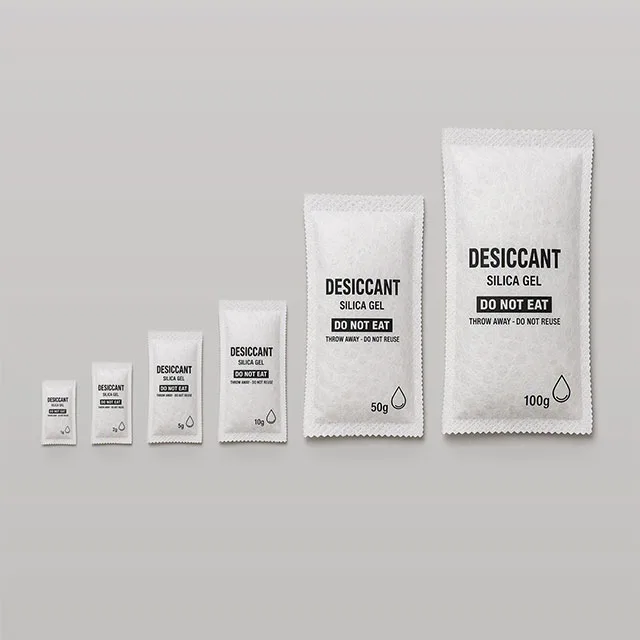
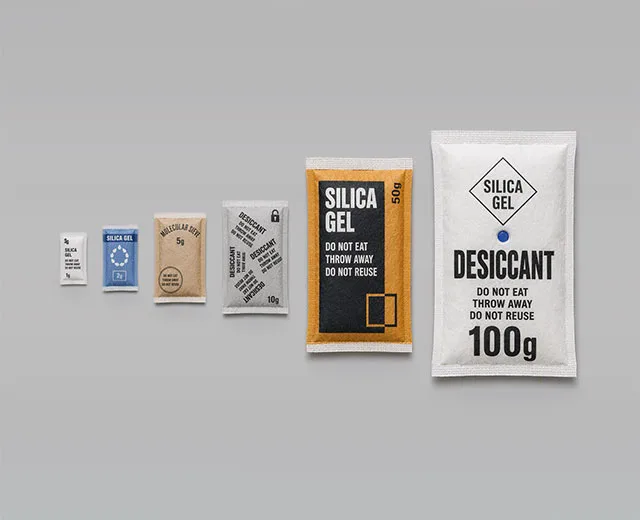
| Color | Size |
| Medical White Tyvek | 1g |
| Industrial Blue | 2g |
| Natural Kraft | 5g |
| Clean Grey | 10g |
| Amber | 50g |
| Custom Color Available | 100g |
| Custom Size Available |
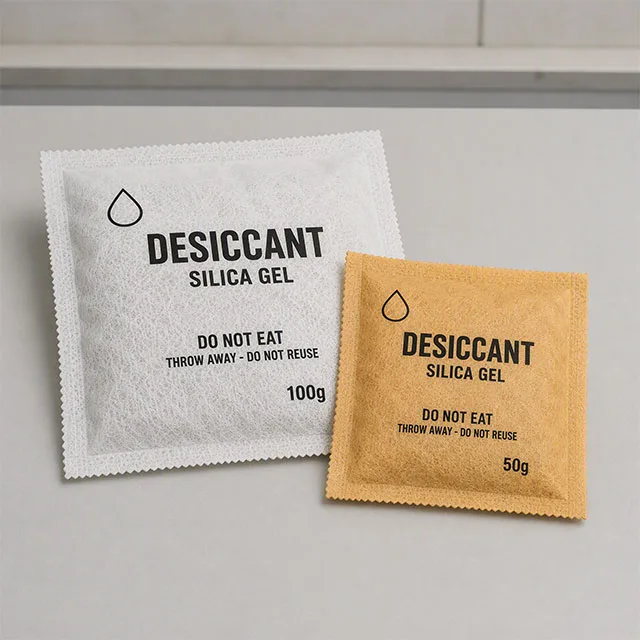
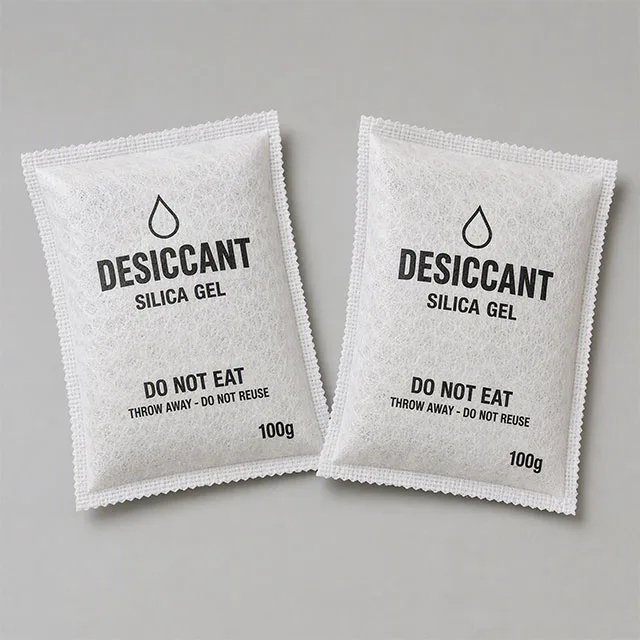
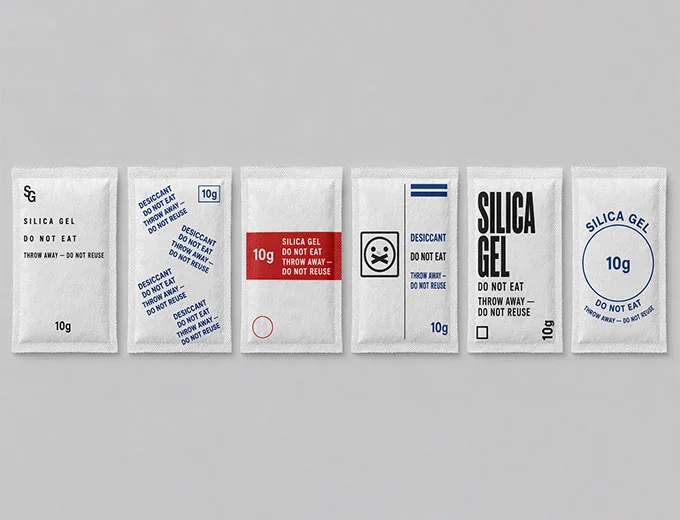
Printing on desiccant bags occupies the intersection of functional labeling and regulatory compliance, where the printed information is literally safety-critical. Every desiccant bag sold internationally must carry: (1) the desiccant material identity (“SILICA GEL” or “MOLECULAR SIEVE” — the material name, not the trade name), (2) the “DO NOT EAT” warning in the language(s) of the destination market, (3) the net weight of desiccant in grams, and (4) the phrase “THROW AWAY — DO NOT REUSE” because spent desiccant that has reached its adsorption capacity provides zero moisture protection if reused. Missing any of these four elements is a customs rejection event in multiple jurisdictions.
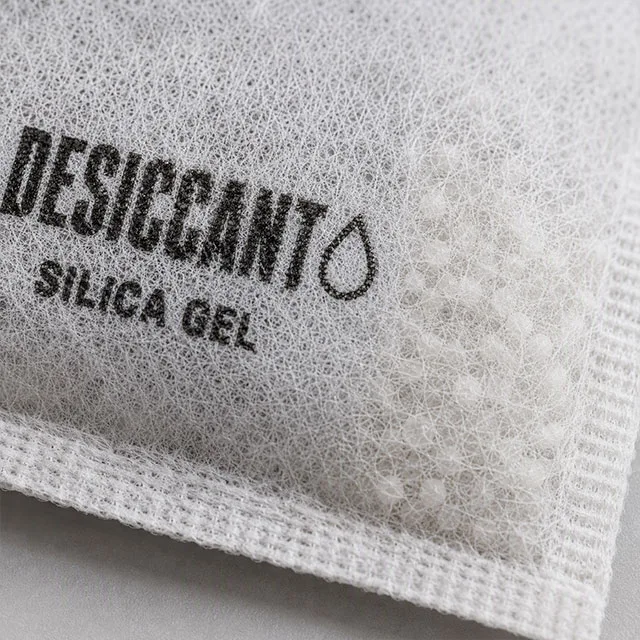
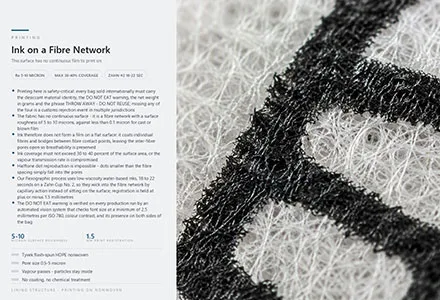
Printing on Tyvek requires a specialized approach because the nonwoven HDPE surface is fundamentally different from a continuous polymer film. Tyvek has no continuous surface — it is a fiber network with a surface roughness (Ra) of 5-10 microns, compared to <0.1 micron for cast or blown film. Ink applied to Tyvek does not form a continuous film on a flat surface; it coats individual fibers, with the ink bridging between fiber contact points and leaving the inter-fiber pores open to maintain breathability. The ink coverage pattern on Tyvek is inherently discontinuous — a fact that determines both print quality (halftone dot reproduction is impossible on Tyvek because dots smaller than the fiber spacing simply fall into pores) and functional performance (ink coverage must not exceed 30-40% of the surface area, or WVTR is compromised).
Our flexographic printing on Tyvek uses low-viscosity water-based inks (Zahn Cup #2: 18-22 seconds) that penetrate into the fiber network through capillary wicking rather than sitting on the surface. The low viscosity is essential — higher-viscosity inks would form a film over the pores, blocking breathability. The color palette is limited to bold, high-contrast solid colors (black, dark blue, red) because fine detail and halftone reproduction are not achievable on Tyvek’s textured surface. Print registration is maintained at ±1.5mm — looser than the ±0.2mm typical of film printing — because the Tyvek substrate has inherent dimensional variability from the flash-spinning process. The critical print element is the “DO NOT EAT” warning, which is verified on every production run using an automated vision system that checks font size (minimum 2.5mm per ISO 780), color contrast, and presence on both sides of the bag.
The lining structure of a desiccant bag is unusual in that the “lining” IS the functional component — there is no separate barrier layer, sealant layer, or decorative layer. The entire package consists of a single material (Tyvek) or a Tyvek/kraft paper laminate, with the desiccant fill sealed inside through heat-sealing of the PE content in the Tyvek fibers.
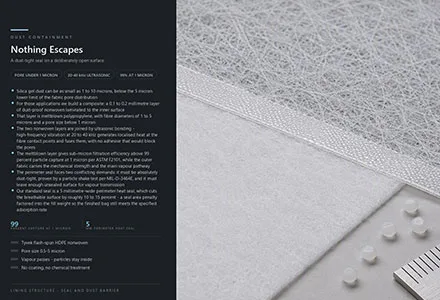
For applications requiring dust containment beyond what Tyvek’s pore size provides — silica gel dust particles can be as small as 1-10 microns, below the 5-micron lower limit of Tyvek’s pore size distribution — we use a composite structure: a thin layer (0.1-0.2mm) of dust-proof nonwoven fabric (meltblown polypropylene with fiber diameter 1-5μm and pore size <1μm) is laminated to the inner surface of the Tyvek through ultrasonic bonding — a process that uses high-frequency (20-40 kHz) mechanical vibration to generate localized heat at the fiber contact points, fusing the two nonwoven layers without the use of adhesives that would block pores. The meltblown layer provides sub-micron filtration efficiency (>99% particle capture at 1μm per ASTM F2101) while the Tyvek provides mechanical strength and the primary WVTR pathway.
The seal construction around the perimeter of the desiccant bag must satisfy two conflicting requirements: it must be absolutely dust-tight (no desiccant particle leakage, verified by a particle shake test per MIL-D-3464E), and it must leave sufficient unsealed Tyvek surface area for moisture vapor transmission. Our standard seal design uses a 5mm-wide perimeter heat seal that reduces the breathable surface area by approximately 10-15% compared to an unsealed bag of the same dimensions — this “seal area penalty” is factored into the desiccant fill weight to ensure the total WVTR of the finished bag meets the specified moisture adsorption rate for the application.
North Side Of Nanyi Road, Shiwan Town Science And Technology Park (10th Floor, Building 1, No. 13)
INQUIRY