Hot & Cold Thermal Bags, Insulated Mailers & Cold Chain Delivery Packaging

Fertilizer, Pesticide & Agrochemical Packaging

Cleaner, Laundry & Air Care Packaging

Custom Medical Packaging Solutions

Protective Structures, Inserts and Retail Packs

Custom Protein Powder Pouches, Vitamin Stick Packs & Nutrition Bar Bags

Cosmetics, Fragrance and Skincare Packaging

Takeout, Bakery and Beverage Packaging

Kibble, treat & wet food packaging
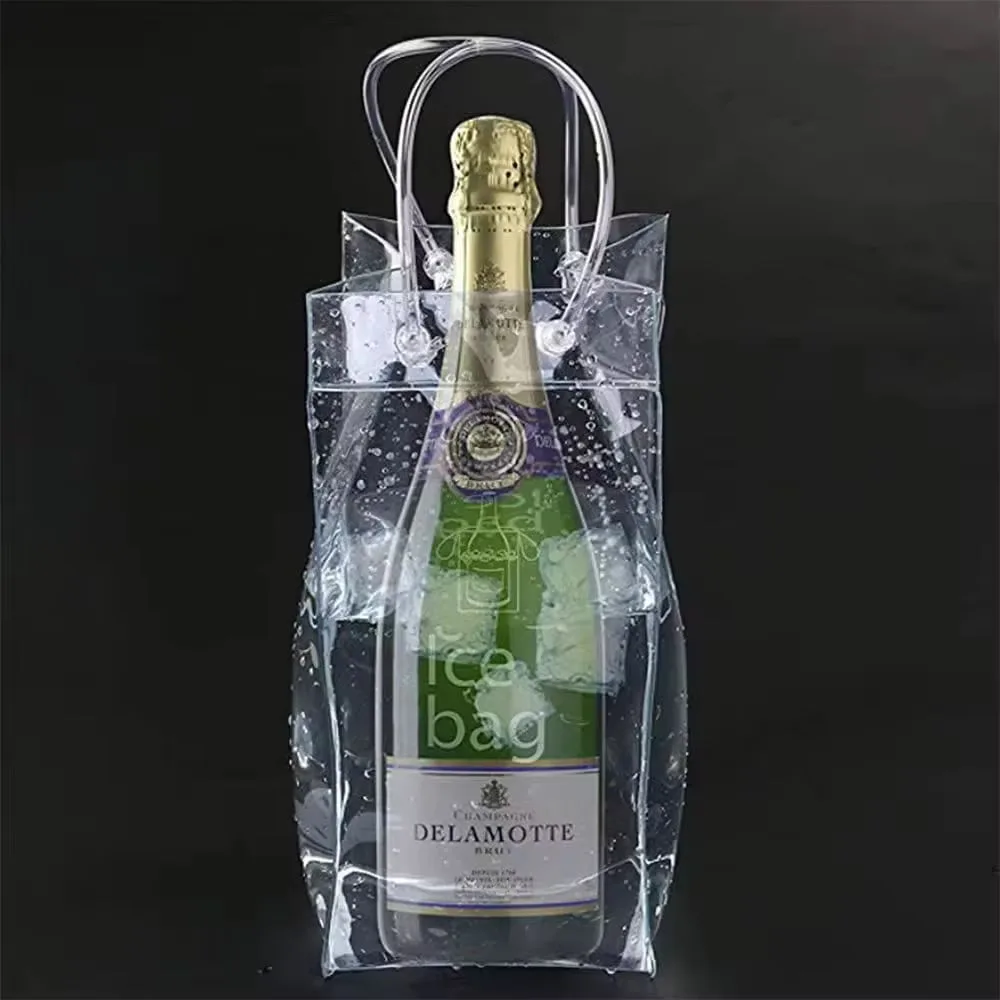
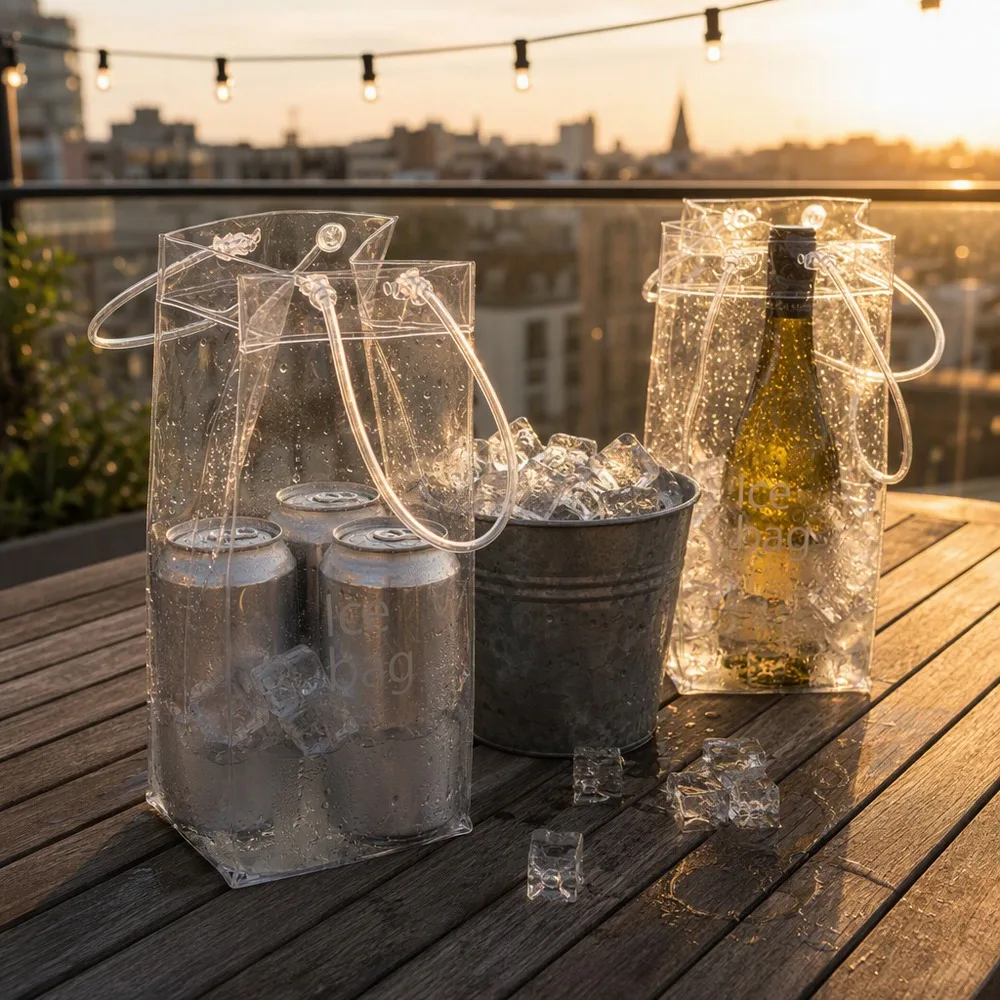
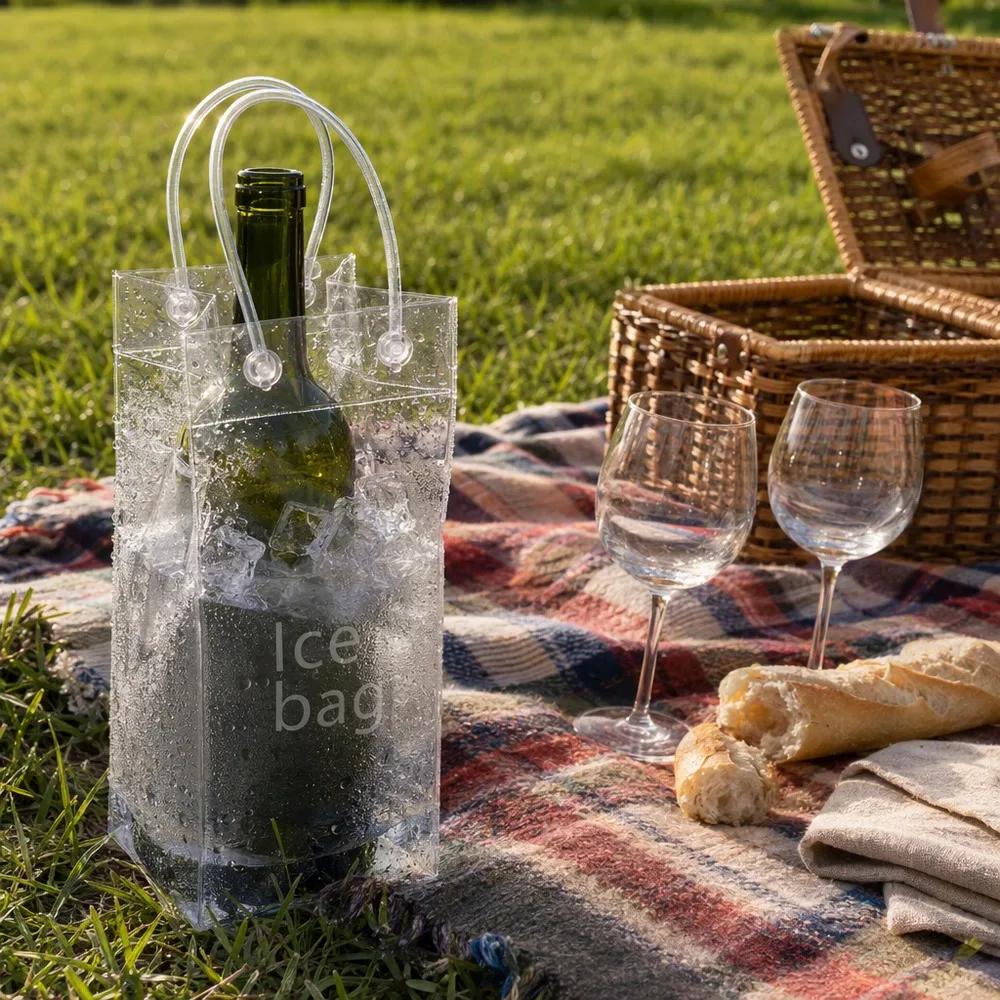
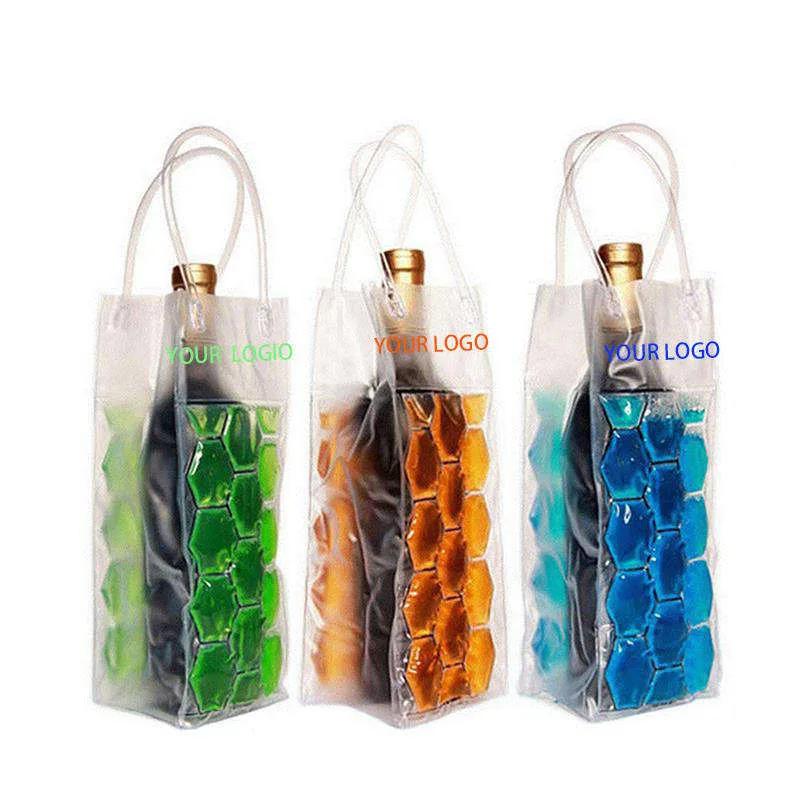
Pour ice into a bag and most of them leak at the bottom seam within the hour. This one is built around that problem: a clear PVC bag with a welded square base, so a bottle and two handfuls of ice stand on the table and the melt stays where it is. The mouth is open, the collar is folded to carry the weight, and the handle is a soft PVC tube welded back into the collar rather than riveted. Nothing is laminated, so the label keeps reading through the wall while the wine chills.
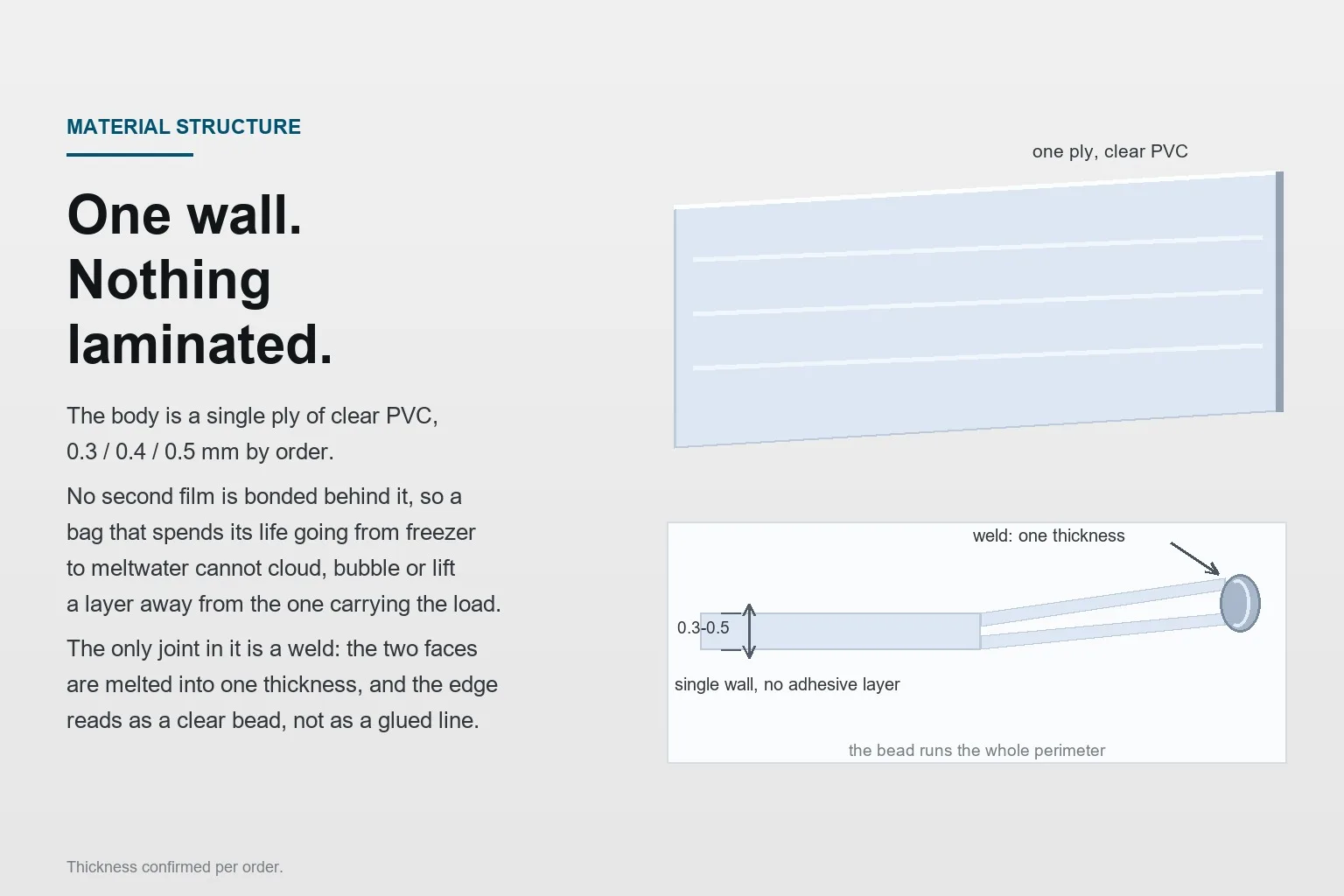
The body is one ply of clear PVC, 0.3 to 0.5 mm by order, with nothing bonded behind it. That matters once the bag is packed with ice: a laminated wall clouds or parts a layer exactly where the bottle is meant to be seen, while a single wall stays clear through a season of meltwater. Every edge is welded, sides and base alike, so a joint is one thickness of PVC rather than an adhesive line.
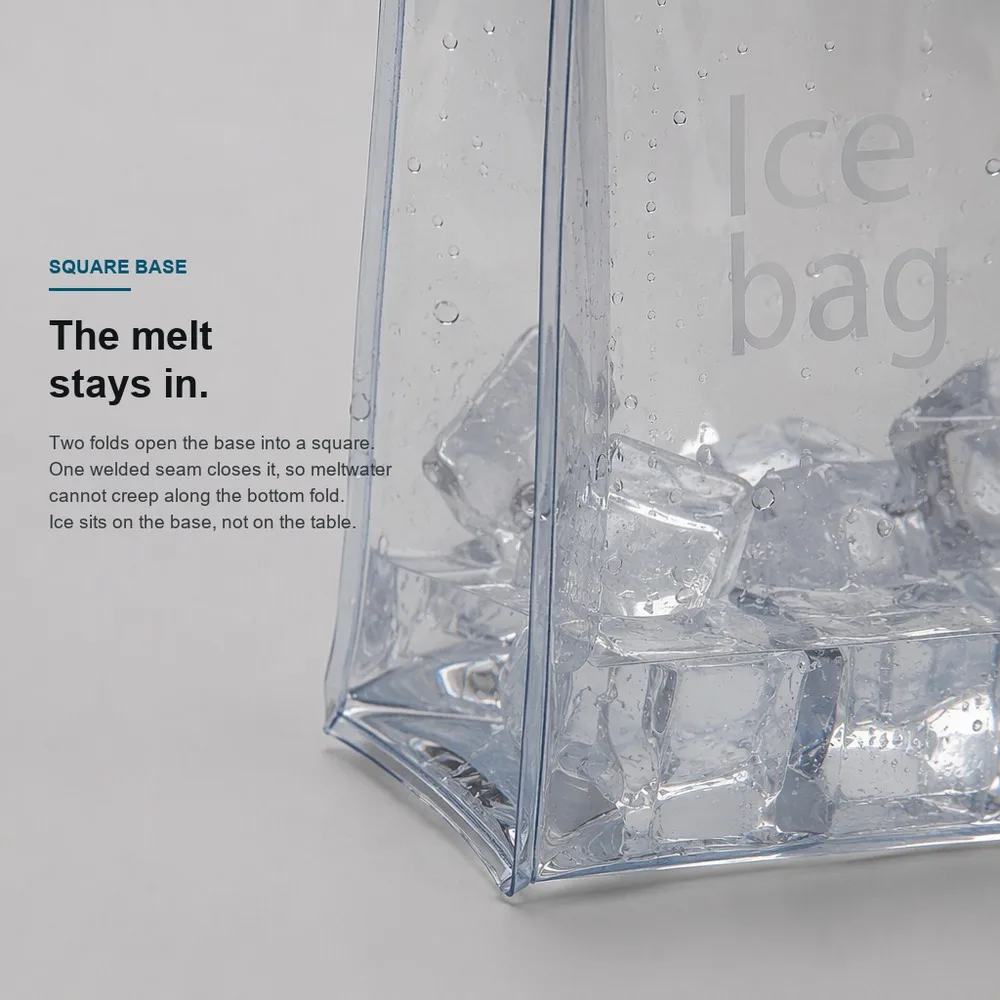
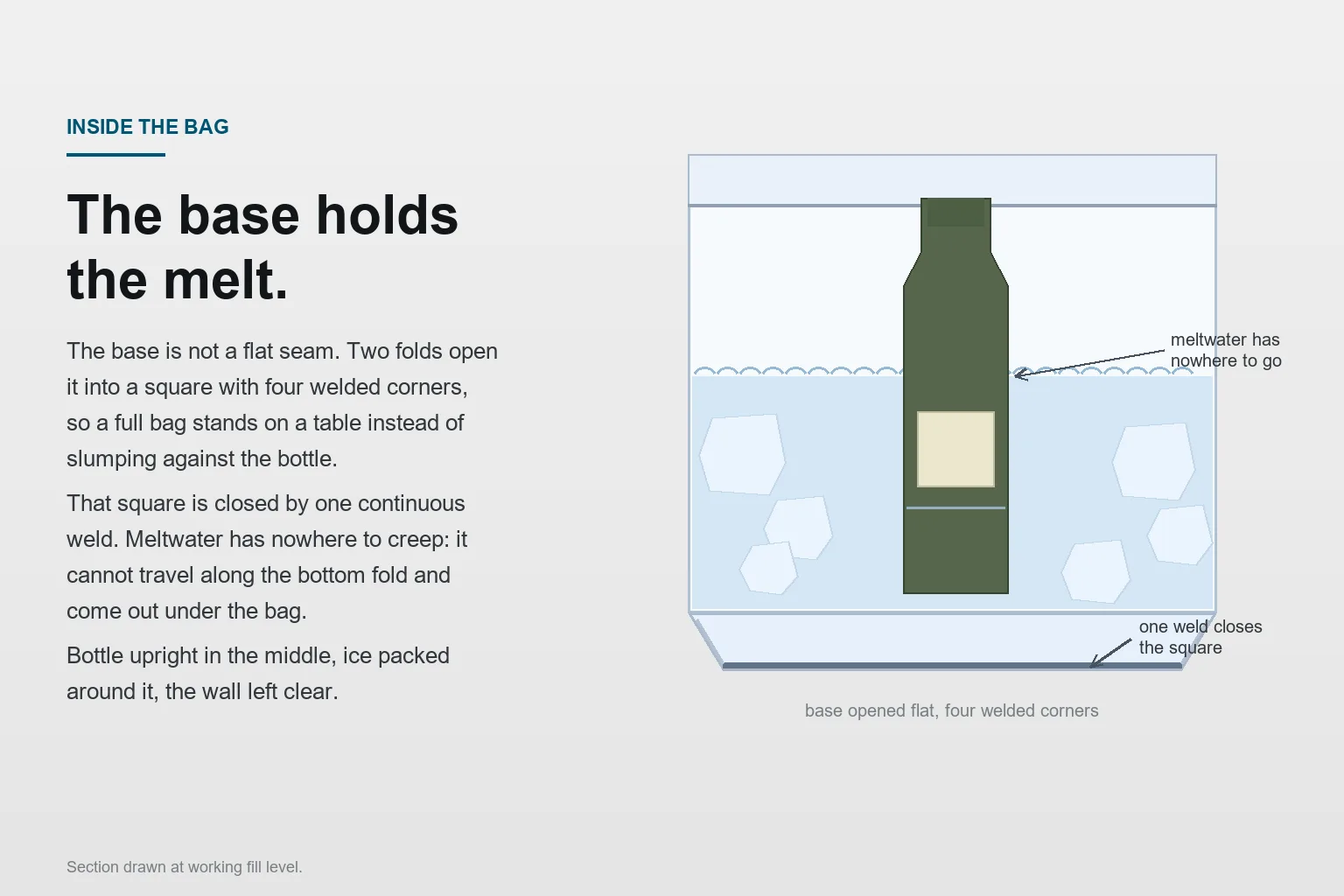
The base is the part that does the work. Two folds open it into a square with four welded corners, so a loaded bag stands on the table instead of slumping against the bottle, and the same square traps the melt. Water cannot travel along the bottom fold and come out underneath the cloth. Ice sits on a welded floor, not in a sleeve.
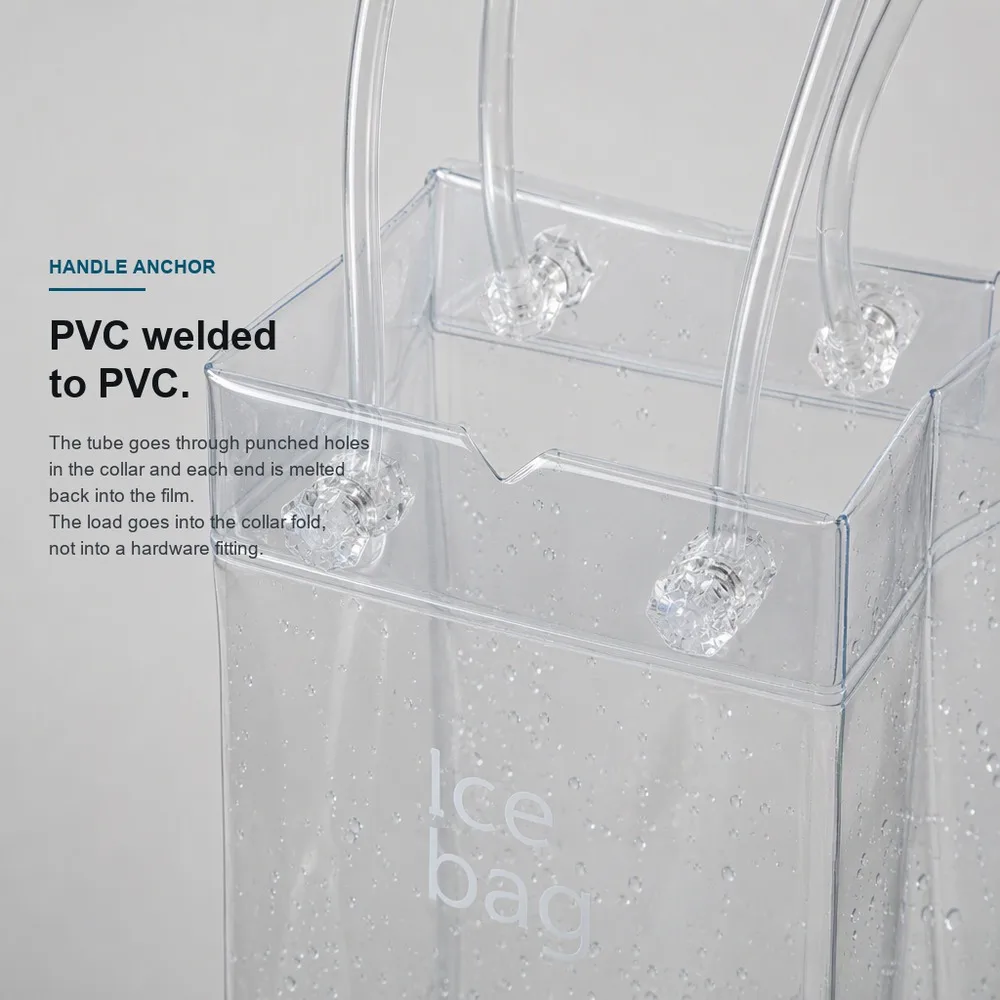
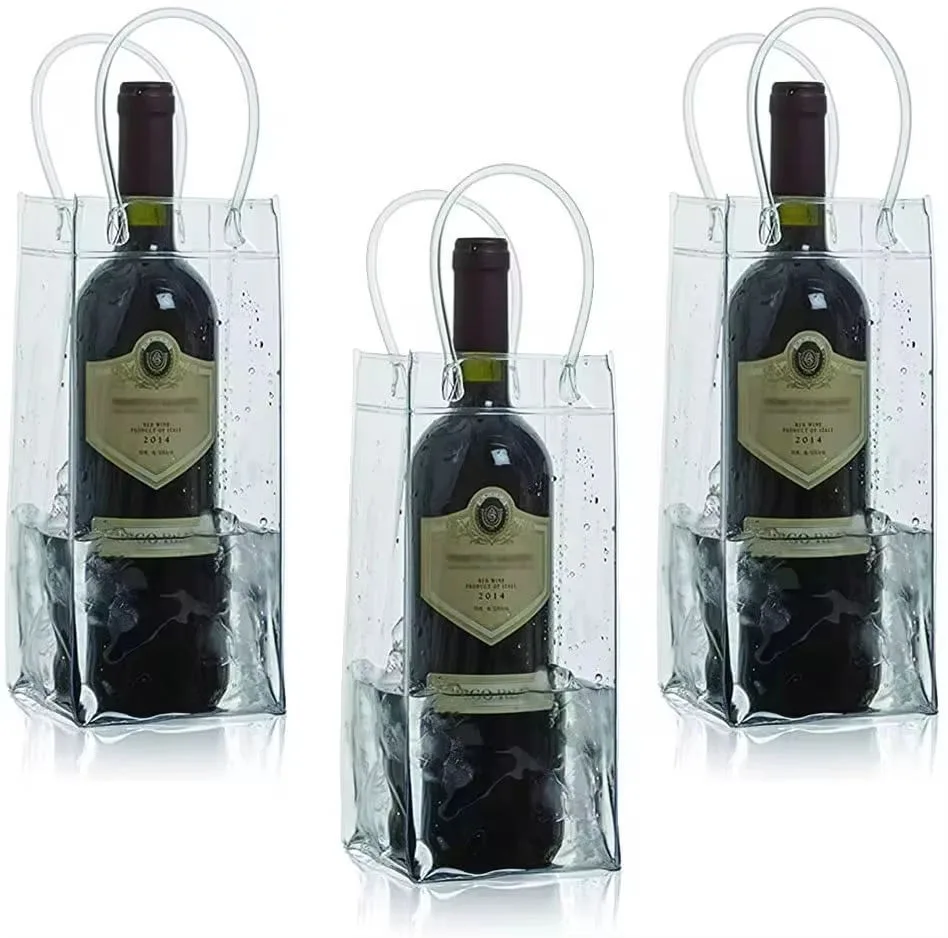
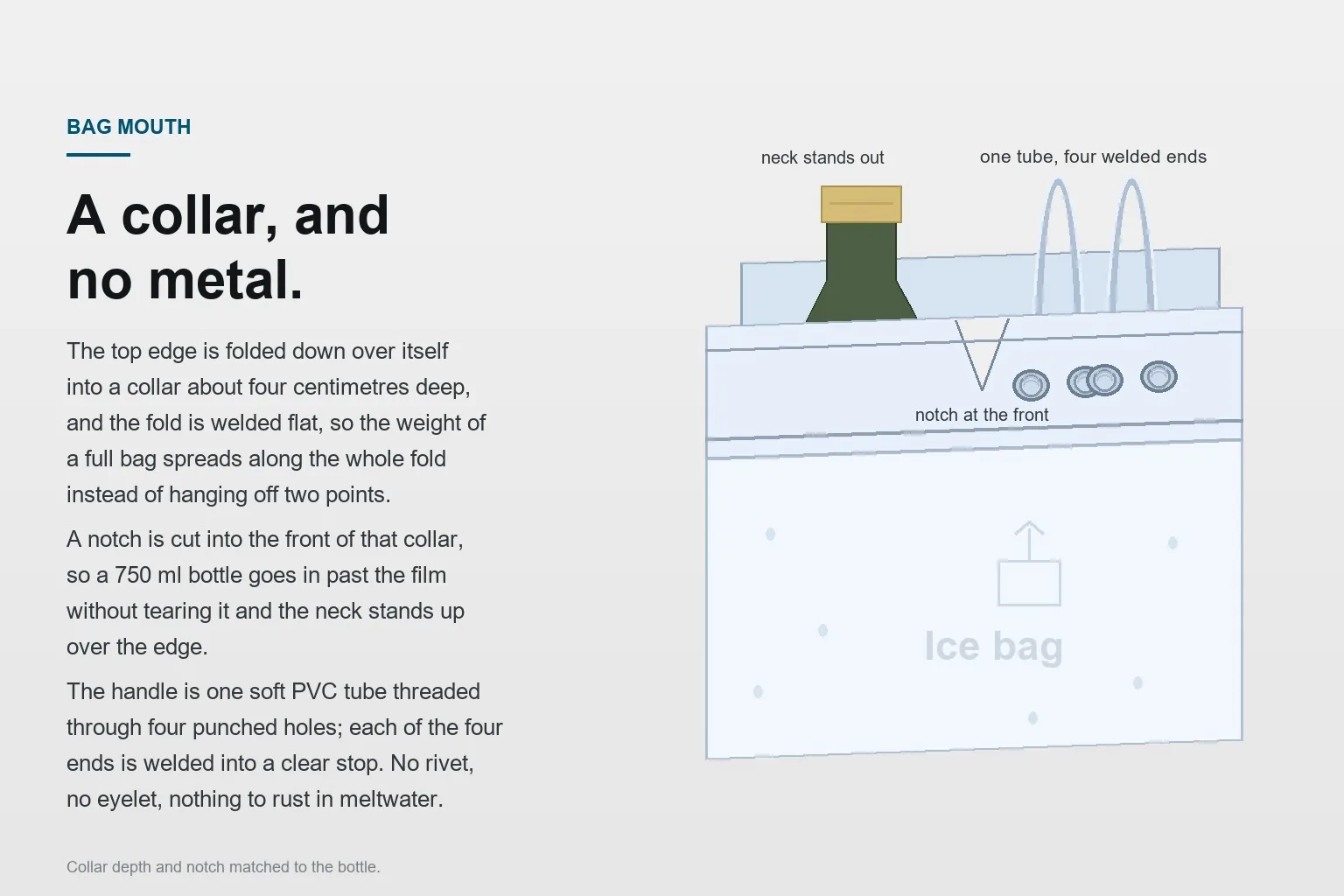
The mouth stays open, and that is deliberate: a bottle goes in, ice goes in, and the neck stands above the collar so the label still reads from outside. A notch cut into the front of the collar lets the bottle past the film without tearing it, and the folded collar takes the load. The handle is one soft PVC tube through four punched holes, each end melted back into the collar – no rivet, no eyelet, nothing to rust in meltwater.
This is an ice bag, not an insulated one. The cold comes from what you put in it and lasts as long as there is ice left; nothing in the wall itself holds temperature. When heat has to be held back by the material, a foil-laminated pouch is the right product instead. This one is chosen for a bottle that will be finished with the meal.
| Parameter | Specification |
|---|---|
| Format | Square-base stand-up bag, open mouth with notched collar |
| Material | Clear PVC film, 0.3 / 0.4 / 0.5 mm |
| Wall | Single ply, no laminate; all edges high-frequency welded |
| Base | Gusseted square, four welded corners, stands when loaded |
| Closure | None; open mouth, notch cut at the front of the collar |
| Handle | Soft PVC tube through 4 punched holes, ends heat-welded |
| Chilling | Fill the bag with ice cubes or ice water |
| Insulation | None; the wall holds no temperature of its own |
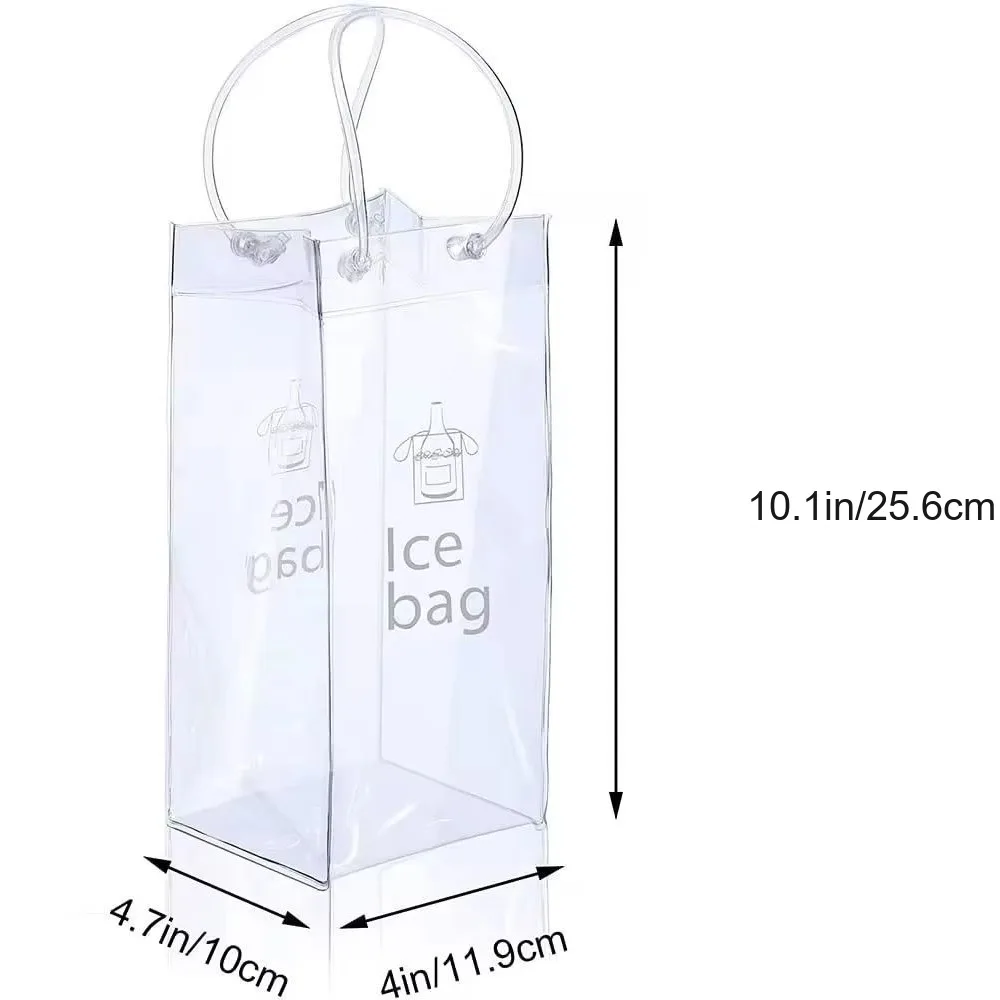
| Size | 11.9 × 10 × 25.6 cm, one 750 ml bottle |
| Stock line mark; custom logo on request, 1-2 colours | |
| Colour | Clear; blue, green or smoke tint on request |
| Packing | Flat-packed, counted per carton |
| Customization | Size, film thickness, print, tint, handle colour |
Print on clear film has one rule: the artwork has to work with whatever is behind it. This face carries a light line drawing and a wordmark, both in translucent white, so a bottle stays legible through the panel. Anything dense – a solid block, a photograph, a barcode – kills the see-through quality the product is bought for, so ink is kept to line work and the centre of the panel is left alone.
The film is printed on the reverse and then welded, which puts the ink inside the wall where ice, water and washing cannot reach it. Screen printing suits PVC at this thickness: the ink sits on the surface, cures at a low temperature and does not distort a film that would move under real heat. One or two colours covers most orders, and a slight drift in registration reads as part of a hand-drawn mark rather than a defect.
Welding is where a printed bag fails. The weld bar runs within a few millimetres of the artwork, and heat reaching dry ink will craze it or lift it, so the plate keeps a clear margin along every seam, the collar fold and the punched holes. That margin is designed into the artwork rather than left to the operator, because once ink has crazed, a reprint is the only repair.
Sampling is judged on the finished bag, not on a flat print: the same artwork is checked after welding, after the holes are punched and after the handles are threaded, in daylight and against a dark bottle. What is being looked for is a mark that still reads at arm’s length through condensation, and a margin that stayed clear where the weld ran.
The body is one ply of clear PVC with no laminate, so the wall stays clear when the bag is packed with ice and meltwater cannot cloud it. Every edge is welded rather than glued: the sides, the base and the folded collar all read as a single thickness with a smooth clear bead. The base opens into a square with four welded corners, and that square is what lets a loaded bag stand on the table and what keeps the melt inside. The handle is a soft PVC tube threaded through punched holes and melted back into the collar, with no metal part anywhere.
North Side Of Nanyi Road, Shiwan Town Science And Technology Park (10th Floor, Building 1, No. 13)
INQUIRY