Custom packaging ·3-5 day sampling - Global delivery support


Three Ways a Parcel Loses Cold, and What Stops Each

November 5, 2026Packaging Notes
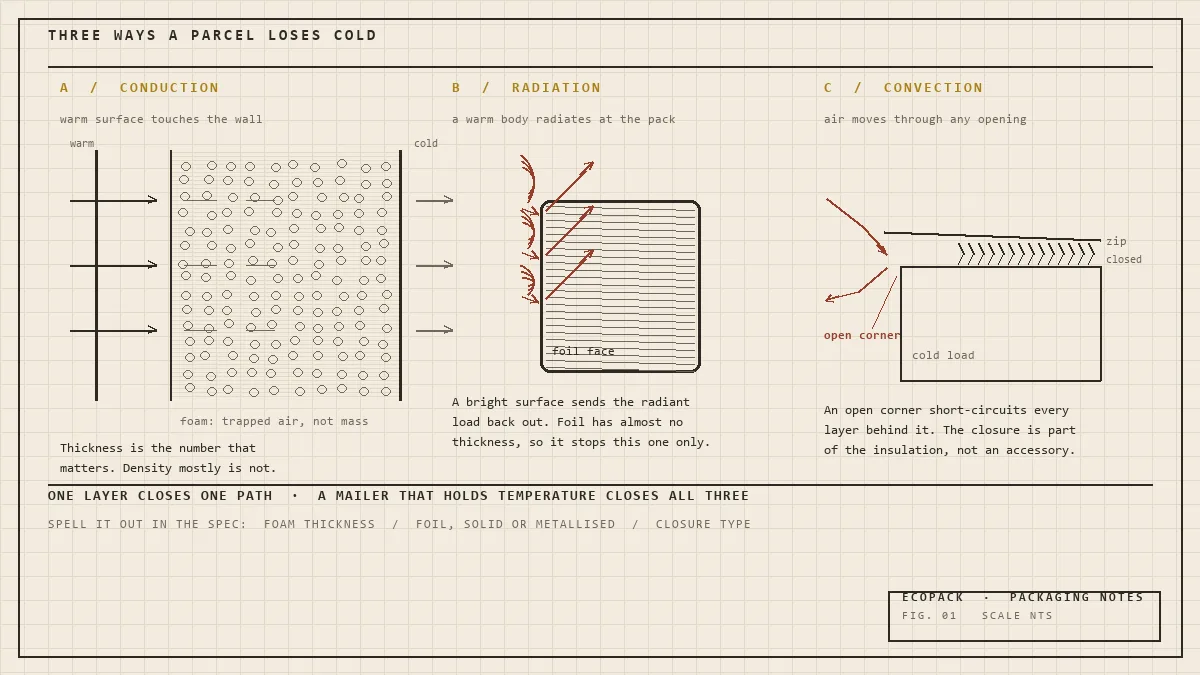
Fig.1 Three paths for heat to reach a cold load, and the one layer in a mailer that closes each path A cold parcel rarely fails because the ice ran out early. It fails because heat found the one path nobody closed. Heat reaches a parcel in three ways, and each one is stopped by a different layer. A mailer that only has one of those layers looks insulated and is not.

Conduction: the path through the wall

Heat travels through solids by contact, and in a mailer that means the film, the foam, the seal, and every point where the payload touches the wall. Foam works because it is mostly air held inside closed cells. Air is a poor conductor, and the cell walls stop it from circulating. What matters is thickness, not density. Twenty millimetres of a light foam outperforms five millimetres of a dense one, so the useful question for a supplier is not “which foam” but “how many millimetres sit between my product and the outside”. A compressed foam mailer answers that without shipping air: the panels are pressed flat for freight and return to full thickness when the film is opened.

Radiation: the path through the air

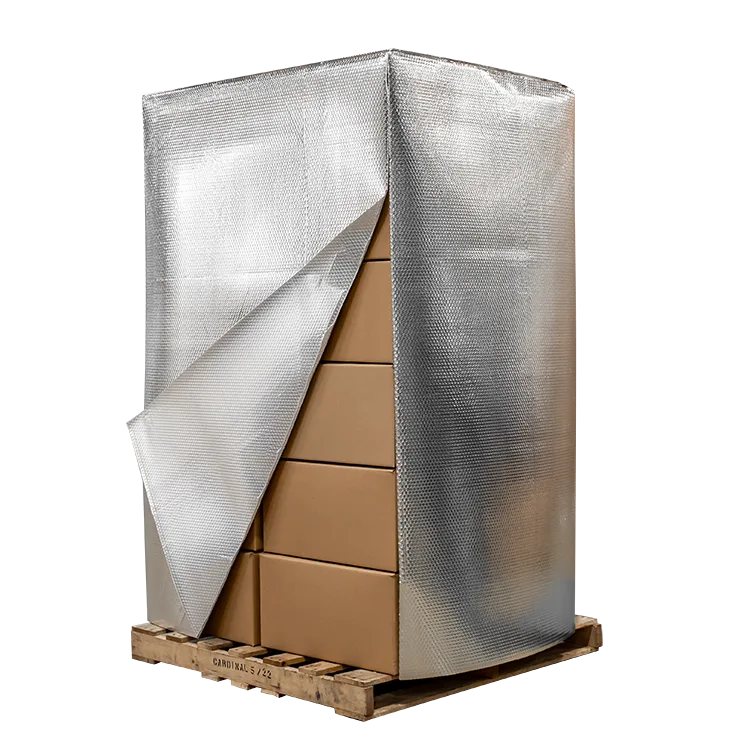
A parcel in a van absorbs radiant heat from the sun on the roof, from a warm pallet beside it, from the floor under it. A bright metallic surface reflects most of that load before it becomes heat inside the pack. Solid aluminium foil is the strongest version of that surface. A metallised foil mailer works on the same principle but is a few hundred angstroms thick, and it loses continuity where the film is creased. On a bag that gets folded, filled and stacked, that difference is not academic – it is the difference between a barrier and a barrier with cracks in it.

Convection: the path through the opening

Warm air does not need to pass through the film. It only needs a gap. A folded lip, a zip that is half closed, a mouth left slightly open: warm air enters, cools, sinks, and keeps circulating through the pack. This is why the closure is part of the insulation, not an accessory. A two-rib zip on a PE foam mailer, plus a peel-and-seal strip, does more for temperature than an extra millimetre of foam, because it removes a path that no amount of material can block.

Why one material is never enough

Foam has no radiant barrier, so it slows conduction while the pack absorbs radiation. Foil has almost no thickness, so it reflects radiation while every contact point conducts. A zip holds air but insulates nothing. The mailers that hold temperature combine the three: foam for conduction, a foil or metallised face for radiation, a closure that actually closes. The same logic applies to a flat cooler pouch: thin, printable, but built around a foil core and a full-perimeter weld, because a pouch with one weak edge behaves like a pouch with no insulation at all.

What to put in the specification

  • Foam thickness in millimetres, and whether it is full-face or a patch
  • Face material: solid foil, metallised film, or plain film
  • Closure: ribs, adhesive strip or heat seal, and whether it is tamper evident
  • A transit test with your payload: weight, starting temperature, ambient profile, duration
We do not quote a hold time from a datasheet. Hold time depends on payload mass, starting temperature, the coolant you use and how the box is packed, so the only number worth trusting is one measured with your product inside. Send us those four inputs and we will run the trial and send the record with the samples. Send us your payload details

INQUIRY